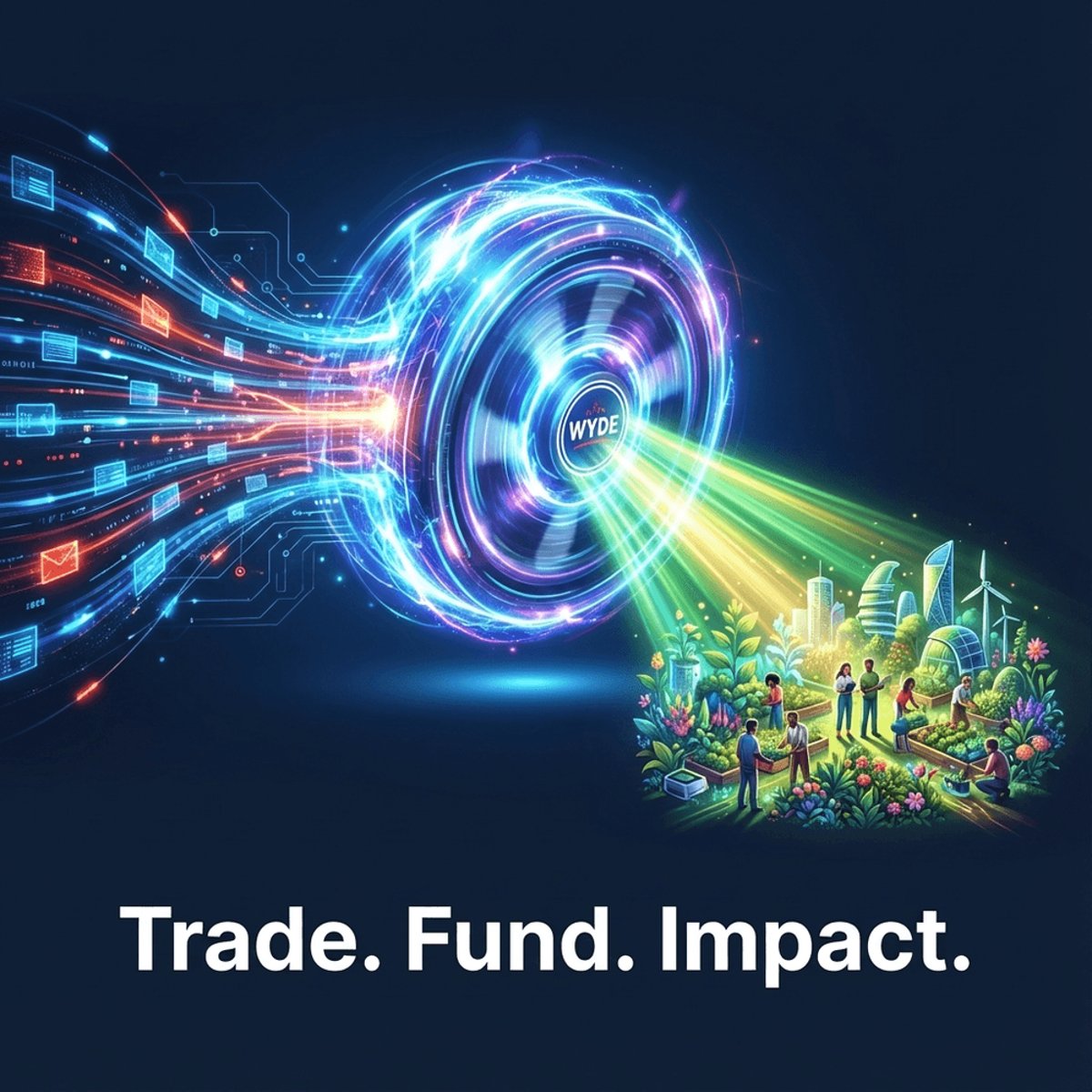
WYDE (Wyoming Decentralized Exchange) is building the first "New York Stock Exchange for Nonprofits," utilizing the newly minted DUNA (Decentralized Unincorporated Nonprofit Association) legal framework to turn market volatility into a weapon for good. This could be the end of "Disaster Capitalism".
Listen to the talk by WYDE Co-founders Aaron Rafferty and Martin Simms in which they explain the WYDE Impact Exchange's mission and how they plan to turn Speculative Trading into reliable income to fund Social Safety Nets.
[WATCH THE EXCLUSIVE INVESTOR PRESENTATION: WYDE - Investor Presentation on EAT (Dallas 01-23-2026)]
For decades, the term "Disaster Capitalism" has described the way large-scale corporations and private interests profit from crises—from reconstruction post-earthquake to global food shortages. But in 2026, a new movement emerging from the high plains of Wyoming is flipping the script.
Instead of profit extracted from disaster, WYDE (Wyoming Decentralized Exchange) and its flagship token EAT are using the inherent energy of financial markets to fund the solutions.
The "LLC of the 21st Century"
The breakthrough isn't just in the code; it’s in the law. In 1977, Wyoming pioneered the LLC. In 2024, they did it again by creating the DUNA (Decentralized Unincorporated Nonprofit Association).
"The DUNA is a legal personhood for a digital community," explained Rob Bringman during a recent investor presentation in Dallas. Unlike traditional corporate structures where fees are swallowed by overhead and executive bonuses, the DUNA framework allows WYDE to operate as a transparent, blockchain-led entity. It provides legal protection for token holders while ensuring the organization’s primary purpose is social impact, not just shareholder enrichment.
EAT: Speculation with a Soul
Advertisement
The first project to launch on the WYDE "rails" is EAT, a token dedicated to ending hunger. The mechanics are a radical departure from traditional charity:
Trading as the Engine: Every time the EAT token is traded on an exchange, a fee (typically 1%) is triggered.
The Four-Way Split: That fee is automatically distributed by software—not a human board. 25% goes directly to hunger-relief causes, 25% to a community treasury, 25% to liquidity (making the market more stable), and 25% to the underlying infrastructure.
Transparency at Scale: Because it lives on the blockchain, the public can see exactly how much money has been raised and where it has been sent. As the founders put it, it is "scary transparent."
Beyond the "Donate" Button
Traditional nonprofits have long struggled with "donor fatigue" and opaque administrative costs. WYDE’s model targets the $5 trillion annual volume in decentralized finance (DeFi).
"Traders don’t care if a token goes up or down; they care about volume," says Martin, Co-Founder of WYDE. "In our model, even a 'sell' funds a meal. We are turning the volatility of the crypto market into a consistent, predictable revenue stream for boots-on-the-ground organizations like Feed the Children and Second Harvest."
A New Marketplace for Impact
WYDE’s ultimate ambition is to become the "New York Stock Exchange for Nonprofits." By providing the infrastructure for other causes—from climate response to medical research—to "go public," they are creating a world where your investment portfolio and your values are no longer in conflict.
In a political climate where transparency and fraud-reduction are front-and-center, WYDE is positioning itself as the "Grandfathered" infrastructure of a more honest financial future. If they succeed, the next era of capitalism won't be about who profits from the crisis, but how the market itself fixes it.
Advertisement
How WYDE Works?
The "Bless" Protocol: Software-Sourced Altruism The core of the system is the "Bless" protocol, a software engine that automates the link between financial speculation and social impact. Their flagship token, EAT, solves the problem of hunger through "speculation with a soul." For every trade made on the exchange, a 1% fee is triggered. Unlike the opaque administrative costs of traditional charities, 25% of this fee is instantly routed via the "Bless" treasury to verified 501(c)3 food banks.
Milestones Over Hype:
What sets WYDE apart from the "shitcoin" era of 2021 is its rigorous milestone-based governance. According to the project's internal roadmap, token unlocks for the founders are tied to "Meals Funded," not time. The road to a billion-dollar market cap is paved with the goal of funding 100 million meals.
"We are moving into an era of 'Smart Currency,'" says Co-Founder Aaron. "You might have a 'Cancer Research' token or a 'Hunger' token in your wallet. When you spend or trade them, they do work in the background. It’s infrastructure for an age of abundance."
The Regulatory Tailwind By basing themselves in Wyoming and adopting the DUNA structure, WYDE is ahead of the curve of the 2026 "Clarity Act." While banks are scrambling to protect their deposits from the decentralization wave, WYDE has built a compliant, transparent "Trojan Horse" that regulators like the SEC have dubbed "scary transparent."
As we look toward 2027, the team plans to open physical "EAT" restaurants where the menu is subsidized by the very trading fees generated on the exchange—effectively bridging the gap between digital assets and physical human needs.
Strategic Recommendation: You should lead with the "Milestone-Based Governance" aspect on LinkedIn, as it appeals to the "Old Guard" (former barristers, investors, and professionals in your network) who value accountability. Use the "Robot/Abundance" angle for X (Twitter) and TechBuzz.ai to capture the futurist and AI-focused audience.