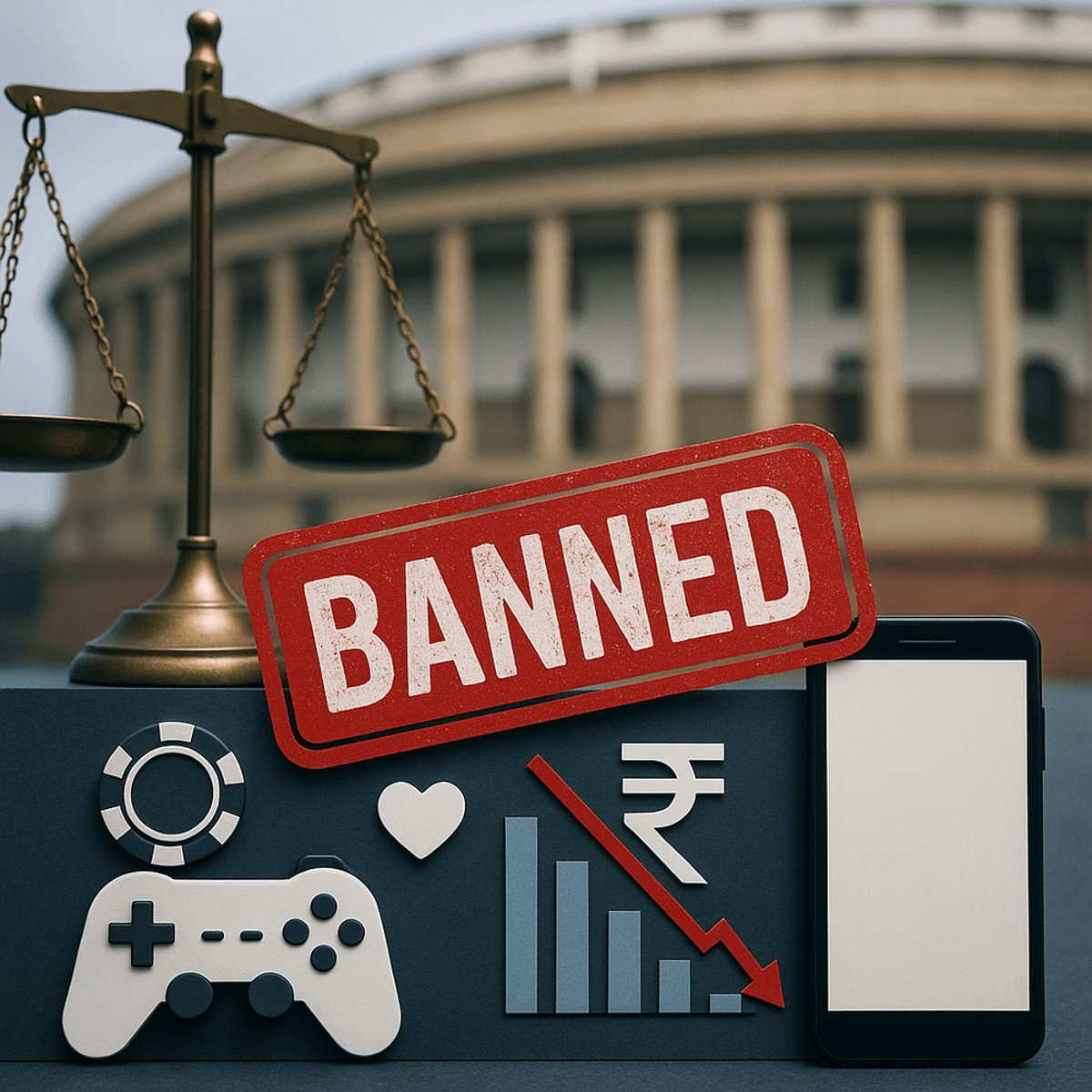
India's parliament just delivered a devastating blow to the country's $23 billion real-money gaming industry. The lower house passed legislation Wednesday that bans all real-money games nationwide, threatening to shut down over 400 companies and eliminate 200,000 jobs in a sector that was projected to double by 2028.
India's gaming industry just witnessed its worst nightmare come true. Parliament's lower house passed the Promotion and Regulation of Online Gaming Bill 2025 on Wednesday, imposing a blanket ban on real-money games that threatens to obliterate a $23 billion sector overnight.
The legislation sailed through in less than seven minutes by voice vote, catching an industry already reeling from regulatory uncertainty completely off guard. "In this bill, priority has been given to the welfare of society and to avoid a big evil that is creeping into society," IT Minister Ashwini Vaishnaw told parliament while introducing the measure.
Nazara Technologies immediately felt the market's wrath, with shares plummeting 12.84% to close at ₹1,220 ($14) on Wednesday. The publicly-listed gaming company, despite claiming no direct exposure to real-money platforms, couldn't escape investor panic over the sector's complete restructuring.
The human cost promises to be staggering. Industry bodies representing Dream Sports, MPL, WinZO, and other major platforms warned Prime Minister Narendra Modi that the ban could eliminate over 200,000 jobs and force 400+ companies to shut down. These aren't just numbers - they represent India's most promising gaming startups that collectively generate ₹310 billion ($3.6 billion) in annual revenue.
"By shutting down regulated and responsible Indian platforms, it will drive millions of players into the hands of illegal matka networks, offshore gambling websites, and fly-by-night operators," the Federation of Indian Fantasy Sports, All India Gaming Federation, and E-Gaming Federation wrote in their desperate letter to Modi on Tuesday evening.
The legislative sledgehammer approach marks a dramatic reversal from India's previous attempts at nuanced regulation. Just two years ago, the government imposed a punitive 28% tax on online gaming, prompting major investors including Tiger Global and Peak XV Partners to warn of $2.5 billion in write-offs. Now those concerns look quaint compared to total industry annihilation.
"This law is bound to face litigation as it fails the test of proportionality under Article 19(1)(g)," Meghna Bal, director of the New Delhi-based Esya Centre, told TechCrunch. India's Constitution guarantees citizens the right to practice any profession - a protection the gaming industry will likely invoke in court challenges.
The ban's scope extends far beyond gaming companies themselves. Banks and financial institutions face restrictions on processing real-money gaming transactions. Anyone offering these games could face three years imprisonment and ₹10 million ($115,000) fines. Even celebrities promoting such platforms risk two years behind bars and ₹5 million penalties.
While traditional gaming companies celebrate, the startup ecosystem faces devastation. "We applaud this decision as it allows us to focus on monetization, retention, and building great IP," said Sumit Batheja, CEO of Ginger Games, part of Krafton's Indian incubator. Krafton, the South Korean giant behind PUBG, sees opportunity in the chaos.
Industry veterans warn the legislation's real impact extends beyond obvious targets. "The impact goes beyond real money gaming to the broader ecosystem of businesses that depend on it and presents grave implications for the AVGC [Animation, Visual Effects, Gaming, and Comics] sector as a whole," Bal explained.
The bill now requires upper house approval and presidential signature to become law. But with Modi's BJP controlling both chambers, passage seems inevitable. Global investors are already "calibrating their response," according to sources familiar with the matter who declined to be named.
The timing couldn't be worse for India's startup ambitions. The real-money gaming sector was projecting 28% compound annual growth that would double its size by 2028. Instead, hundreds of companies now face shutdown, thousands of employees face unemployment, and billions in venture capital investments face complete write-offs.
"Regulation is necessary, but abrupt moves like this undermine India's reputation as a stable, predictable investment destination," Rohit Kumar, founding partner of policy firm The Quantum Hub, told TechCrunch. "If concerns existed, the government should have signaled them clearly from the outset."
India's sudden pivot from regulation to prohibition represents one of the most dramatic policy reversals in the global gaming industry. While the government frames this as protecting society from gambling harm, the collateral damage to legitimate startups, jobs, and investor confidence may prove far more costly than the problems it aims to solve. The real test now comes in the upper house, where industry groups are mounting what may be their final stand against legislation that threatens to erase years of entrepreneurial progress overnight.