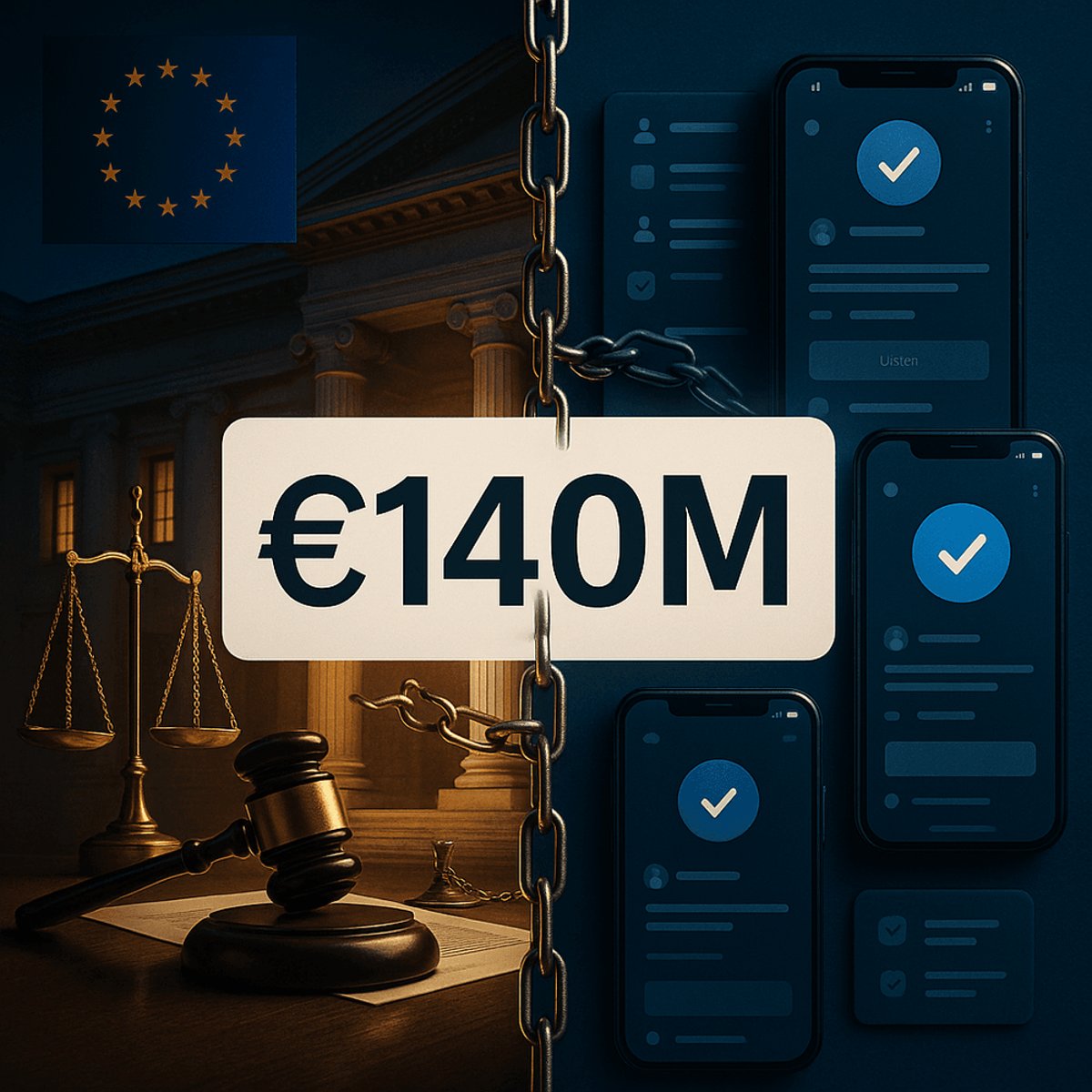
The European Commission just slammed X with a €140 million fine for violating the Digital Services Act, marking the first major penalty under the EU's sweeping tech regulation. The fine targets the platform's 'deceptive' blue checkmark system and failure to meet transparency requirements, escalating regulatory pressure on Elon Musk's social media empire.
The European Union just delivered its first major blow under the Digital Services Act, hitting X with a staggering €140 million fine that puts every social media platform on notice. The penalty targets what regulators call 'deceptive practices' around the platform's blue checkmark verification system - a cornerstone of Musk's monetization strategy since acquiring Twitter for $44 billion.
The fine represents a watershed moment for EU tech regulation. Since the DSA took effect in August 2023, regulators have been building cases against major platforms, but this marks the first time they've wielded their most powerful weapon: financial penalties that can reach up to 6% of global annual revenue. For context, that ceiling would translate to roughly $180 million for X based on estimated revenues.
At issue is X's overhaul of Twitter's verification system, which traditionally marked authentic accounts of public figures with blue checkmarks. Under Musk's leadership, the platform transformed verification into a paid subscription service through X Premium, allowing anyone to purchase the blue badge for $8 monthly. EU regulators argue this fundamentally misled users about account authenticity and credibility.
The 'deceptive' label carries particular sting because it strikes at the heart of X's business model transformation. When Musk took over Twitter, he immediately targeted the verification system as elitist and undemocratic. "Power to the people! Blue for $8/month," he posted in November 2022, launching the paid verification that European regulators now deem misleading.
Beyond verification issues, the Commission cited X's failure to meet DSA transparency obligations. The law requires platforms to publish detailed reports about content moderation decisions, algorithmic systems, and risk assessments. X has struggled to maintain the compliance infrastructure that Twitter's previous management had built, particularly after laying off roughly 80% of staff following Musk's acquisition.
This enforcement action puts X in uniquely precarious territory compared to other U.S. tech giants operating in Europe. While Meta, Google, and TikTok have invested heavily in EU compliance teams, X has taken a more confrontational approach to regulation. The platform briefly pulled out of the EU's voluntary Code of Practice on Disinformation in May 2023, though it later rejoined.
The timing couldn't be worse for Musk's platform, which has been bleeding advertisers and struggling financially since the acquisition. Major brands including Disney, Apple, and IBM have suspended advertising over content moderation concerns. The EU fine adds regulatory pressure just as X attempts to rebuild its revenue base through subscription services and creator monetization.
For the broader tech industry, this penalty establishes the EU's willingness to use the DSA's full enforcement power. The law covers any platform with more than 45 million monthly EU users, encompassing virtually every major social media service. Companies are now watching closely to see whether this represents isolated action against X or the beginning of systematic enforcement.
The fine also highlights how post-acquisition corporate restructuring can create compliance gaps. X's reduced workforce means fewer resources for the detailed reporting and risk assessment that DSA compliance demands. Other platforms are likely reviewing their own compliance capabilities in light of this precedent.
What happens next could reshape how American tech companies operate in Europe. X has 30 days to pay the fine and implement corrective measures, though the company could appeal through EU courts. More broadly, this action signals that the EU isn't backing down from tech regulation despite potential trade tensions with a second Trump administration.
This €140 million fine represents more than just a financial penalty - it's the EU asserting its regulatory authority over American tech platforms at a critical moment. For X, it compounds existing business pressures while setting a costly precedent for DSA non-compliance. For the industry, it signals that European regulators are moving beyond warnings to serious enforcement. As other platforms rush to strengthen their compliance frameworks, the message is clear: the era of light-touch tech regulation in Europe is definitively over.