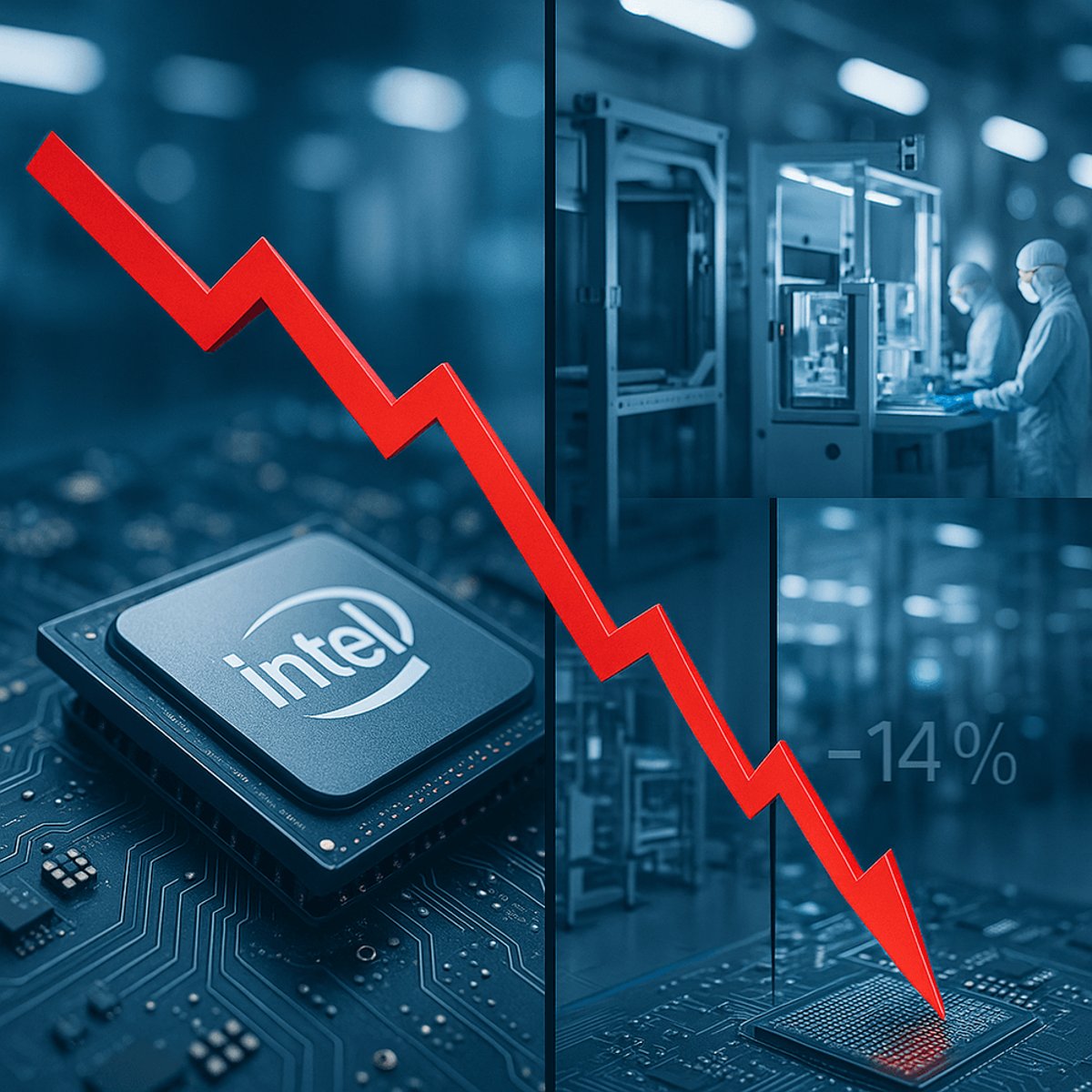
Intel's turnaround story just hit a wall. Shares of the embattled chipmaker plunged 14% Friday after the company warned it can't meet customer demand and issued guidance that fell far short of Wall Street expectations. The stock nosedive wipes out weeks of gains built on hopes that Intel could finally compete in the AI chip race, and it signals that the company's manufacturing problems run deeper than investors anticipated.
Intel just delivered a reality check that sent shockwaves through the chip industry. Despite beating Wall Street's fourth-quarter expectations, the company's shares plummeted 14% Friday as CEO Lip-Bu Tan admitted the company can't meet demand for its products and production efficiency remains below target.
The revelation came during Thursday's earnings call with analysts, where Tan delivered a sobering message about the chipmaker's manufacturing challenges. "We are on a multiyear journey," he told investors. "It will take time and resolve." That's not what Wall Street wanted to hear from a company whose stock had more than doubled over the past year on turnaround optimism.
The guidance Intel provided for the first quarter amplified investor concerns. The company expects revenue between $11.7 billion and $12.7 billion with breakeven adjusted earnings per share, falling short of analyst expectations for 5 cents per share and $12.51 billion in revenue according to LSEG data reported by CNBC. That's a significant miss at a time when competitors are posting blowout results riding the AI boom.
The supply shortage Tan described isn't just a temporary hiccup. It points to deeper issues in Intel's foundry business, which has struggled to match the manufacturing prowess of TSMC and Samsung. While those rivals are minting money fabricating chips for AI data centers, Intel's foundry operation remains a drag on the business.
Investors had been counting on Intel's next-generation 14A manufacturing technology to attract major customers and prove the company could compete in advanced chipmaking. CFO David Zinsner told CNBC that Intel expects 14A customers to appear in the second half of 2026, but analysts at RBC Capital Markets warned that "meaningful revenue contribution" might not materialize until late 2028. That's a long time to wait for a company that's already years behind in the AI chip race.
The timing couldn't be worse for Intel. The company had attracted significant investments over the past year from the U.S. government (which took an equity stake as part of CHIPS Act funding), SoftBank, and even Nvidia. Those votes of confidence had pushed Intel's stock up more than 100% as investors bet on an American manufacturing renaissance in semiconductors.
But analysts are now pumping the brakes hard on that enthusiasm. "We appreciate the recent excitement around opportunity for INTC but still don't see a clear path forward given further share loss, no AI strategy and unclear fab/packaging opportunities," analysts at Jefferies wrote in a note to clients. Bank of America's Vivek Arya went further, questioning why anyone would buy a stock trading at 90 times price-to-earnings with such murky prospects.
The foundry business sits at the heart of Intel's challenges. Unlike Nvidia, which designs chips but outsources manufacturing, or AMD, which spun off its fabs years ago, Intel remains vertically integrated. That strategy worked when Intel dominated PC processors, but it's become a liability as the industry pivots to AI accelerators and specialized chips where Intel has limited presence.
Production yield issues - the percentage of chips that come off manufacturing lines working properly - suggest Intel's advanced processes aren't ready for prime time. Tan's admission that yields are below target indicates the company's struggling with the technical complexity of cutting-edge chip production, the same challenge that has separated industry leaders from also-rans.
Despite the carnage in the stock, Intel did manage to exceed fourth-quarter expectations, showing the underlying business hasn't completely fallen apart. But in today's market, beating last quarter's numbers matters far less than what you're promising for next quarter, and Intel's outlook suggests the turnaround will take years longer than the market anticipated.
The competitive landscape makes Intel's situation even more precarious. Nvidia continues to dominate AI chips with its latest Blackwell architecture flying off shelves. AMD is gaining ground in data centers. Even Qualcomm and upstarts like Cerebras are carving out AI chip niches. Intel's watching from the sidelines, unable to manufacture enough chips to meet demand even as it lacks a compelling AI product to compete with rivals.
Intel's 14% stock collapse reveals a harsh truth: beating earnings doesn't matter when your manufacturing can't keep pace and your AI strategy remains unclear. The company's admission that it can't meet demand while simultaneously lacking compelling AI products exposes the depth of its competitive disadvantage. With foundry revenue potentially years away and rivals like Nvidia and AMD dominating the AI chip market that's driving semiconductor growth, Intel faces a long, uncertain road back to relevance. Investors who bet on a quick turnaround are learning that fixing decades of manufacturing missteps takes more than government subsidies and strategic investments - it requires technical execution that Intel hasn't yet demonstrated it can deliver.