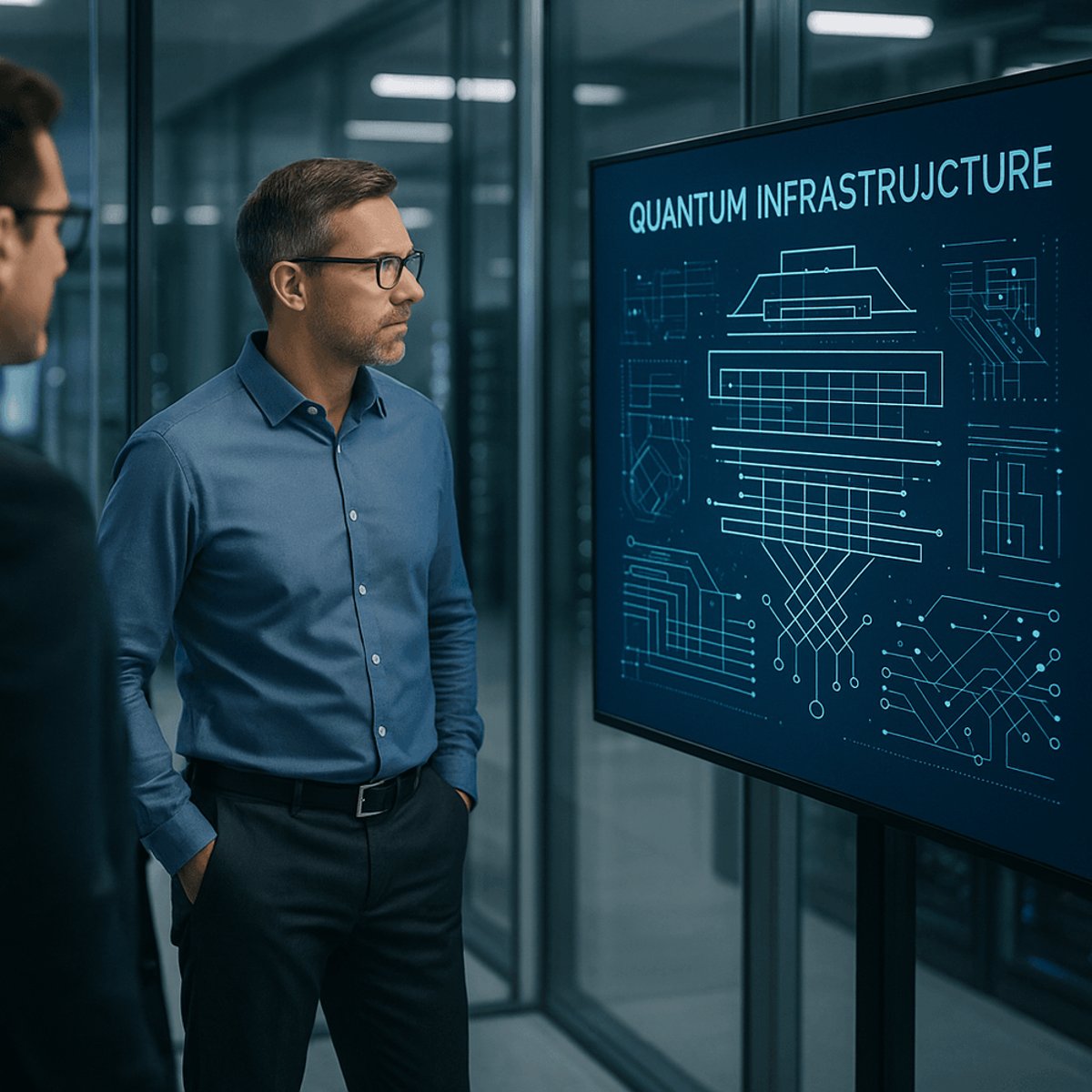
Fresh off a $665 million exit to AMD, serial entrepreneur Peter Sarlin isn't waiting for quantum computing to mature before solving its enterprise adoption problem. His new venture QuTwo is building the infrastructure layer that companies will need when quantum finally arrives at scale, betting that enterprises who start preparing now will dominate when the technology reaches commercial viability. It's a classic pick-and-shovels play in an emerging market that analysts predict will hit $125 billion by 2030.
QuTwo just emerged from stealth with a counterintuitive pitch: get enterprises running on quantum computing infrastructure before quantum computers are actually ready for prime time. Founder Peter Sarlin, who pocketed $665 million when AMD acquired his AI startup last year, is banking on companies wanting to future-proof their systems now rather than scramble when quantum breaks into the mainstream.
The timing looks deliberate. While quantum computing remains largely experimental, major players like IBM, Google, and Microsoft are pouring billions into hardware development. But there's a glaring gap in the stack - the middleware and tooling that enterprises will need to actually integrate quantum processing into existing workflows. That's where QuTwo comes in.
"We saw this pattern in AI," Sarlin told TechCrunch in an interview. "The companies that built infrastructure early captured disproportionate value." His previous venture focused on enterprise AI deployment before selling to AMD in what became one of Finland's largest tech exits. Now he's applying the same playbook to quantum.
The approach mirrors what happened during the cloud migration wave of the 2010s. Companies like HashiCorp and Docker built infrastructure tooling years before cloud became table stakes, then rode the adoption curve as enterprises raced to modernize. QuTwo is positioning itself as the HashiCorp of quantum computing - building the abstraction layers that will let companies write quantum-ready code without needing PhD-level physics expertise.
What makes this particularly interesting is the market timing. Quantum computing has been perpetually "five years away" for the past two decades, leading to skepticism about commercial viability. But recent breakthroughs in error correction and qubit stability have shifted the conversation. McKinsey projects quantum will generate $125 billion in annual value by 2030, with pharmaceuticals, materials science, and financial services seeing the earliest impact.
QuTwo's infrastructure targets three core problems enterprises face with quantum adoption: translating classical algorithms into quantum circuits, managing hybrid classical-quantum workloads, and benchmarking performance across different quantum hardware providers. Think of it as Kubernetes for quantum - an orchestration layer that abstracts away hardware complexity.
The startup hasn't disclosed funding details yet, but Sarlin's track record likely made fundraising straightforward. His AMD exit established him as one of Europe's most successful deep tech founders, and quantum infrastructure sits at the intersection of multiple hot investment themes - enterprise software, emerging hardware, and AI-adjacent technologies.
Competitive pressure is already building. Classiq raised $51 million last year for quantum software development, while Zapata Computing went public via SPAC focused on enterprise quantum applications. But most competitors are building tools for quantum developers. QuTwo is going a layer higher, targeting CTOs and enterprise architects who need to make infrastructure decisions now about technologies they won't deploy for years.
There's also the AMD connection to consider. While details remain scarce, Sarlin's relationship with the chipmaker could prove strategically valuable as AMD explores quantum processor development. The company has stayed relatively quiet on quantum compared to Intel and Nvidia, but has hinted at research initiatives. A partnership with QuTwo could accelerate AMD's quantum ambitions while giving the startup early access to emerging hardware.
The enterprise angle is crucial. Consumer quantum applications remain science fiction, but B2B use cases in drug discovery, supply chain optimization, and cryptography are becoming tangible. Companies like Volkswagen are already experimenting with quantum for traffic optimization, while financial institutions are testing quantum encryption. QuTwo is betting that as proof-of-concepts multiply, demand for production-grade infrastructure will explode.
Sarlin's timing on his AMD exit looks prescient in hindsight. He sold near the peak of AI infrastructure valuations, then pivoted to quantum just as investor attention shifts toward the next computing paradigm. It's the kind of pattern recognition that separates serial entrepreneurs from one-hit wonders - knowing when to exit one wave and catch the next.
The Finland connection matters too. The Nordic country has quietly built a quantum computing ecosystem, with VTT Technical Research Centre operating one of Europe's few quantum computers and IQM emerging as a hardware player. QuTwo taps into that talent pool while maintaining proximity to European enterprise customers who've shown willingness to adopt emerging technologies faster than their American counterparts in some categories.
QuTwo's emergence marks a inflection point in quantum commercialization - when entrepreneurs start building for a technology that's still maturing, it signals the market believes arrival is inevitable rather than hypothetical. Sarlin's bet is that enterprises will pay now to avoid getting caught flat-footed later, the same calculation that drove early cloud and AI adoption. Whether quantum delivers on its decades of promises remains to be seen, but the infrastructure layer is getting built either way. For QuTwo, success doesn't require quantum computers in every data center by 2027 - just enough enterprise anxiety about being left behind to justify investing in readiness today.