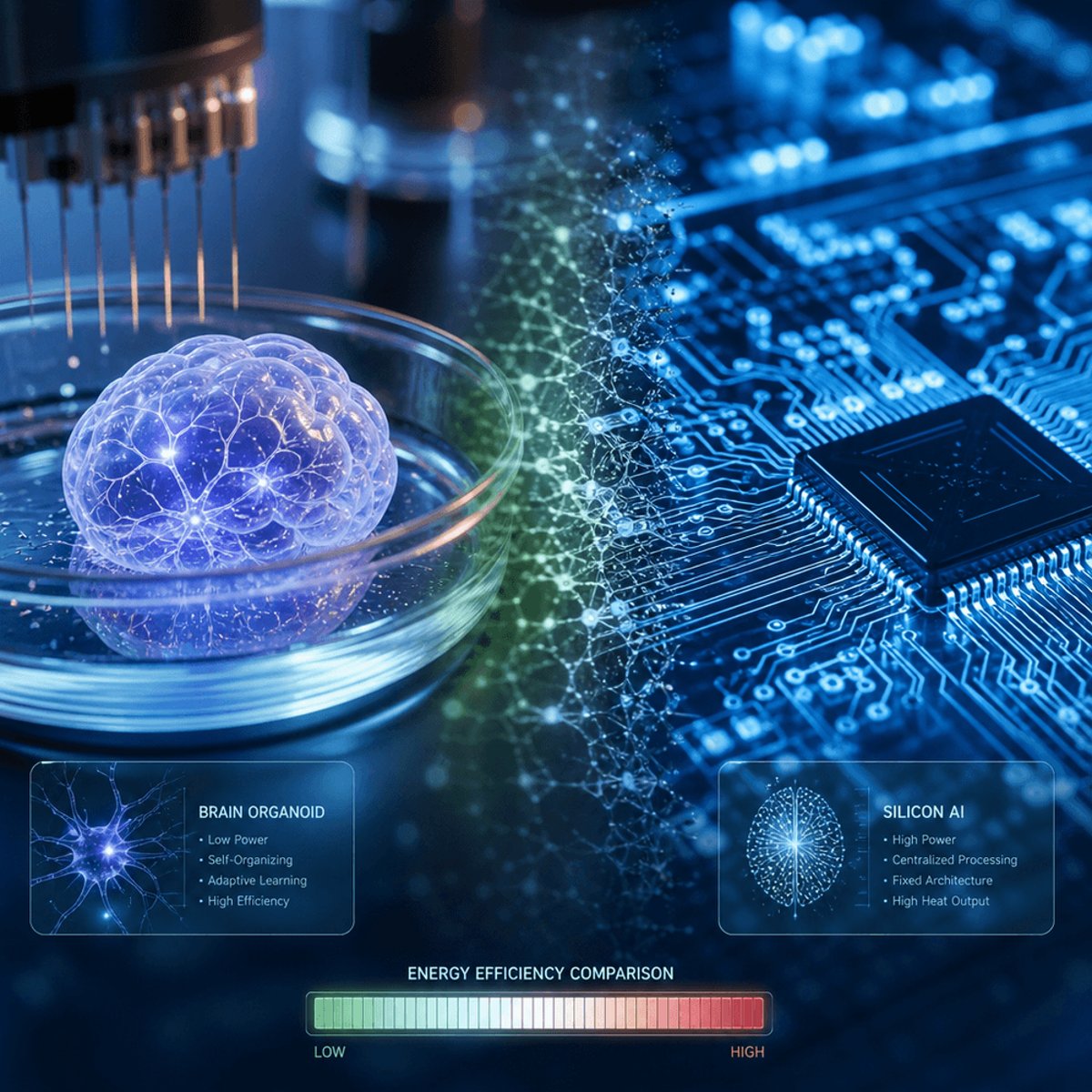
The AI revolution might be taking an unexpected turn - away from silicon chips and toward petri dishes. Researchers across the globe are cultivating miniature human brains known as organoids, and early results suggest these lab-grown neural clusters could eventually outperform the artificial neural networks that power today's AI systems. It's a paradigm shift that challenges everything we thought we knew about the future of computing, replacing transistors with actual neurons.
The artificial intelligence boom that's dominated tech headlines for the past few years might be reaching an inflection point. While companies like OpenAI, Google, and Meta continue racing to build larger language models on ever-more-powerful chips, a quieter revolution is happening in biology labs around the world.
Researchers are growing what amounts to miniature human brains - organoids no larger than a pea - and teaching them to compute. These aren't science fiction creations, but real neural tissue cultivated from stem cells, complete with functioning neurons that communicate through synapses just like the brain in your skull. The kicker? Early experiments suggest they might be better at certain computational tasks than the artificial neural networks they're named after.
The concept flips conventional AI development on its head. Instead of using silicon to mimic biological processes, why not use actual biology? A human brain runs on roughly 20 watts of power - about the same as a dim light bulb - while training a large language model can consume megawatts. Our brains pack 86 billion neurons into three pounds of tissue. The efficiency gap is staggering.
Several research teams have already demonstrated proof-of-concept systems. These organoid computing platforms connect lab-grown neural tissue to electrode arrays, allowing researchers to send electrical signals in and measure the organoids' responses. The neural tissue learns to respond to patterns, essentially functioning as a biological processor. What researchers are finding is that these organic systems excel at pattern recognition and adaptive learning - tasks that require massive computational resources in traditional AI.
But this isn't just about building a better chatbot. The implications cut deeper. If organoids can genuinely outthink neural networks, we're not just talking about a new computing substrate - we're talking about a fundamentally different approach to intelligence itself. Silicon-based AI, no matter how sophisticated, ultimately follows programmed rules and statistical patterns. Organoids are alive. They grow, adapt, and potentially even dream, if such a concept can apply to neural tissue in a dish.
The technical challenges are formidable. Keeping brain tissue alive requires carefully controlled environments with precise temperature, nutrient delivery, and waste removal. Scaling these systems beyond laboratory experiments means solving problems that look more like medical life support than data center engineering. And there's the longevity question - how long can these organoids function before they degrade or need replacement?
Then there's the ethics minefield. At what point does a cluster of neurons gain rights? If an organoid can learn and potentially suffer, what are our obligations to it? These aren't abstract philosophical questions - they're practical concerns that researchers and ethicists are grappling with right now. Some jurisdictions are already considering regulatory frameworks for biological computing, treating it more like medical research than tech development.
The competitive landscape is shifting too. While Nvidia builds ever-more-powerful GPUs for AI training and tech giants stockpile chips, a different kind of infrastructure is emerging. Biotech labs with expertise in tissue cultivation and neuroscience are becoming potential players in the computing industry. The skill sets required - cell biology, neuroscience, bioengineering - look nothing like traditional computer science.
Industry analysts suggest we're still years away from commercial organoid computing systems. But the trajectory is clear. Labs that successfully demonstrate stable, scalable biological processors could leapfrog the entire semiconductor industry. Imagine a future where your personal AI assistant isn't running on a server farm in Virginia, but on living neural tissue grown specifically for your needs.
The energy efficiency alone makes this compelling. As AI's power consumption becomes increasingly untenable - some estimates suggest AI could account for 10% of global electricity use by 2030 - biological alternatives start looking not just interesting, but necessary. A computing paradigm that runs on glucose instead of megawatts could be the difference between sustainable AI and an environmental crisis.
What makes this moment particularly striking is the timing. Just as silicon-based AI appears to be hitting diminishing returns - with models requiring exponentially more data and compute for incremental improvements - biological computing offers a completely different scaling curve. Natural neurons have had billions of years of evolutionary optimization. We're just starting to tap into that.
The research community remains divided on timelines. Some believe practical organoid computers are decades away. Others point to the rapid progress in stem cell technology and neural interfaces as evidence we could see working systems within five to ten years. What's not in question is whether it's possible - the proof-of-concept work has already demonstrated that. The question is how fast we can move from laboratory curiosity to practical technology.
The conversation about AI's future has been dominated by debates over model size, training data, and chip architectures. But the real disruption might come from abandoning silicon entirely. Lab-grown brain organoids represent more than just an alternative computing substrate - they're a fundamentally different approach to intelligence that could make today's neural networks look as primitive as vacuum tubes. Whether this biological revolution happens in five years or fifty, the trajectory is set. The question isn't whether organoids will change computing, but how quickly we can navigate the technical and ethical challenges to get there. For an industry obsessed with the next breakthrough, the answer might literally be growing in a lab dish right now.