There are two distinct people thinking about launching a charity-themed token in May 2026. One is a crypto-native deployer who saw Pump.fun's Charity Coins launch on April 30 and wants to ride the cycle while routing some upside to a cause. The other is a nonprofit founder who has watched the WYDE-Feed the Children partnership and is asking whether their own organization should launch a cause coin. They have nothing in common except the legal framework that applies to what they're about to do.
This piece is for both. The exposure profiles diverge significantly depending on which path you're on, but the compliant template is the same. The bottom line is direct: launching wrong has documented downside that compounds at every layer of participation. Launching right is harder but defensible.
If you're launching using a charity's name without written consent
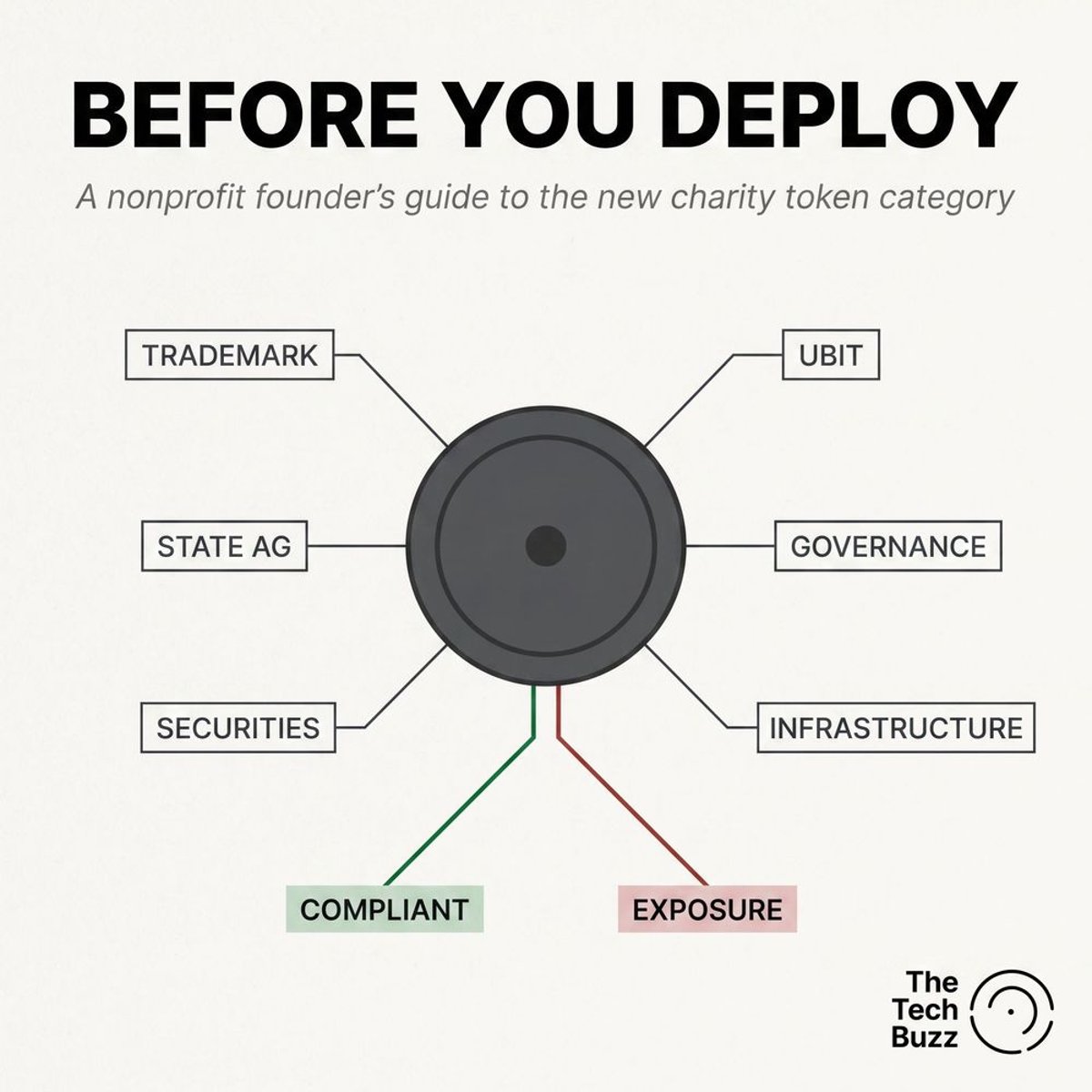
Four categories of personal legal exposure for any deployer who launches a memecoin using a real charity's name, image, or branding without permission. Each maps to a documented precedent. None of these apply when written consent and a structured partnership exist.
1. Trademark infringement and false endorsement. Using a charity's name or logo on a tradeable financial instrument without permission is a textbook Lanham Act violation under 15 U.S.C. §§ 1114 and 1125. The charity has standing to sue for damages, disgorgement of any profits, and injunctive relief. Burwick Law and Wolf Popper LLP issued a cease-and-desist to Pump.fun in February 2025 demanding removal of more than 200 tokens that allegedly used the firms' branding. Same factual structure applies to charity tokens.
2. State Charitable Solicitations Act exposure. Most states require anyone soliciting donations in a charity's name to obtain consent first. Alaska v. GoFundMe, PayPal Giving Fund, Charity Navigator, JustGiving, Pledgeling, and Network for Good (filed March 10, 2026) is the live test case. Civil penalties run $1,000 to $25,000 per violation. If your token says "100% to St. Jude" without consent, every transaction is potentially a separate violation.
3. Securities class-action perimeter. The pending Aguilar v. Baton Corporation Ltd. (S.D.N.Y. 1:25-cv-00880) alleges every token Pump.fun helped create is an unregistered security and that the platform earned roughly $500 million in fees from a system structurally designed for pump-and-dump activity. Anyone who deployed a token on the platform is potentially named in discovery, and any profits earned can be subject to disgorgement.
4. Reputation and future-deal exposure. A deployer who shows up in a Lanham Act complaint, an Alaska AG investigation, or the Aguilar v. Baton class-action discovery file has a permanent record that follows them. KOL deals, exchange listings, custodian relationships, and bank accounts all run background reviews. The reputational compounding is the cost most deployers underestimate at launch.
If you're a nonprofit founder considering self-issuing a token without a structured operating partner
A different exposure profile, and the stakes are arguably higher because what's at risk is the organization's tax-exempt status, not just personal liability. Four risks specific to charities considering self-issuance rather than partnering with a structured operator. None of these apply when a structured 501(c)(4) operator sits between the trading activity and the 501(c)(3) charity.
1. UBIT exposure if you receive trading-fee revenue directly. A 501(c)(3) that takes ongoing trading-fee revenue may face unrelated business income tax at the 21% federal corporate rate under IRC §§ 511-514. The relevant question is whether the activity passes the substantially related test of IRC § 513. Trading-fee revenue from a memecoin platform almost always fails the test cleanly, regardless of where the proceeds are eventually directed.
2. Tax-exempt status risk from operating activities. Running a token-based revenue model from inside your 501(c)(3) raises questions about whether the activity is consistent with your charitable purpose. Repeated UBIT findings or substantial commercial activity can put your exemption at risk under the operational test of IRC § 501(c)(3). Losing the exemption is the catastrophic-downside scenario most founders never seriously price in.
3. Brand association with the underlying platform. Launching your cause coin on Pump.fun, even with full internal consent, attaches your charity's name to a platform with a documented graduation rate under 2 percent and an estimated $4-5.5 billion in alleged user losses. Donor confusion and reputational damage are concentrated risks. The infrastructure choice carries downstream brand consequences your board will have to defend.
4. Governance and operating-entity structure. A defensible cause-coin model typically separates the charity (501(c)(3)) from the operator (501(c)(4) or similar). Self-issuing a token from inside the 501(c)(3) without the separation creates governance, fiduciary, and tax problems that get expensive to unwind. The board's fiduciary duties extend to ensuring the activity does not compromise the charitable mission.
What a compliant launch looks like (works for both paths)
Five elements distinguish a compliant launch from a non-compliant one, regardless of which audience above is doing the launching.
Written partnership agreement between named legal entities. Anonymous wallets and unsigned commitments do not count. A defensible launch has a recognizable legal entity on the operator side: a 501(c)(3), 501(c)(4), or LLC with documented governance, named officers, and counsel of record. For a degen launching with a charity's branding, that means an actual signed agreement with the charity. For a nonprofit founder, that means a separate operating entity with proper governance.
On-chain verifiable fee routing. All trading-related fees route to a public wallet, with grant distributions to the charity recorded on a public blockchain. A trader can paste the contract address into a block explorer and see the full flow without taking the operator's word for it.
Independent infrastructure off mass-launchpad platforms. Standard ERC-20 mechanics on a recognized chain like Base, with market maker liquidity and exchange listings. No bonding curve. No anonymous-deployer launch surface. No 98% rug-pull base rate inherited from the platform.
Recognized exempt-org governance form on the operator side. A Wyoming 501(c)(4) DUNA, a Delaware nonprofit corporation, or a similar structure that places UBIT exposure at the operator level and routes funds to any partner charity as standard charitable grants. This is the structural element that protects nonprofit founders specifically from tax-exempt status risk.
Documented disclosures and term provisions. Token mechanics, fee allocation, exclusivity, and termination disclosed before launch and operated inside a defined contractual framework that protects the charity, the operator, and any participating donors or traders.
The publicly documented case study of a partnership meeting all five elements is the WYDE Association partnership with Feed the Children, announced April 8, 2026 via GlobeNewswire. The model demonstrates how the operating entity (Wyoming 501(c)(4)) absorbs the structural risk while the partner charity receives standard charitable grants.
Three checks before you deploy
Is there written consent from any third-party charity? If you're using a charity's name and you don't have a signed agreement plus a public partnership announcement from the charity, the answer is no. Six categories of personal liability follow from there.
Is the operating-entity structure separated from any 501(c)(3)? If you're a nonprofit founder, your 501(c)(3) should not be the issuer of the token or the recipient of trading-fee revenue. The operating entity (501(c)(4) or equivalent) sits between the trading activity and the charitable grant.
Is the infrastructure choice defensible? Pump.fun's 98% rug-pull rate and active class-action perimeter become your launch's brand association regardless of intent. Independent infrastructure on a recognized chain with no bonding curve protects against inherited platform exposure.
If any of the three checks fails, the compliance posture is non-defensible. For degens, that means six categories of personal legal exposure compounding from launch forward. For nonprofit founders, that means putting the organization's tax-exempt status, brand, and donor relationships at structural risk.
The path forward exists. It requires more legal scaffolding than a Pump.fun deployment, and that's the point. \
Sources
Aaron Rafferty is co-founder and CEO of WYDE Association, a Wyoming 501(c)(4) operating the first regulated Impact Exchange.