TL;DR: Pool.fans at a Glance
Pool.fans transforms Clanker token fee streams into tradeable ERC-20 assets called Fee Tokens. Instead of fees flowing directly to your wallet, they accumulate in a vault. You receive tokens representing your claim on that vault. Those tokens can be sold, staked, used as collateral, or held for yield. The protocol takes a 1% cut from all projects and routes it to $FANS stakers, creating diversified exposure across the entire Clanker ecosystem. Contracts are audited by 0xMacro.
The Problem Pool.fans Solves: Illiquid Revenue Streams
Every Clanker token generates trading fees. When someone buys or sells, roughly 1% of the transaction goes to designated recipients. For successful tokens, this creates real revenue. The fees generated on each transaction are split between Clanker, the interface from which the token was created, and the creator.
But there's a catch. That revenue is illiquid. You can't sell half your future fees. You can't use your fee stream as collateral. You can't give partners verifiable claims on specific percentages. The money just drips into your wallet over time.
This creates problems:
For creators who need capital now: You have a token generating $5,000 per week in fees. You need $50,000 to fund development. Your options? Sell your base tokens (hurting price) or wait ten weeks (delaying growth).
For investors who want yield exposure: You believe a token will have high trading volume, but you don't want narrative exposure to the meme itself. There's no way to buy just the cash flow.
For partners who want transparent splits: You promised a contributor 10% of fees. How do they verify you're actually sending 10%? Trust, basically.
Pool.fans fixes all three.
How Revenue Tokenization Actually Works
Step 1: Deploy a Revenue Vault
When you decide to tokenize your Clanker fees, Pool.fans deploys a dedicated vault contract. This vault becomes the new destination for your trading fees instead of your personal wallet.
The vault is specific to your token and your reward type. If your Clanker token has multiple reward streams (like WETH fees and paired-token fees), each stream gets its own vault.
Step 2: Mint Your Fee Tokens
Once the vault is active, Pool.fans mints exactly 100 Fee Tokens representing 100% of that fee stream. You, as the creator, receive all 100.
The math stays simple forever:
- 1 Fee Token = 1% of future fees
- 10 Fee Tokens = 10% of future fees
- 100 Fee Tokens = 100% of future fees
Step 3: Do Whatever You Want With Your Fee Tokens
Here's where it gets interesting. Fee Tokens are standard ERC-20s. They work everywhere ERC-20s work:
Sell them: Run an Initial Revenue Offering (IRO). Set a price, sell 30 Fee Tokens, raise capital without touching your base token supply.
Stake them: Lock Fee Tokens in staking contracts to incentivize long-term holding.
Use as collateral: Deposit in DeFi lending protocols (once integrated) to borrow against your future revenue.
Pay contributors: Give team members or partners Fee Tokens instead of base tokens. They get direct, verifiable claims on revenue.
Trade them: List on DEXs. Let the market discover what your fee stream is worth.
Step 4: Claim Your Share
Fees accumulate in the vault as trades happen. When you want to collect, call claimRewards(). The vault calculates your proportional share based on how many Fee Tokens you hold and sends your cut.
One clever feature: revenue auto-settles on transfer. If you sell your Fee Tokens to someone else, any unclaimed fees automatically go to you first. The buyer starts fresh with only future fees.
The $FANS Token: Index-Like Exposure to All Tokenized Projects
Pool.fans takes a 1% protocol fee from every project that tokenizes through it. That fee doesn't go to a company treasury. It flows into the $FANS vault.
$FANS stakers earn a diversified stream of:
- WETH from trading fees across many tokens
- Various Clanker tokens themselves
- Additional $FANS from protocol distributions
This creates something like an index fund for Clanker fee revenue. Instead of picking which tokens will generate the most trading volume, $FANS holders get exposure to all of them.
The more projects that tokenize through Pool.fans, the more revenue flows to $FANS stakers. Network effects compound: successful early projects prove the model, attracting more creators, generating more fees, making $FANS more valuable, attracting more creators.
Initial Revenue Offerings: Raise Capital Without Selling Your Token
Traditional fundraising for token projects sucks. Your options:
-
Sell base tokens: Dumps price, signals lack of confidence, gives up governance power
-
Venture deals: Dilutes ownership, adds pressure for returns, takes months
-
Wait for revenue: Works eventually, but you need money now
IROs offer a fourth path. Sell claims on future revenue while keeping your base tokens intact.
How an IRO Works
-
Configure the sale: Set a flat price per Fee Token (say, 0.5 ETH each), how many you're selling (say, 20 out of 100), and how long the sale runs (say, 7 days)
-
Announce and market: Buyers deposit ETH at the fixed price
-
Distribute Fee Tokens: Buyers receive their tokens directly
-
Use the capital: You now have 10 ETH for development, marketing, or operations
Why Buyers Participate
Buyers are essentially purchasing a revenue share. If they believe your token will generate significant trading volume, Fee Tokens offer:
-
Yield without price risk: Fee Tokens pay based on volume, not price appreciation
-
Transparency: All fee accumulation is visible on-chain
-
Liquidity: Fee Tokens are tradeable, unlike informal revenue-share agreements
-
Diversification: Buy Fee Tokens across multiple projects for portfolio yield
Two Asset Classes, Two Investment Theses
Pool.fans creates a clean separation between two ways to participate in a Clanker token:
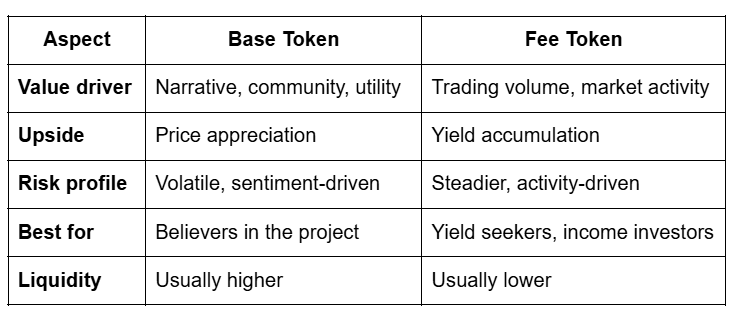
A project might have a vibrant community but low trading volume (high base token value, low Fee Token value). Another might be controversial with constant trading but no loyal holders (low base token value, high Fee Token value).
This separation gives both creators and investors more tools.
The Technical Architecture: Vaults, Factories, and Registries
Revenue Share Registry
A permanent, immutable contract that maps tokenized Clanker tokens to their vaults. Once deployed, this registry cannot change. It serves as the source of truth for which vaults exist and which tokens they represent.
Tokenizer Factories
Factory contracts that deploy new vaults. Different versions exist for different Clanker contract versions (V3.1.0 and V4). When you tokenize, the factory:
-
Deploys a new Revenue Vault specific to your token
-
Registers it in the permanent registry
-
Returns the vault address for you to configure in Clanker
Revenue Vaults
Individual contracts that hold and distribute fees. Key features:
-
Per-asset isolation: Each reward type gets its own vault
-
Automatic settlement: Unclaimed fees transfer to sellers during token transfers
-
Rescue function: Accidentally sent tokens (except revenue tokens) can be recovered
-
Claim interface: Simple claimRewards() function for fee collection
All contracts have been audited by 0xMacro, a respected security firm in the Ethereum ecosystem.
Risks Worth Understanding Before You Tokenize
Trading Volume Dependency
Fee Tokens only generate returns when people trade the underlying Clanker token. A dead token produces zero yield regardless of how many Fee Tokens you hold. Unlike bonds with fixed payments, Fee Token returns are entirely variable.
Liquidity Risk
Fee Token markets may be thin. If few people trade them, you might struggle to sell at fair prices. The $FANS protocol fee creates some baseline demand, but individual Fee Token liquidity could be poor.
Smart Contract Layers
Your funds flow through multiple contracts: the Clanker token, the Clanker fee locker, the Pool.fans vault, and potentially DeFi protocols where you use Fee Tokens. Each layer adds potential failure points. Audits reduce but don't eliminate risk.
Immutable Splits
Remember that Clanker's reward percentages cannot change after deployment. If you tokenize 60% of your fees through Pool.fans, that decision is permanent. Choose carefully.
Complexity
Understanding Fee Tokens requires grasping Clanker's fee structure, vault mechanics, and how different reward types work. This learning curve limits adoption and may lead to user errors.
Key Resources and Links
**Official Resources
**
**Related Protocols
**
Analytics
Frequently Asked Questions
**What's the difference between Fee Tokens and the base Clanker token?
**
The base token represents ownership in the community/project. Fee Tokens represent claims on trading fee revenue. You can hold one without the other. They have different value drivers and risk profiles.
**Can I tokenize fees from any Clanker token?
**
You can tokenize fees from Clanker V3.1.0+ tokens where you have admin rights to the fee recipient. You must be the fee admin to initiate tokenization.
**What happens if I sell all my Fee Tokens?
**
You lose all claims on future fees from that stream. Any accumulated but unclaimed fees are settled to you before the transfer completes.
**How does Pool.fans make money?
**
Pool.fans takes 1% of all tokenized fee streams and routes it to $FANS stakers. There's no separate company treasury or VC extraction.
**Are the contracts audited?
**
Yes, by 0xMacro. You can find the audit report linked in the documentation.
**Can I use Fee Tokens in other DeFi protocols?
**
Fee Tokens are standard ERC-20s, so technically yes. Actual integration depends on individual protocol support. The composability is there; adoption takes time.
Disclaimer: This content is educational and does not constitute financial advice. Token values and fee yields fluctuate based on market conditions and trading activity. Smart contract risks exist regardless of audit status. Always conduct your own research before participating in any cryptocurrency project.
**Related Articles
**