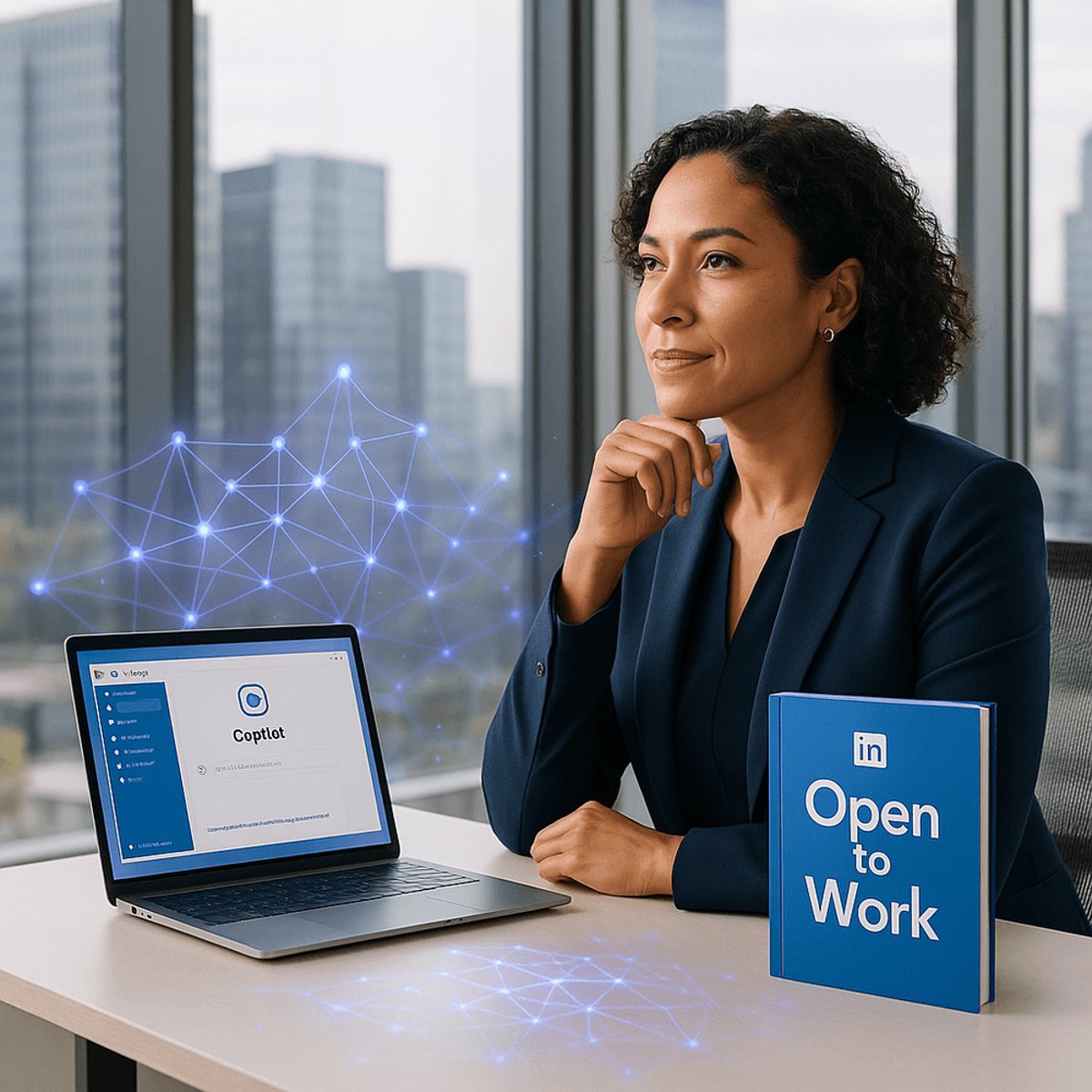
LinkedIn CEO Ryan Roslansky just launched a book addressing the question millions are asking: what does AI mean for my career? Released today through Microsoft, 'Open to Work: How to Get Ahead in the Age of AI' aims to guide workers through a labor market being reshaped in real-time by automation. Co-authored with LinkedIn's Aneesh Raman, the book arrives as AI anxiety dominates workplace conversations and traditional career ladders crumble under technological acceleration.
LinkedIn CEO Ryan Roslansky is betting that workers don't need more AI hype - they need a roadmap. His new book, 'Open to Work: How to Get Ahead in the Age of AI,' hit shelves today with a message that cuts through the usual tech triumphalism: the future of work isn't predetermined, and the people who show up to build it will shape what it becomes.
The timing isn't accidental. Across LinkedIn's 900 million member base, conversations about AI and job security have exploded. Roslansky, who also serves as Executive Vice President of Microsoft Office overseeing products like Word, Excel, and Copilot, has a front-row seat to these anxieties playing out in real-time.
'At a time when technology dominates the headlines, the conversation I see most often on LinkedIn is deeply human: what does AI mean for my job and my career?' Roslansky writes in today's announcement. That question - raw, practical, and urgent - drives the entire project.
Co-authored with Aneesh Raman, LinkedIn's workforce expert, the book promises something different than abstract predictions. It's built on data flowing through the world's largest professional network and structured around three core strategies: engage with AI before you're forced to, adapt by focusing on what you control, and become irreplaceable by leaning into distinctly human skills.
The 'engage early' philosophy reflects what Roslansky sees happening across industries. Workers waiting for AI to arrive at their desks are already behind. The book pushes readers to experiment with tools like Microsoft's Copilot now, while stakes are lower and learning curves matter less.
But the practical advice connects to a broader corporate strategy. Microsoft and LinkedIn aren't just publishing career guides - they're architecting the infrastructure where work and AI collaboration happen. Roslansky describes it as turning everyday tools into 'a canvas for human and AI collaboration at scale.'
That vision extends beyond individual workers. The book draws on insights from LinkedIn members and workplace experts to address not just employees asking 'what's next for my job,' but also leaders asking what comes next for their companies and communities. It's a tacit acknowledgment that AI disruption doesn't respect organizational charts.
The old model - predictable titles, ladder-like progression, stable career arcs - has been eroding for years. AI is just accelerating what was already in motion. Roslansky frames this as opportunity rather than catastrophe, but only if people make deliberate choices about how they respond.
'The new world of work is being assembled right now, task by task, policy by policy, business by business,' he writes. 'It will reflect the choices of the people who show up to build it.' That's both rallying cry and warning - the future isn't arriving on autopilot.
The book's release coincides with Microsoft President Brad Smith hosting Roslansky on his Tools and Weapons podcast, extending the conversation beyond the page. It's a coordinated push from Microsoft's leadership to reframe AI not as job-killer but as amplifier - if workers approach it strategically.
Roslansky is explicit about the philosophical stakes: 'We've always believed technology should serve people. AI should help humans. Not the other way around. That doesn't happen by accident. It happens when we all decide to make it true.' It's a values statement, but also a product roadmap for how Microsoft and LinkedIn plan to integrate AI across their platforms.
The book's focus on 'what makes you uniquely you' as the path to irreplaceability taps into growing research around AI's limitations. While large language models excel at pattern recognition and content generation, they struggle with context-dependent judgment, relationship building, and creative problem-solving rooted in lived experience.
For LinkedIn, the book also serves as market research vehicle. By codifying what they're seeing in labor market data and member behavior, Roslansky and Raman are essentially publishing their internal thesis on where professional development needs to go - and where LinkedIn's products should follow.
The guide's availability at linkedin.com/opentowork ties directly to LinkedIn's existing 'Open to Work' feature, which lets members signal job-seeking status. It's brand extension meeting thought leadership, wrapped in practical career advice.
Whether the book delivers on its promise to help workers 'build confidence and momentum' remains to be seen. But its existence confirms what workplace surveys already show: AI anxiety is the dominant professional concern of 2026, and tech leaders know they need to address it head-on or risk backlash as automation accelerates.
Roslansky's book arrives at an inflection point where AI capability is outpacing workforce preparation. By packaging LinkedIn's labor market intelligence into actionable guidance, he's attempting to turn anxiety into agency - betting that workers who understand the shift can navigate it successfully. Whether 'Open to Work' becomes essential reading or just another business book depends on whether its strategies actually help people adapt faster than their jobs transform. Either way, its publication signals that even tech leaders recognize they can't just build AI tools and hope workers figure out the rest. The conversation about AI and careers has moved from abstract to urgent, and platforms like LinkedIn and Microsoft are positioning themselves as guides rather than just technology providers.