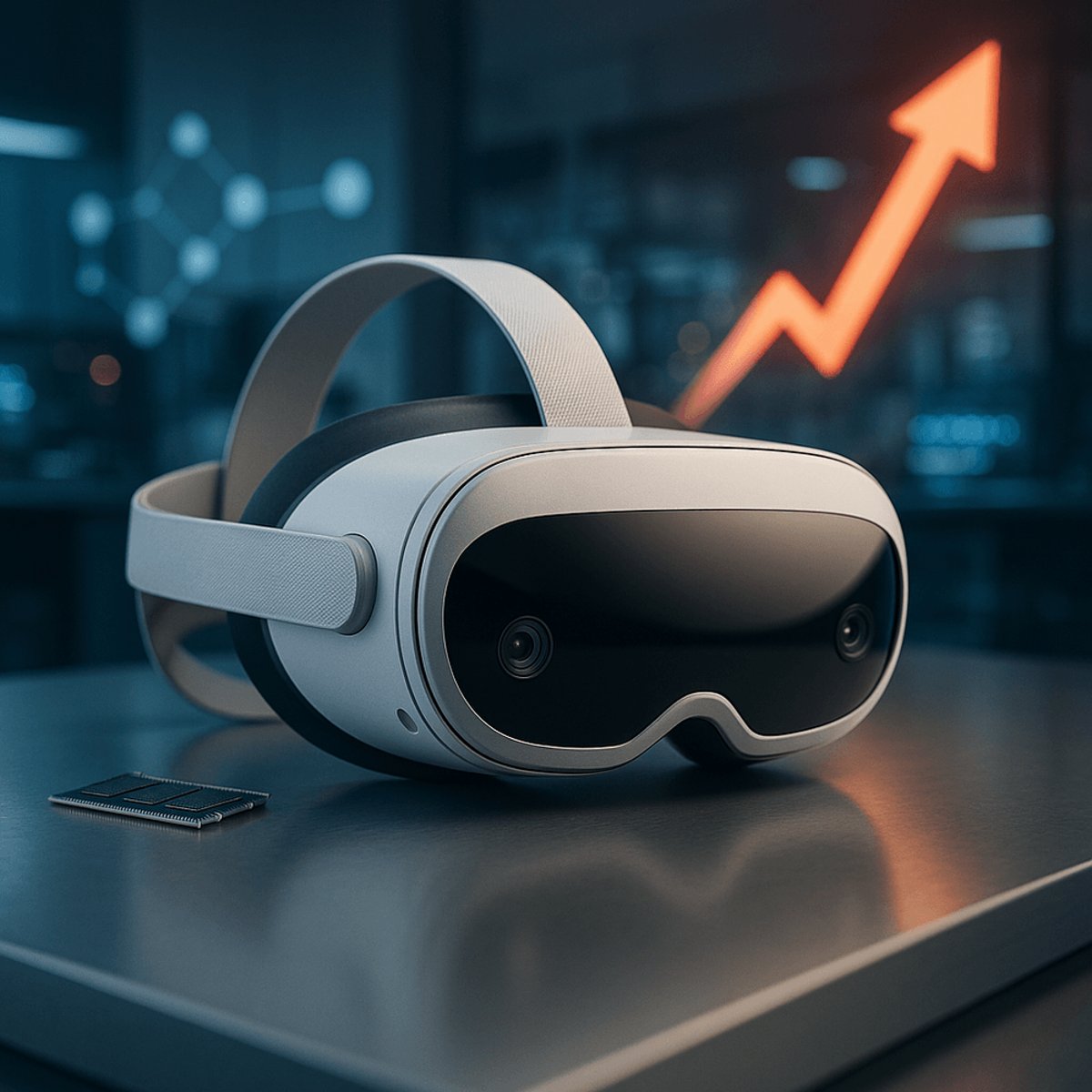
Meta is raising prices across its Quest VR headset lineup starting April 19, marking an unusual reversal in consumer tech where prices typically fall over time. The Quest 3 will jump $100 to $599.99, while both Quest 3S models climb $50 to $349.99 and $449.99 respectively. The company is citing a global RAM shortage as the culprit behind the increases, a move that signals broader supply chain pressures hitting even Meta's Reality Labs division despite its $65 billion investment in the metaverse.
Meta just did something almost unheard of in consumer electronics - it's raising prices on hardware that's already in market. Starting April 19, the Quest 3 will cost $599.99, a steep $100 jump from its current price, while the Quest 3S models are climbing $50 each to $349.99 for 128GB and $449.99 for 256GB. The reason? A RAM shortage that's apparently severe enough to force Meta's hand despite the company's massive Reality Labs budget.
This marks the first time Meta has increased prices on existing VR hardware, breaking with decades of consumer tech convention where products get cheaper as manufacturing scales and components mature. The timing is particularly striking given that the Quest 3 launched in late 2023, meaning Meta is hiking prices on hardware that's already been in production for over two years.
The RAM shortage explanation points to broader supply chain tensions rippling through the tech industry. Memory chip constraints have been building since late 2025, driven by AI datacenter demand competing with consumer electronics for the same DRAM supplies. Samsung, SK Hynix, and Micron - the three companies that control roughly 95% of global DRAM production - have been prioritizing high-margin server memory over consumer-grade chips.
For Meta, the price increase couldn't come at a worse moment strategically. The company has been fighting an uphill battle to make VR mainstream, with Reality Labs posting $4.6 billion in operating losses just last quarter according to recent earnings reports. Quest headsets were positioned as the affordable gateway to Meta's metaverse ambitions, with the 3S models specifically designed to undercut competitors and drive adoption.
The Quest 3, which Meta positioned as its premium mixed reality device with improved passthrough cameras and the Snapdragon XR2 Gen 2 chip, now sits uncomfortably close to Apple's Vision Pro territory on price - though still well below the Vision Pro's $3,499 starting point. But at $600, Meta loses one of its key advantages: being the budget-friendly option for VR newcomers.
Industry analysts have been warning about memory constraints for months. The explosion in AI computing has created unprecedented demand for high-bandwidth memory, with Nvidia's latest GPU shipments consuming massive quantities of HBM chips. That upstream pressure has cascaded down to consumer DRAM, squeezing availability for smartphones, laptops, and now VR headsets.
Meta's announcement comes just weeks after Sony quietly reduced PlayStation VR2 production targets and HTC delayed its Vive XR Elite refresh, suggesting the RAM crunch is hitting the entire VR industry. The shortage has created a perfect storm - rising component costs meeting a market segment that's already struggling with adoption beyond enthusiasts and early adopters.
What makes this particularly painful for consumers is the lack of alternatives. Meta dominates the standalone VR market with roughly 75% share, meaning Quest buyers don't have many options if they want wireless, self-contained headsets. The price hike effectively taxes the existing VR user base and could stall momentum just as Meta was starting to see broader consumer interest in mixed reality applications.
The company hasn't indicated whether these prices are temporary or the new normal. If the RAM shortage persists through 2026 as some supply chain experts predict, Meta might be stuck with higher prices through its next product cycle. That could force uncomfortable decisions about whether to absorb costs to maintain market share or pass them along to consumers who are already on the fence about VR adoption.
For anyone eyeing a Quest headset, the message is clear: buy before April 19 or pay the premium. Meta's move suggests the component supply situation is worse than many realized, and it probably won't be the last hardware maker forced to break the cardinal rule of consumer electronics - never raise prices on existing products.
Meta's decision to raise Quest prices mid-cycle reveals just how serious the RAM shortage has become - serious enough that even a company burning billions on Reality Labs can't absorb the costs. For consumers, this is a rare moment where waiting doesn't pay off. For the VR industry, it's a warning sign that component constraints could derail the mainstream adoption story just as mixed reality was starting to gain traction. Watch to see if Sony, HTC, and other VR players follow suit, and whether this becomes the new normal or a temporary supply chain hiccup.