The microdosing movement just hit a wall. A rigorous Phase 2B trial by Melbourne-based MindBio Therapeutics found that tiny doses of LSD performed worse than a caffeine pill in treating major depressive disorder, suggesting the wellness trend embraced by Silicon Valley execs and creative professionals may be riding almost entirely on placebo effects. The findings mark a potential turning point for the psychedelic therapy industry, which has bet big on microdosing's clinical promise.
For nearly a decade, microdosing psychedelics has been Silicon Valley's worst-kept wellness secret. CEOs, programmers, and novelists have evangelized taking sub-perceptual amounts of LSD or psilocybin mushrooms—roughly 5-10% of a full dose—claiming everything from laser focus to elevated mood without the full hallucinogenic experience. The practice became so normalized that WIRED and other outlets chronicled its spread through tech culture as both productivity hack and mental health intervention.
But a new clinical trial is throwing cold water on the entire phenomenon. Melbourne-based MindBio Therapeutics just wrapped an eight-week Phase 2B study of 89 adults with major depressive disorder, and the results are brutal for believers: LSD microdoses didn't just fail to outperform a placebo. They actually did worse.
CEO Justin Hanka shared the top-line data on LinkedIn last week, calling it "the most vigorous placebo controlled trial ever performed in microdosing." Patients received between 4 and 20 micrograms of LSD—well below the 100-200μg threshold for a full trip—while others got caffeine pills or were told they might receive methylphenidate (Ritalin). Depression symptoms were tracked using the Montgomery-Åsberg Depression Rating Scale, a standard clinical assessment tool.
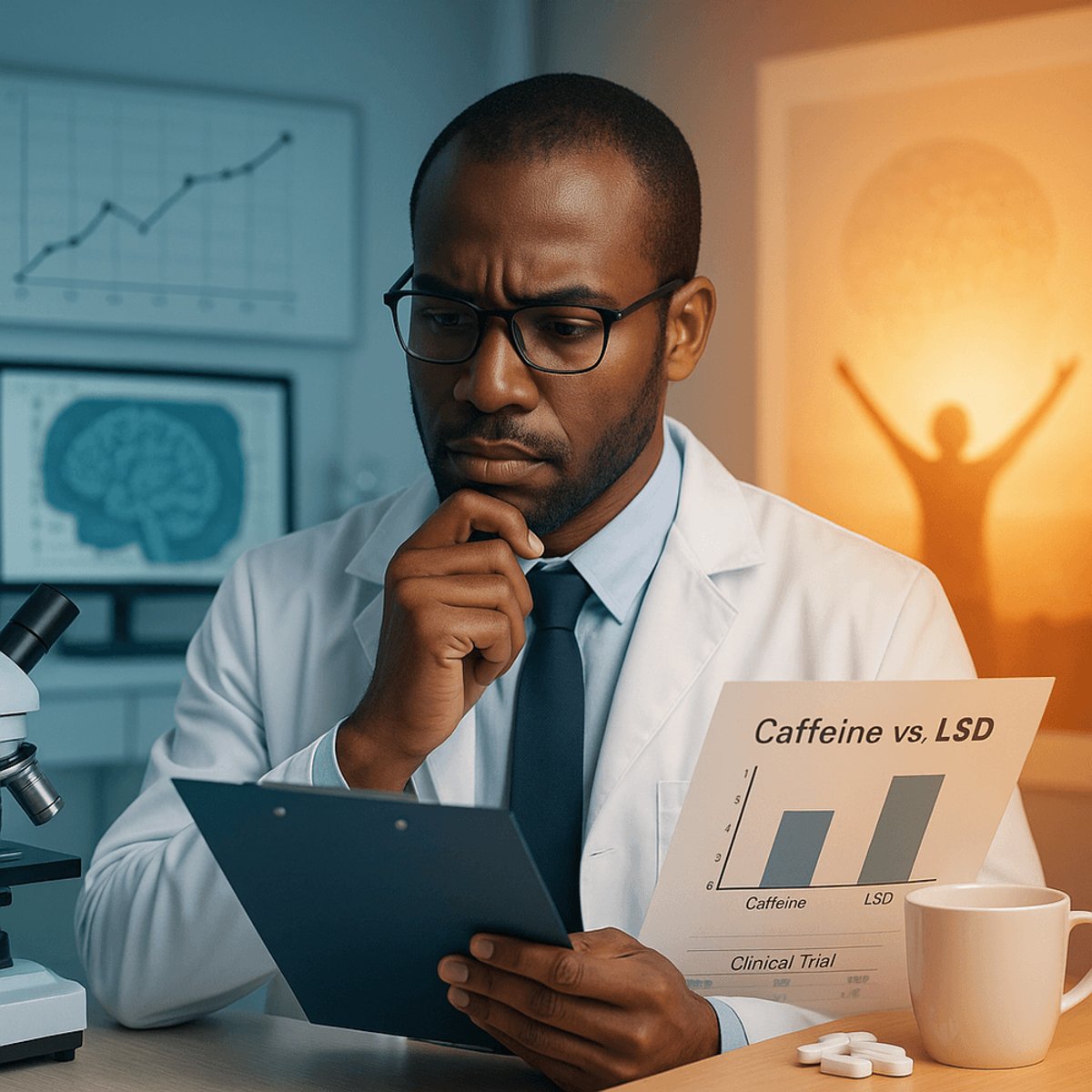
The caffeine group showed better MADRS scores than the LSD group. Translation: A decent cup of coffee appears more effective at treating clinical depression than tiny doses of acid. "It's probably a nail in the coffin of using microdosing to treat clinical depression," Hanka told WIRED. "It probably improves the way depressed people feel—just not enough to be clinically significant or statistically meaningful."
The findings align with suspicions some researchers have harbored for years. Jay A. Olson, now a postdoctoral fellow at the University of Toronto, ran an audacious 2020 experiment at McGill University where he gave 33 people a placebo while convincing them it was psilocybin. Researchers acted out drug effects in a room with trippy lighting to prime expectations. The resulting paper, titled "Tripping on Nothing," found most participants reported feeling high despite consuming nothing psychoactive.
"The main conclusion we had is that the placebo effect can be stronger than expected in psychedelic studies," Olson explained to WIRED. "Placebo effects were stronger than what you would get from microdosing." He's careful to note that doesn't mean the effects aren't real—just that they may stem from expectation and environment rather than the drug itself. "It can be true at the same time that microdosing can have positive effects on people, and that those effects are perhaps almost entirely placebo."
What makes MindBio's study particularly interesting is its "double-dummy" design. Patients knew they might be getting LSD, caffeine, or Ritalin, lowering their expectations. This differs dramatically from the company's earlier Phase 2A trial, an open-label study where patients definitely knew they were microdosing LSD. That trial, recently published in Neuropharmacology, showed MADRS scores dropping 59.5% with benefits lasting six months.
The whiplash between studies reveals something crucial about psychedelic research: When people know they're taking a mythologized substance with decades of counterculture mystique, outcomes improve dramatically. Strip away that knowledge through rigorous blinding, and the magic fades.
Jim Fadiman, the 86-year-old psychedelic researcher who created the popular "Fadiman protocol" (microdose once every three days), isn't buying it. He argues the active caffeine placebo itself has psychoactive properties that muddy the waters. "Double-dummy is a remarkably apt term," he said dryly. "What I know is that if you take enough caffeine, you will not be depressed!"
Fadiman points to hundreds of real-world reports he's collected over years that contradict MindBio's controlled findings. It's a tension playing out across psychedelic research: anecdotal evidence suggesting profound benefits butting against clinical trials struggling to prove efficacy beyond placebo.
Hanka stands by the science. "We are bewildered at the significant difference between the open label Phase 2A trial results and the Phase 2B trial results," he acknowledged. "But that is the nature of good science—a properly controlled trial will get a proper result. Our Phase 2B trial was of the highest standard, a triple-blind, double-dummy, active placebo controlled trial. I haven't seen another psychedelic trial that has gone to these lengths to control and blind a trial."
For some microdosing advocates, the placebo question doesn't diminish their experience. Author Ayelet Waldman published A Really Good Day in 2017, chronicling how microdosing helped treat her mood disorder. She told WIRED she considered the placebo possibility extensively while writing. "I wrote about this a number of times in various chapters and decided in the end it didn't matter. What mattered was that I felt better."
That's a reasonable position for individual wellness seekers. But it creates a thorny problem for the psychedelic therapy industry trying to win FDA approval and insurance coverage. If benefits can't be distinguished from placebo in rigorous trials, why would anyone assume the legal risks of procuring Schedule I substances? LSD remains classified alongside heroin and methamphetamine under federal law.
The implications extend beyond depression treatment. Anecdotal reports have credited microdosing with everything from increased focus to improved sexual function, often with the same scientific rigor as a Yelp review. If the depression claims crumble under scrutiny, the entire edifice of microdosing benefits faces questions.
Hanka seems ready to move on. He's invested millions into MindBio's psychedelic research and is now pivoting to "Booze A.I.," a smartphone app using artificial intelligence to analyze voice biomarkers for blood alcohol concentration. "Had I known six years ago what I know about psychedelics," he said, "I probably wouldn't have ventured into the microdosing field."
The study hasn't been published in a peer-reviewed journal yet, which means the scientific community hasn't fully dissected the methodology. But the top-line results represent a significant data point in the broader conversation about psychedelics, expectation, and the power of belief to shape subjective experience.
The microdosing mystique built over the past decade may be crumbling under the weight of rigorous science. MindBio's findings don't invalidate individual experiences—plenty of people genuinely feel better after microdosing—but they suggest those benefits might come from ritual, intention, and expectation rather than pharmacology. For an industry trying to medicalize psychedelics, that's a problem. For individuals seeking wellness, it raises uncomfortable questions about whether the legal and financial risks are worth chasing effects a strong coffee might deliver. As the psychedelic renaissance matures from counterculture experiment to clinical reality, the gap between believer testimonials and controlled trials is becoming harder to ignore.