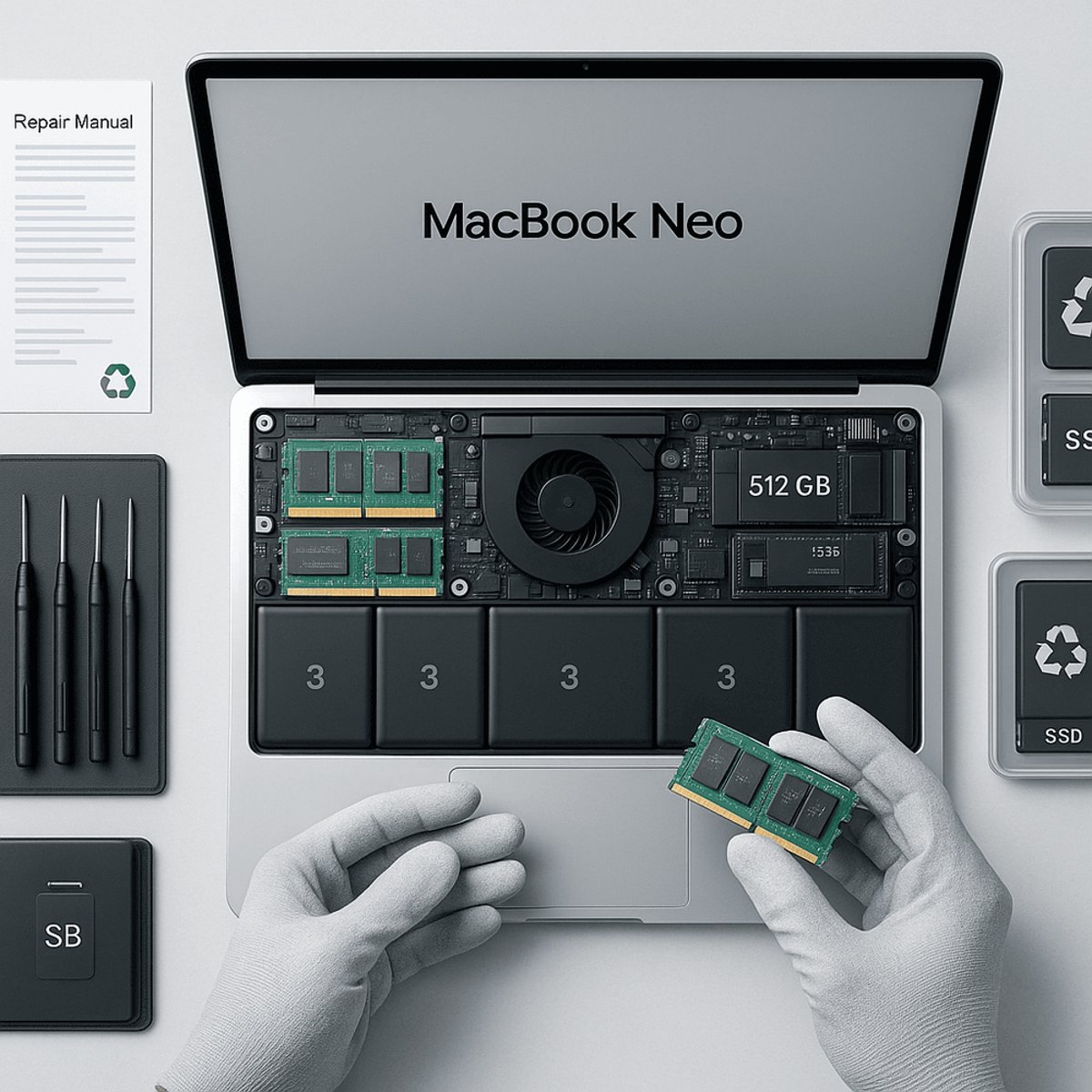
Apple's new MacBook Neo just pulled off something the company hasn't managed in over a decade - it's actually easy to fix. iFixit, the repair advocacy group that's spent years battling Apple's sealed designs, is calling it "the most repairable MacBook" in roughly fourteen years. The development marks a significant shift for a company that's been synonymous with glued-in batteries and proprietary screws, suggesting Apple's right-to-repair commitments might finally be translating into real hardware changes.
Apple just did something it hasn't done since the early 2010s - it built a MacBook you can actually fix yourself. The new MacBook Neo, already making waves as Apple's most budget-friendly laptop, is now earning unexpected praise from the repair community for being genuinely serviceable.
iFixit, the repair-focused organization that's become Apple's unofficial report card on device serviceability, assessed the MacBook Neo and declared it the company's most repairable laptop in "about fourteen years," according to TechCrunch. That timeline takes us back to around 2012, before Apple's obsession with thinness led to glued-in batteries, soldered storage, and designs that essentially turned laptops into disposable devices.
The timing couldn't be more significant. Apple's faced mounting pressure from right-to-repair advocates, regulatory bodies, and increasingly eco-conscious consumers who've grown frustrated with the company's throwaway approach to hardware. The EU's been pushing hard on repairability requirements, and several U.S. states have passed or are considering right-to-repair legislation that would force manufacturers to provide parts, tools, and documentation to consumers and independent repair shops.
What makes the MacBook Neo different? While full teardown details are still emerging, the fact that iFixit is willing to give it such high marks suggests Apple's made fundamental design changes. We're likely talking about modular components, accessible battery replacements, and possibly even upgradeable storage or memory - features that were standard on MacBooks until Apple decided thin-and-light trumped everything else.
The MacBook Neo's positioning as Apple's most affordable laptop makes this even more interesting. Typically, budget devices sacrifice build quality and serviceability to hit lower price points. Apple's doing the opposite here - delivering both affordability and repairability in the same package. That's a direct challenge to the industry narrative that says you can't have premium design, competitive pricing, and user serviceability simultaneously.
For context, Apple's recent MacBook Pro and MacBook Air models have consistently scored poorly on iFixit's repairability scale. The M1 and M2-powered machines featured unified memory soldered directly to the processor, SSDs that were either soldered or used proprietary connectors, and batteries adhered with industrial-strength adhesive. Even simple repairs like battery replacements required specialized tools and significant disassembly.
The shift comes as Apple's been quietly expanding its Self Service Repair program, launched in 2022, which provides genuine parts and repair manuals to customers willing to fix their own devices. But the program's been criticized for being cumbersome and expensive - sometimes costing nearly as much as having Apple do the repair. A truly repairable MacBook Neo could vindicate that program and prove Apple's serious about the initiative.
Competitors are watching closely. Framework has built its entire business model around modular, repairable laptops that let users swap ports, upgrade components, and easily replace parts. Dell and HP have also been emphasizing serviceability in their business-class machines. If Apple's now competing on repairability alongside performance and design, it raises the bar for the entire industry.
The environmental implications are substantial too. E-waste from discarded electronics is one of the fastest-growing waste streams globally. Laptops that can be repaired and upgraded instead of replaced could significantly extend device lifecycles. Apple's made big commitments around carbon neutrality and recycling, but extending product lifespan through repairability is arguably more impactful than any recycling program.
What we don't know yet is whether this represents a genuine philosophy shift at Apple or if the MacBook Neo is an outlier - a budget device that gets different design priorities than the premium models that drive Apple's profits. The real test will be whether these repairability features migrate upward to the MacBook Air and MacBook Pro lines, or if Apple maintains its sealed-unit approach for higher-end machines.
The MacBook Neo's repairability also raises questions about Apple's broader product strategy. The company's been moving aggressively into services and subscriptions as hardware sales plateau. Devices that last longer through repairs could disrupt upgrade cycles Apple depends on for revenue. But they also create more loyal customers and strengthen Apple's environmental credentials at a time when both matter more than ever.
The MacBook Neo's repairability breakthrough represents more than just a design choice - it's a potential inflection point for Apple's relationship with device longevity and consumer rights. If this signals a genuine commitment to serviceable hardware rather than a one-off experiment with a budget model, it could reshape expectations across the entire laptop industry. The question now is whether Apple will extend these principles to its premium lines or if the MacBook Neo remains an exception that proves the rule. Either way, the fact that iFixit is celebrating an Apple laptop's repairability for the first time in 14 years suggests something meaningful has shifted in Cupertino.