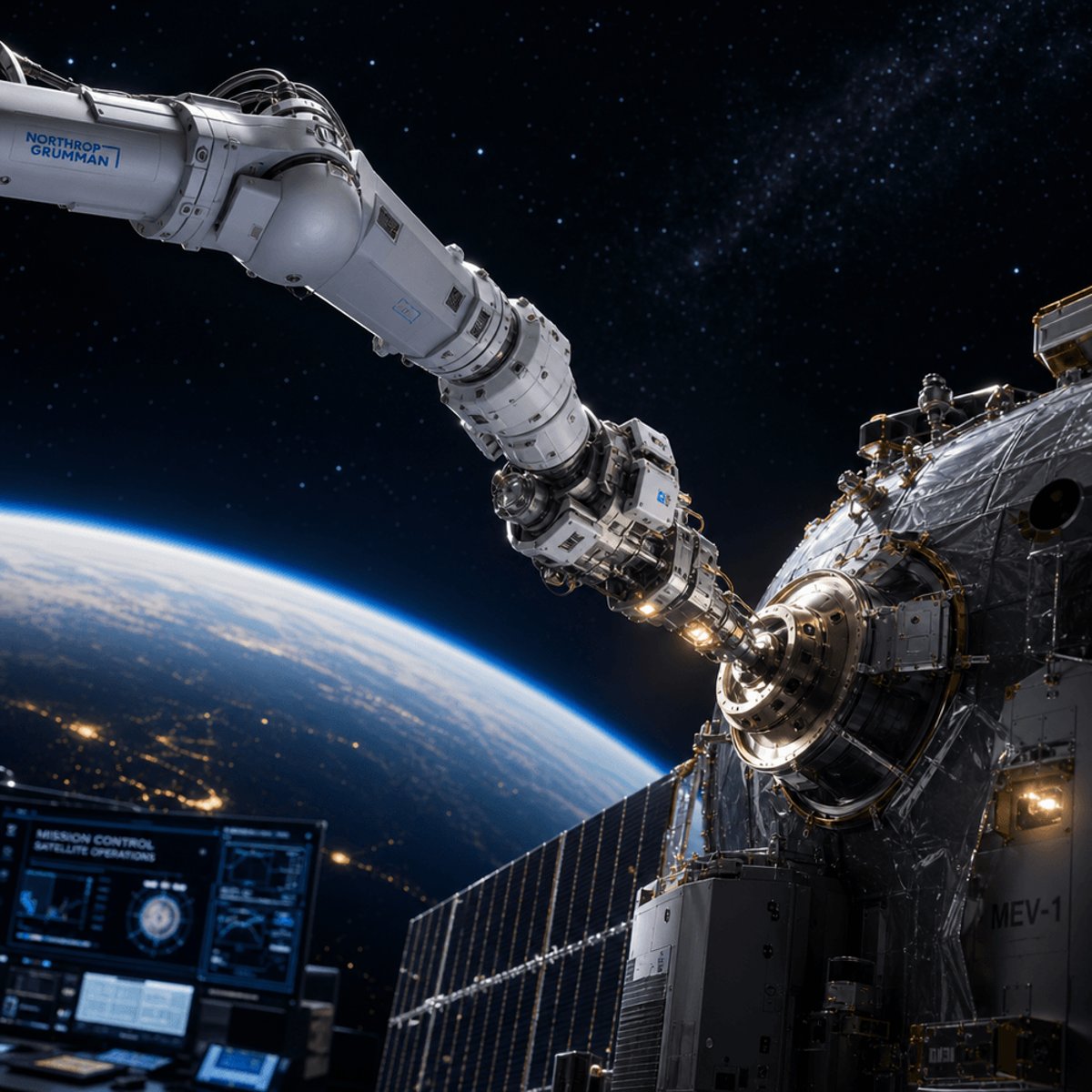
Space just got its first mechanic. Northrop Grumman's Mission Robotic Vehicle is attempting something never done before - attaching a new thruster to an aging satellite while both hurtle through orbit at 17,000 mph. The mission marks a turning point for the satellite industry, where billion-dollar assets typically become space junk the moment their fuel runs out. If successful, this robotic repair job could extend satellite lifespans by years and reshape how companies think about space infrastructure.
Northrop Grumman is making history 22,000 miles above Earth. The defense contractor's Mission Robotic Vehicle (MRV) has begun the delicate process of attaching a new thruster to an aging communications satellite, marking the first time a robot has attempted to swap out components on an operational spacecraft in orbit.
The mission represents a fundamental shift in how the satellite industry handles aging assets. Traditionally, when a satellite's fuel runs low or a component fails, operators face a stark choice - let it drift into a graveyard orbit or watch millions in revenue vanish. The MRV aims to change that equation entirely.
"We're essentially creating AAA roadside assistance for space," one aerospace industry analyst noted. The comparison isn't far off. Just as a dead battery doesn't mean scrapping your car, a depleted fuel tank shouldn't mean abandoning a multi-hundred-million-dollar satellite that's otherwise functional.
Northrop hasn't disclosed which satellite is receiving the upgrade, but the implications are industry-wide. Satellite operators from SES to Intelsat have watched their assets age past their design lives, still capable of relaying signals but running on fumes. The global fleet of geostationary satellites alone represents over $15 billion in hardware, much of it facing premature retirement.
The MRV itself is a marvel of autonomous engineering. Unlike Northrop's earlier Mission Extension Vehicles, which simply docked with satellites to provide station-keeping, this robot can manipulate external components. It uses a combination of robotic arms, computer vision, and precision maneuvering thrusters to approach, inspect, and modify satellites that were never designed to be serviced.
That last part is crucial. Today's satellites are built as sealed units - launch them, forget them, replace them. The MRV has to work around that constraint, attaching new thrusters to mounting points and fuel ports that weren't meant for robotic hands. It's like performing surgery on a patient who was never supposed to need it.
The technical challenges are staggering. In orbit, there's no margin for error. A miscalculation of mere inches at orbital velocities could damage both the MRV and its target. The robot operates with millisecond-precision burns from dozens of tiny thrusters, adjusting its approach in real-time based on sensor data streaming back to ground controllers.
Northrop has been building toward this moment for years. The company's first Mission Extension Vehicle successfully docked with an Intelsat satellite in 2020, proving that orbital rendezvous was commercially viable. A second mission followed in 2021. But those were relatively simple - grab the satellite, take over its positioning. This thruster attachment requires a whole new level of dexterity.
The market opportunity is massive. Morgan Stanley estimates the satellite servicing industry could reach $3.1 billion by 2030, driven largely by life-extension missions like this one. Every year a satellite operator can squeeze out of existing hardware is a year they don't have to spend $200-500 million on a replacement.
Competitors are watching closely. SpaceLogistics, a Northrop subsidiary, has pioneered this field, but startups like Astroscale and established players like Maxar are developing their own servicing vehicles. The race is on to prove not just technical capability but economic viability.
What makes this mission particularly significant is its implications for sustainability in space. The orbital environment around Earth is getting crowded - over 8,000 satellites and counting, plus tens of thousands of pieces of trackable debris. Anything that extends satellite life and reduces the need for replacements helps ease the congestion.
But there's also a strategic angle. Satellite servicing technology could theoretically be used for less benign purposes - inspecting rivals' hardware, interfering with operations, or worse. That's why the U.S. Space Force has taken a keen interest in these capabilities, both as a potential customer and as a regulatory observer.
The current mission timeline remains unclear. Orbital operations move at their own pace, with weather, technical checks, and the physics of orbital mechanics dictating the schedule. Ground teams at Northrop's Mission Operations Center are monitoring every maneuver, ready to abort if anything looks off.
If the thruster attachment succeeds, the target satellite could gain years of operational life. More importantly, it would validate a new business model for space infrastructure - one where assets are maintained rather than discarded, where orbital real estate becomes truly renewable.
The broader space economy is taking notes. As satellite constellations proliferate and orbital assets become critical infrastructure for everything from internet connectivity to climate monitoring, the ability to repair and upgrade on-orbit becomes strategic. Companies are already designing next-generation satellites with servicing in mind, adding standardized docking ports and modular components.
Northrop's thruster swap attempt is more than an engineering demonstration - it's a proof of concept for an entirely new space economy. If robots can repair satellites, the calculus for orbital operations changes fundamentally. Suddenly, spacecraft aren't disposable but maintainable assets, orbital positions become long-term investments, and the economics of space infrastructure start to resemble terrestrial utilities. The mission's success or failure will be measured in more than technical metrics. It'll determine whether space becomes a place we maintain or just keep filling up with replacements.