NVIDIA just made its biggest enterprise AI bet yet. The chipmaker announced a sweeping strategic partnership with Dassault Systèmes, the French industrial software giant, to build what they're calling Industry World Models - AI systems grounded in physics that can simulate everything from drug molecules to entire factories. The deal positions NVIDIA's infrastructure as the backbone for mission-critical industrial AI while Dassault adopts NVIDIA's tech to design next-generation AI factories. It's a rare two-way partnership that could reshape how manufacturers, pharma companies, and engineers deploy AI at scale.
NVIDIA and Dassault Systèmes are betting the future of industrial AI won't run on generic chatbots but on physics-validated simulations that understand the real world. The two companies announced their partnership today at 3DEXPERIENCE World in a joint appearance by NVIDIA CEO Jensen Huang and Dassault CEO Pascal Daloz.
The core idea: marry Dassault's Virtual Twin technology - digital replicas of physical systems used across aerospace, automotive, and manufacturing - with NVIDIA's accelerated computing stack. The result is what they're calling Industry World Models, AI systems trained not just on text but on decades of validated scientific and engineering data. "We are entering an era where artificial intelligence does not just predict or generate, but understands the real world," Daloz said in prepared remarks. "When AI is grounded in science, physics and validated industrial knowledge, it becomes a force multiplier for human ingenuity."
Huang framed it as the next evolution of AI. "Physical AI is the next frontier of artificial intelligence, grounded in the laws of the physical world," the NVIDIA founder told attendees. "Together with Dassault Systèmes, we're uniting decades of industrial leadership with NVIDIA's AI and Omniverse platforms to transform how millions of researchers, designers and engineers build the world's largest industries."
But this isn't just a technology handshake. Both companies are making tangible infrastructure commitments. Dassault is deploying what it calls AI factories through its OUTSCALE cloud brand, powered by NVIDIA's latest chips across three continents. These facilities will run AI models directly within Dassault's 3DEXPERIENCE platform while guaranteeing data sovereignty and IP protection - critical concerns for manufacturers handling proprietary designs.
Going the other direction, NVIDIA is adopting Dassault's model-based systems engineering tools to design its own AI factories, starting with the upcoming NVIDIA Rubin platform. That platform will integrate into the NVIDIA Omniverse DSX Blueprint for large-scale AI infrastructure deployment. It's rare to see this kind of mutual adoption between enterprise giants.
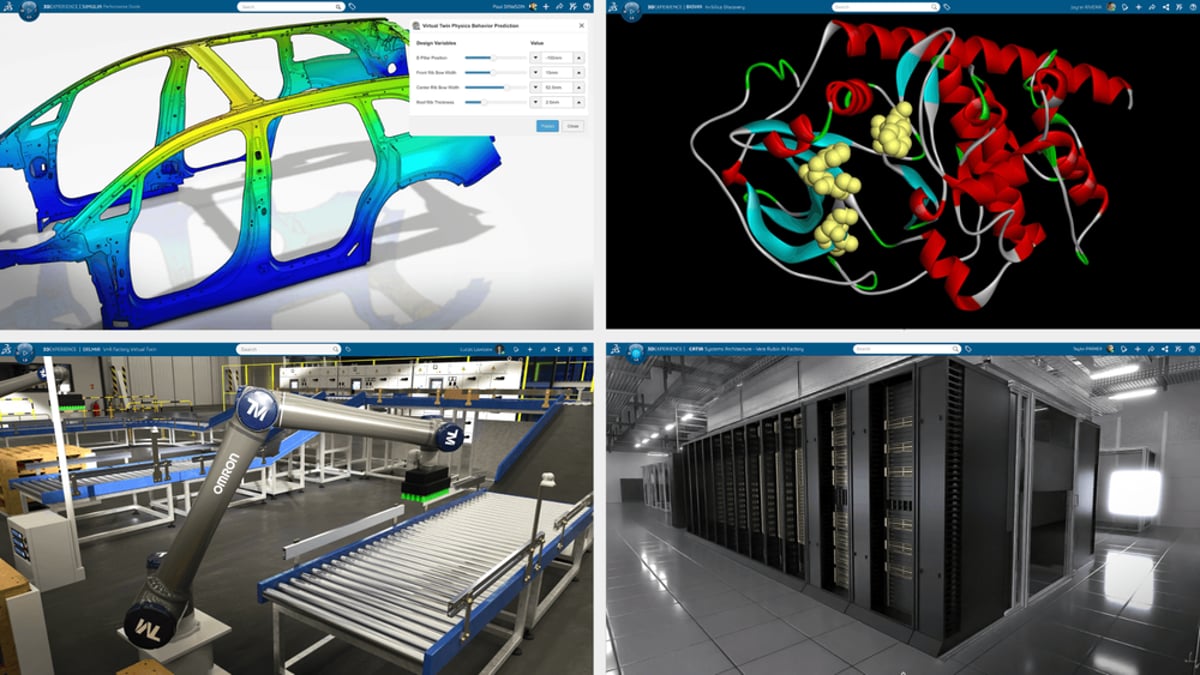
The technical integration spans four major domains. In biology and materials research, NVIDIA BioNeMo will combine with Dassault's BIOVIA platform to accelerate molecular discovery. For engineering design, Dassault's SIMULIA simulation tools will tap NVIDIA CUDA-X libraries to let engineers instantly predict outcomes without waiting hours for traditional simulations.
On the factory floor, NVIDIA Omniverse physical AI libraries will integrate into Dassault's DELMIA manufacturing platform, enabling what they call autonomous, software-defined production systems. Think factories that can simulate and optimize themselves in real time.
Perhaps most intriguing is the concept of "virtual companions" - AI agents that sit inside Dassault's 3DEXPERIENCE platform, powered by NVIDIA Nemotron open models. These aren't general-purpose assistants but specialized agents trained on industry-specific data that can deliver what Dassault calls "trusted, actionable intelligence with industrial-scale efficiency." The idea is to give engineers and designers AI collaborators that actually understand the constraints and requirements of their specific domain.
Early customer reactions suggest real appetite for this approach. "Through the NVIDIA-Dassault Systèmes collaboration, we gain the computational power to model and optimize our products at scale, accelerating innovation while delivering on our sustainability commitments," said Cécile Béliot, CEO of Bel Group, the French food manufacturer.
OMRON, the Japanese automation giant, sees it as essential for modern manufacturing. "By combining NVIDIA physical AI frameworks with Dassault Systèmes' Virtual Twin Factory and OMRON's automation technologies, manufacturers can move from design to deployment with greater confidence and speed," said Motohiro Yamanishi, President of Industrial Automation at OMRON.
Lucid Motors is exploring how physics-informed AI models could compress its development cycles. "Our exploration of multi-physics based Digital Twin simulation models, powered by NVIDIA's open-source, physics-informed AI models, has the potential to help our teams move from concept to production faster than ever before, without sacrificing predictive accuracy," said Vivek Attaluri, Lucid's Vice President of Vehicle Engineering.
The National Institute for Aviation Research at Wichita State is testing virtual companions for aircraft design. "Dassault Systèmes' Virtual Companions for engineering, leveraging the 3DEXPERIENCE agentic platform using NVIDIA Nemotron open models, accelerate the by-design compliant synthesis of aircraft Virtual Twins," said Shawn Ehrstein, Director of Emerging Technologies at NIAR.
This partnership elevates what was already an existing collaboration between the two companies into something more foundational. They're essentially trying to establish a standard architecture for how industrial AI gets built and deployed - one that treats AI not as a point solution but as a mission-critical system of record that needs to be scientifically validated.
The announcement comes as both companies face pressure to demonstrate AI's value beyond hype. NVIDIA needs to prove its chips power more than just chatbots and image generators. Dassault needs to show its legacy engineering platforms can evolve for the AI era. This partnership gives them both a story about AI that's grounded in physics, not just probabilities.
This partnership signals a fundamental shift in how enterprise AI gets built for industrial applications. Instead of retrofitting general-purpose models onto industrial workflows, NVIDIA and Dassault are architecting AI systems from the ground up with physics and scientific validation baked in. If they can deliver on the promise of virtual companions that truly understand engineering constraints and Industry World Models that compress development cycles, they'll have created something far more valuable than another AI copilot. The real test will be whether manufacturers trust these systems enough to make them mission-critical - and whether the economics actually pencil out at scale. Early customer enthusiasm suggests they're onto something, but turning physics-informed AI into a new category will take more than a single announcement.