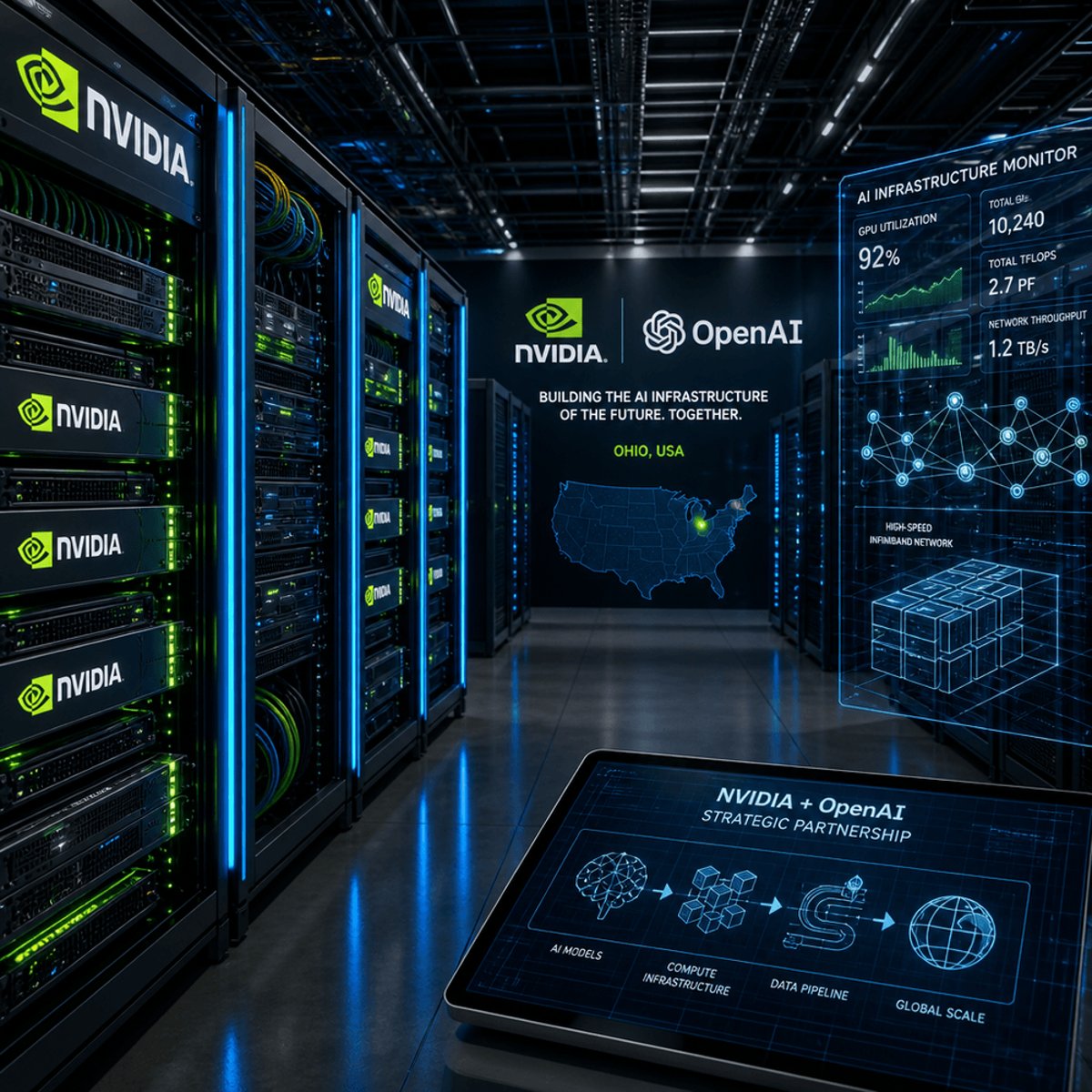
Nvidia is putting its money where its chips are, backing financing for OpenAI's new data center in Ohio as the AI arms race triggers unprecedented infrastructure spending. The deal marks a strategic shift from selling GPUs to financing the facilities that house them, signaling just how critical—and capital-intensive—the race for AI supremacy has become. With tech giants now pouring billions into compute capacity, Nvidia's move transforms it from hardware vendor to infrastructure kingmaker.
Nvidia just made a power play that reshapes the AI infrastructure landscape. The chip giant is backing financing for OpenAI's Ohio data center, according to CNBC, in a move that transforms Nvidia from pure hardware supplier to strategic infrastructure partner. The deal comes as technology companies shell out billions to build the massive compute facilities needed to train and run increasingly powerful AI models.
This isn't just about selling more H100s. By financing OpenAI's infrastructure, Nvidia effectively locks in long-term GPU demand while deepening its relationship with one of AI's most influential players. It's a page straight from the hyperscaler playbook—control the infrastructure, control the ecosystem. And with OpenAI burning through compute at unprecedented rates to develop models beyond GPT-4, securing dedicated capacity is existential.
The Ohio location is strategic. The state has emerged as an unexpected AI infrastructure hub, offering cheaper power, tax incentives, and proximity to Midwest connectivity corridors. Nvidia itself recently secured exclusive access to separate Ohio data center capacity, making the region a critical node in the company's infrastructure ambitions. Now with OpenAI planting its flag in the same territory, Ohio is becoming ground zero for the AI compute buildout.
What's driving this infrastructure frenzy? Raw economics. Training frontier AI models now costs hundreds of millions of dollars, while inference—running those models at scale—demands thousands of GPUs operating 24/7. OpenAI reportedly runs ChatGPT on more than 25,000 Nvidia GPUs, and that's before accounting for model training, research experiments, and enterprise deployments. The compute requirements are only accelerating.
But here's where it gets interesting. Nvidia financing data centers creates a potential conflict of interest with its hyperscaler customers—Amazon, Microsoft, and Google—who are themselves racing to build AI infrastructure. Microsoft already backs OpenAI with $13 billion and provides Azure compute. Now Nvidia is essentially competing to control the same infrastructure layer, potentially creating tension in the supply chain.
The financial structure of the deal remains undisclosed, but it likely involves some combination of equipment financing, lease guarantees, or direct capital investment. Nvidia's balance sheet can certainly handle it—the company is sitting on over $26 billion in cash after record AI chip sales. Using that war chest to finance customer infrastructure creates a moat: OpenAI gets the capital it desperately needs, while Nvidia ensures those facilities are packed with its GPUs rather than emerging competitors.
This move also signals Nvidia's concern about the broader infrastructure bottleneck. You can design the world's most powerful AI chip, but if your customers can't afford to build facilities to house them, your growth stalls. By removing the financing barrier, Nvidia accelerates deployment while maintaining its dominant position in the AI stack. It's vertical integration without the regulatory headaches of outright ownership.
The timing is critical. Competitors are circling. AMD is gaining traction with its MI300X chips, while Google continues pushing its TPU architecture. Startups like Cerebras and Groq are attacking specific workloads. By financing infrastructure, Nvidia doesn't just sell chips—it embeds itself into the long-term operational fabric of AI leaders. That's a much harder position to disrupt.
For OpenAI, the deal solves an immediate problem: capital. Building data centers requires hundreds of millions upfront before they generate a dollar of revenue. With the company reportedly exploring new funding rounds at valuations above $100 billion, demonstrating concrete infrastructure plans becomes crucial for justifying those numbers to investors. Nvidia's backing provides both capital and credibility.
The broader industry is watching closely. If this model works, expect Nvidia to replicate it with other AI-native companies like Anthropic, Cohere, and Inflection. We could see a wave of chip-vendor-backed infrastructure deals that fundamentally reshape how AI compute gets financed and deployed. It would represent a return to the integrated models of earlier computing eras, when IBM both built and financed the mainframes that ran corporate America.
Nvidia's financing of OpenAI's Ohio data center marks a fundamental shift in the AI infrastructure game. This isn't just about selling chips anymore—it's about controlling the entire stack from silicon to facilities. As AI companies burn billions in compute and struggle to secure capacity, expect more chip vendors to use their balance sheets as strategic weapons. The question now is whether Nvidia's hyperscaler customers will tolerate their supplier becoming an infrastructure competitor, or whether this triggers a new wave of vertical integration as everyone races to control their own AI destiny. Ohio just became the testing ground for the next phase of the AI wars.