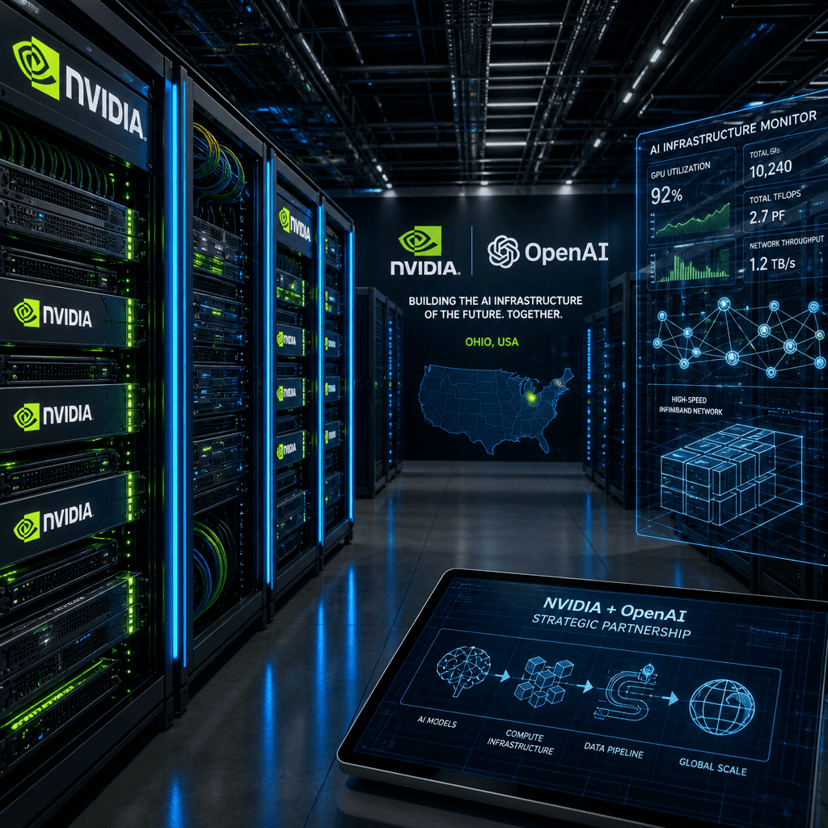
Nvidia just made a striking move beyond chip sales, securing exclusive rights to land, power, and shell capacity at SB Energy's PORTS-Pike Technology Campus in Pike County, Ohio. The deal marks a strategic shift for the AI chipmaker into guaranteed infrastructure territory, locking down the physical resources needed to host massive AI compute operations before competitors can stake their claims. It's the kind of vertical integration play that signals Nvidia isn't just selling the shovels anymore - it's claiming the goldmine too.
Nvidia isn't waiting for customers to figure out where to plug in its chips anymore. The company announced it has locked down exclusive land, power, and shell capacity through a partnership with SB Energy at the PORTS-Pike Technology Campus in Pike County, Ohio. The deal guarantees Nvidia the physical infrastructure to host its AI compute operations, marking a notable departure from the company's traditional role as a chip supplier.
The arrangement gives Nvidia control over what insiders call LPS capacity - land, power, and shell - the trifecta of resources that have become choke points in the AI infrastructure arms race. While Nvidia's announcement didn't disclose financial terms or the exact scale of capacity secured, the exclusivity clause signals the company is thinking beyond chip margins.
Pike County might seem like an unlikely AI hub, but the PORTS-Pike Technology Campus sits on strategically valuable real estate. The region offers access to stable power grids and relatively affordable energy - two commodities that have become as precious as the silicon itself in the era of power-hungry large language models. OpenAI's training runs can consume megawatts of electricity, making power availability as critical as processor speed.
This move comes as hyperscalers like Amazon Web Services, Microsoft Azure, and Google Cloud scramble to secure data center capacity. Industry sources suggest available power and cooling infrastructure has become the limiting factor for AI expansion, not chip availability. By securing its own guaranteed space, Nvidia is essentially future-proofing its ability to deliver complete AI solutions rather than just hardware components.
The partnership with SB Energy is particularly telling. SB Energy, backed by SoftBank Group and focused on renewable energy infrastructure, brings clean power credentials to the table - increasingly important as AI companies face scrutiny over their carbon footprints. The collaboration positions Nvidia to offer enterprise customers not just computing power but sustainably sourced computing power, a selling point that matters when Meta and others have committed to net-zero emissions targets.
Nvidia's vertical integration strategy mirrors moves by cloud giants who've spent years building their own data center empires. But for a chip company to guarantee physical infrastructure capacity represents a fundamental business model shift. It suggests Nvidia sees its future less as a component supplier and more as an end-to-end AI infrastructure provider competing directly with the hyperscalers who've been its biggest customers.
The Ohio campus will exclusively host Nvidia compute, according to the announcement, meaning competitors won't be able to lease space at this particular facility. That exclusivity clause is the real story here - it's Nvidia drawing a line in the concrete, literally, about controlling its own destiny in the AI infrastructure stack.
Timing matters too. This announcement comes as enterprise demand for dedicated AI infrastructure continues to outpace supply. Companies training proprietary models don't want to compete for shared cloud resources. They're increasingly looking for guaranteed capacity, exactly what Nvidia is now positioned to offer through deals like this one.
The SB Energy partnership also positions Nvidia to potentially offer colocation services or managed AI infrastructure to enterprise clients who need guaranteed compute but don't want to build their own data centers. That would put Nvidia in direct competition with traditional colocation providers and could reshape how enterprise AI infrastructure gets deployed.
What's not clear yet is whether this is a one-off deal or the first of many. If Nvidia starts securing exclusive capacity at multiple sites, it would signal a major strategic pivot that could rattle both chip competitors and cloud providers. The company has the cash reserves and market position to execute such a strategy, especially with AI demand showing no signs of cooling.
Nvidia's Ohio infrastructure play isn't just about securing real estate - it's about controlling the entire AI value chain from chip design to the building those chips live in. As power and space become the new bottlenecks in AI deployment, expect the infrastructure land grab to accelerate. The question now is whether Nvidia's hyperscaler customers will appreciate their supplier becoming a direct competitor, or if this calculated risk will pay off by opening entirely new enterprise revenue streams. Either way, the AI infrastructure war just got a lot more interesting, and Pike County, Ohio just became an unlikely front line.