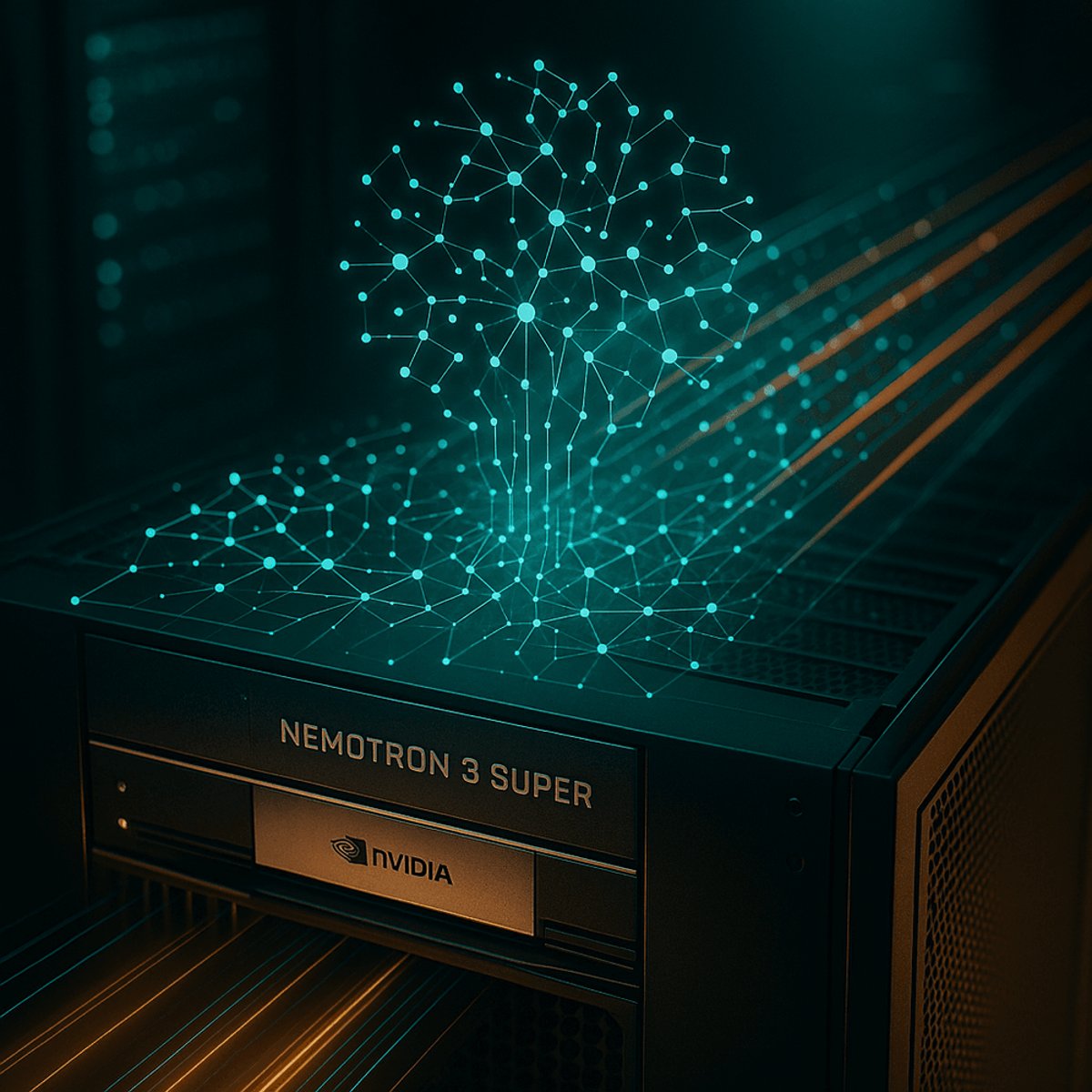
Nvidia just dropped a heavyweight contender in the agentic AI race. The company's new Nemotron 3 Super - a 120-billion-parameter open model with 12 billion active parameters - delivers five times higher throughput for autonomous AI systems, marking a significant leap in efficiency for enterprises running complex agent workflows. The launch signals Nvidia's aggressive push into the exploding agentic AI market, where autonomous systems are rapidly replacing traditional scripted automation across industries.
Nvidia is making its biggest bet yet on agentic AI. The chipmaker launched Nemotron 3 Super today, an open-source large language model engineered specifically to power autonomous agent systems at enterprise scale. The numbers tell the story - five times higher throughput compared to previous generation models, achieved through a sophisticated mixture-of-experts architecture that activates just 12 billion parameters out of a total 120 billion.
The timing couldn't be more strategic. As enterprises pivot from simple chatbots to complex multi-agent systems that can reason, plan, and execute tasks autonomously, infrastructure bottlenecks have become the limiting factor. Nvidia's approach tackles this head-on by optimizing for the specific workload patterns of agentic AI - long reasoning chains, tool use, and multi-step task execution that traditional models struggle to handle efficiently.
Perplexity, the AI-powered search startup, is the first partner out of the gate. The company is offering its users access to Nemotron 3 Super for complex research and information synthesis tasks where autonomous agents need to orchestrate multiple queries and synthesize results. It's a smart proving ground - search demands exactly the kind of multi-step reasoning and accuracy that agentic systems promise.
What makes Nemotron 3 Super different comes down to architecture. The mixture-of-experts design means only a fraction of the model's parameters activate for any given task, dramatically reducing computational overhead while maintaining the reasoning depth of a much larger model. For enterprises running hundreds or thousands of autonomous agents simultaneously, that efficiency translates directly to cost savings and faster response times.
Nvidia's move into open model releases marks a shift in strategy. While the company built its AI dominance selling GPUs to train and run proprietary models from OpenAI, Google, and others, releasing competitive open models creates a different kind of moat. If Nemotron becomes the go-to foundation for agentic AI, enterprises will need Nvidia's GPU infrastructure to run it at scale - locking in hardware sales while commoditizing the model layer.
The agentic AI market is heating up fast. Microsoft recently previewed autonomous agents in Copilot Studio, while Google is testing Project Astra for multi-modal agent experiences. But most of these efforts run on closed, proprietary infrastructure. Nvidia's open approach could fracture that landscape, giving enterprises a viable path to build and deploy agents without vendor lock-in at the model level.
Early benchmarks from Nvidia's blog post claim "high accuracy for autonomous agents" across complex reasoning tasks, though the company hasn't released detailed performance comparisons against competitors like Anthropic's Claude or OpenAI's GPT-4. The proof will come from real-world deployments over the coming months as enterprises test whether the throughput gains hold up under production workloads.
For developers, Nemotron 3 Super is available now through Nvidia's AI platform. The open licensing means teams can fine-tune and deploy the model on their own infrastructure or through cloud providers - a flexibility that's been sorely missing from the current generation of frontier models locked behind API-only access.
The bigger picture here is infrastructure. As AI shifts from single-shot queries to persistent, multi-agent systems running 24/7, the economic equation changes completely. A chatbot that processes one query at a time is manageable. An autonomous system orchestrating dozens of specialized agents, each running continuous reasoning loops, needs fundamentally different infrastructure. Nvidia is positioning itself to own that layer.
Nvidia's Nemotron 3 Super launch is less about releasing another large language model and more about staking claim to the infrastructure layer powering the next wave of enterprise AI. With autonomous agents rapidly moving from proof-of-concept to production deployments, the five times throughput advantage could prove decisive for companies choosing their foundational stack. The real test starts now - whether the performance gains hold up at scale, how enterprises balance open flexibility against proprietary capabilities from competitors, and whether Nvidia can turn model adoption into the hardware lock-in it's betting on. Watch for enterprise deployment announcements and detailed benchmark comparisons as rivals respond.