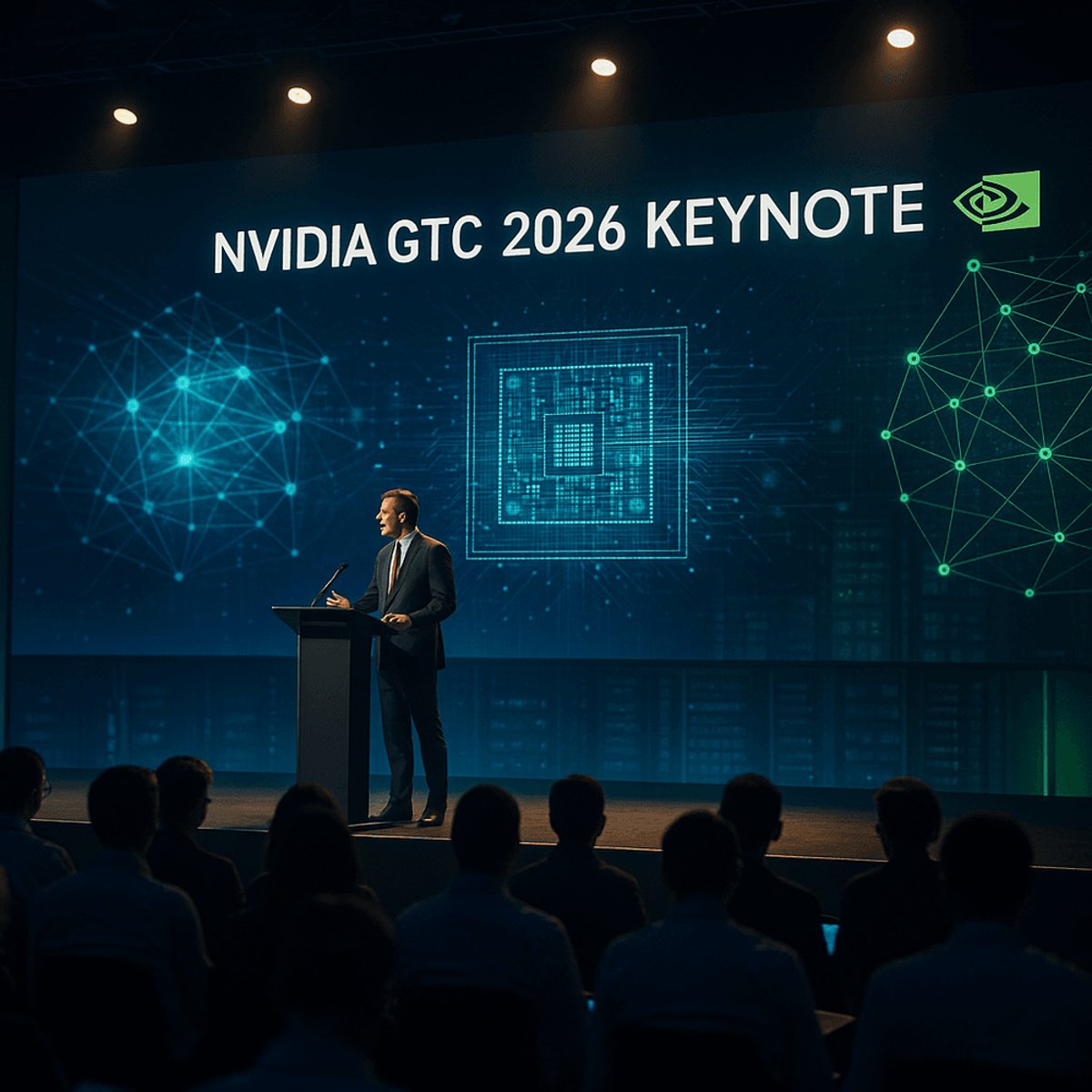
NVIDIA just opened the doors on GTC 2026, the chip giant's flagship conference that's become the industry's most-watched AI event. CEO Jensen Huang takes the stage in San Jose with rolling announcements expected through March 20, and if history holds, we're about to see everything from next-gen GPU architecture to enterprise AI partnerships that'll reshape the competitive landscape. The timing comes as NVIDIA fights to maintain its stranglehold on AI infrastructure while rivals like AMD and new challengers circle.
NVIDIA just fired the starting gun on GTC 2026, and the entire AI industry is watching. The company's annual developer conference kicked off Wednesday in San Jose with CEO Jensen Huang's keynote setting the stage for nine days of announcements, demos, and the kind of product reveals that tend to move markets.
This isn't your typical tech conference. GTC has evolved into the Super Bowl of AI infrastructure, where NVIDIA telegraphs its roadmap and competitors scramble to respond. Last year's event brought chip architecture updates that sent enterprise buyers into multi-billion dollar purchasing cycles. This year's stakes feel even higher.
The live coverage from NVIDIA's official blog promises rolling updates through March 20, suggesting the company has enough in the pipeline to sustain a week-plus news cycle. That's ambitious even by NVIDIA's standards, and it signals the breadth of what's coming - likely spanning everything from data center GPUs to edge AI to automotive compute platforms.
Huang's keynote typically runs long and technical, diving deep into architecture details that matter enormously to the developers and enterprise architects who actually deploy this hardware. He's known for surprise announcements, whether that's a new chip family, a major cloud partnership, or software tools that suddenly make certain AI workloads vastly cheaper to run.
The competitive context makes this GTC particularly interesting. NVIDIA's dominance in AI accelerators remains nearly absolute - the company controls an estimated 80-90% of the market for chips that train large language models. But that dominance is under pressure from multiple directions. AMD keeps pushing its MI300 series as a credible alternative. Intel is trying to claw back relevance with Gaudi chips. And custom silicon from Google, Amazon, and Microsoft threatens to eat into NVIDIA's hyperscaler revenue.
Then there's the China factor. Export controls have locked NVIDIA out of selling its most advanced chips to Chinese customers, creating both a revenue hit and an opening for domestic Chinese chip designers. How NVIDIA addresses that gap - whether through China-specific chip variants or pivot to other markets - could surface during GTC.
The conference also comes at an inflection point for enterprise AI adoption. The initial LLM training gold rush is maturing into a more complex landscape of inference workloads, multimodal models, and edge deployment. NVIDIA needs to show it's not just the training leader but also the inference and deployment leader. That means software tools, frameworks, and probably partnerships with the SaaS companies actually building AI products.
Expect Huang to spend significant time on NVIDIA's CUDA ecosystem, the software moat that makes switching away from NVIDIA chips painful for developers. Any updates to CUDA, TensorRT, or the company's AI Enterprise software stack will matter as much as hardware specs.
The automotive angle is worth watching too. NVIDIA's been pushing hard into autonomous vehicle compute with its DRIVE platform, and GTC often brings updates on which automakers are adopting the technology. Given the recent turbulence in the EV and autonomous driving markets, any major design wins would be significant.
What we won't get is much detail on NVIDIA's actual financials or forward guidance - that's for earnings calls. But the product roadmap revealed at GTC typically telegraphs where revenue will flow over the next 12-18 months. If NVIDIA announces chips that won't ship until late 2026 or 2027, that's a signal about how long the current architecture will keep printing money.
The live demo component of GTC matters too. NVIDIA tends to show off AI applications running on its hardware - everything from drug discovery simulations to real-time rendering to chatbots processing video. These demos serve as proof points that the technology actually works at scale, not just in lab benchmarks.
Industry analysts will be parsing every slide and statement for clues about NVIDIA's manufacturing relationship with TSMC, its primary chip fabrication partner. Any hints about 3nm or 2nm production timelines, yields, or capacity allocations could reveal constraints or advantages in NVIDIA's supply chain.
The conference runs through March 20, which means NVIDIA is pacing announcements across multiple days rather than dumping everything in the opening keynote. That's smart event management but also suggests genuine breadth - possibly separate focus days for data center, automotive, edge AI, and developer tools.
What happens at GTC doesn't stay at GTC. The partnerships announced, the chips revealed, and the roadmap telegraphed here will ripple through enterprise IT budgets, cloud provider strategies, and AI startup plans for the next year. If you're building on AI infrastructure, you're watching this closely.
GTC 2026 is less a conference and more a market-moving event disguised as developer education. What NVIDIA reveals over the next nine days will shape AI infrastructure spending, competitive dynamics, and product roadmaps across the industry. The company's ability to maintain technical leadership while navigating geopolitical constraints, supply chain complexity, and emerging competition will be on full display. For anyone building, buying, or betting on AI infrastructure, the next week matters enormously. Check back for updates as announcements roll out.