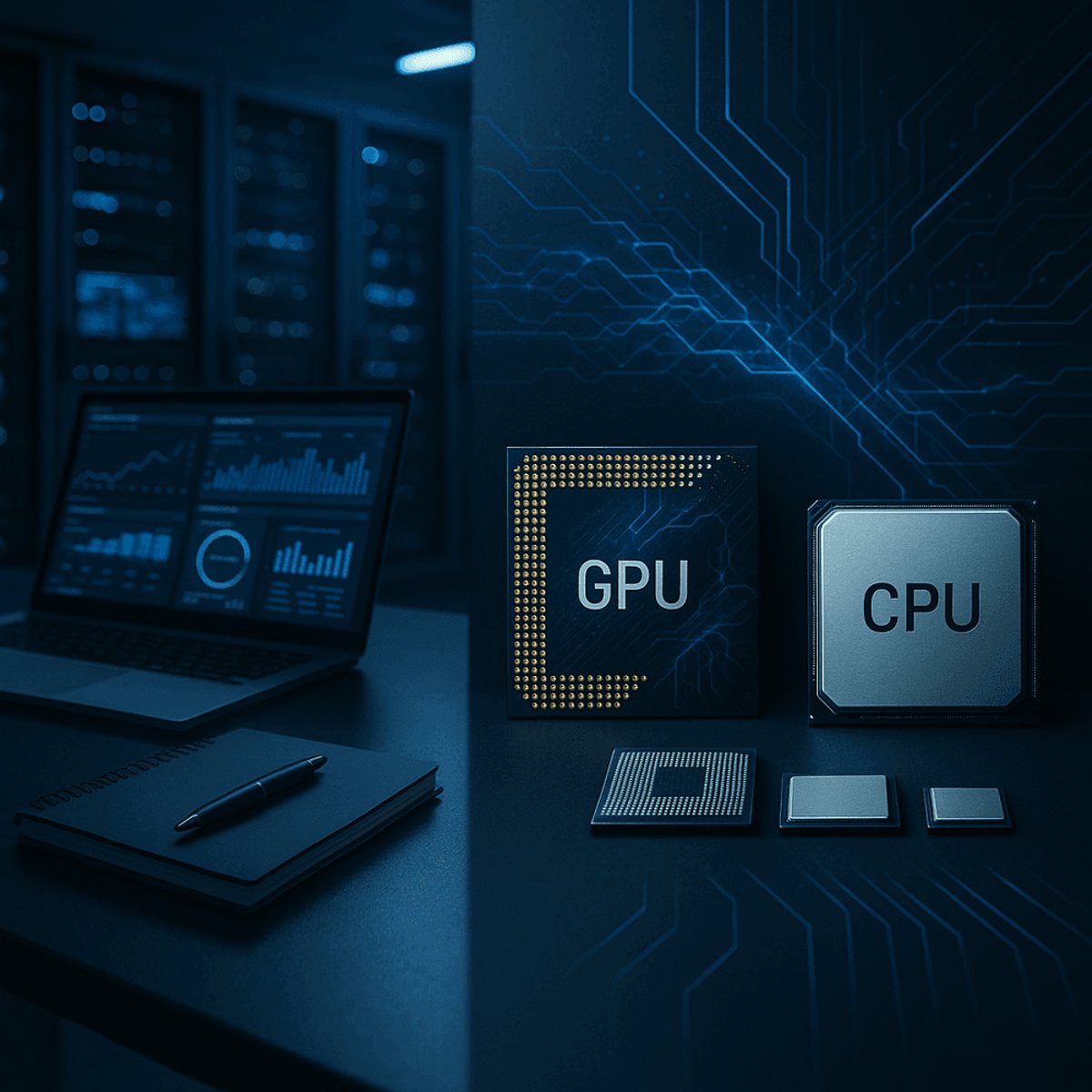
The AI chip wars just took an unexpected turn. Nvidia CEO Jensen Huang is preparing to showcase a new generation of CPU processors designed specifically for agentic AI at the company's GTC conference this week, marking a strategic pivot from the GPU-centric approach that propelled the chipmaker to a $2 trillion valuation. Both Nvidia and rival AMD are experiencing surging demand for traditional CPUs as enterprises discover that autonomous AI agents require fundamentally different computing architectures than the large language models that dominated 2024 and 2025.
Nvidia built a chipmaking empire on graphics processors, but the next phase of AI is forcing even Jensen Huang to rethink the playbook. At this week's GTC conference in San Jose, industry insiders expect the leather-jacket-wearing CEO to detail a new family of CPUs purpose-built for agentic AI - the autonomous software agents that reason, plan, and act independently rather than simply generating text responses.
The timing couldn't be more telling. While Nvidia has dominated AI infrastructure with its H100 and H200 GPUs that power OpenAI, Anthropic, and nearly every other major LLM, the emergence of agentic systems is exposing gaps in pure GPU architectures. These AI agents don't just process massive matrix calculations - they orchestrate workflows, manage memory, make sequential decisions, and interact with external tools. That requires the kind of general-purpose computing power that CPUs have delivered for decades.
AMD saw the shift coming first. The company's EPYC server processors have posted double-digit growth for six consecutive quarters, with CEO Lisa Su attributing much of the momentum to AI inference workloads during the company's recent earnings call. But Nvidia isn't ceding territory. The company acquired server CPU designer Arm-based startup Mellanox in 2020 for $7 billion and has been quietly building out its Grace CPU architecture alongside its GPU roadmap.
What makes agentic AI different comes down to workload characteristics. Training GPT-4 or Claude required massive parallel processing - exactly what GPUs excel at. But an AI agent booking your travel, managing your calendar, and coordinating with other agents spends more time on sequential logic, API calls, and state management. According to enterprise infrastructure data, these workloads show 60-70% CPU utilization versus 30-40% GPU, inverting the ratio seen in LLM training.
The market is responding. Hyperscalers like Microsoft, Google, and Amazon Web Services are all reconfiguring data center designs to balance CPU and GPU capacity. Microsoft Azure's recent infrastructure announcements emphasized what the company calls 'AI reasoning clusters' that pair high-core-count CPUs with GPU accelerators, rather than the GPU-dense configurations used for model training.
For Nvidia, the CPU push represents both opportunity and risk. The company commands 80%+ market share in AI GPUs but faces entrenched competition in CPUs from AMD and Intel. Grace CPU adoption has been slower than some analysts expected, with customers hesitant to bet on Nvidia in a market segment where AMD and Intel have decades of ecosystem advantages. But the agentic AI wave gives Nvidia a fresh angle - positioning Grace as purpose-built for the next generation of AI workloads rather than a general-purpose server chip.
Industry observers expect Huang to announce Grace CPU variants optimized for inference and agent orchestration, potentially with tighter integration to Nvidia's GPU lineup. The company's superchip strategy - combining Grace CPUs and Hopper GPUs on the same package - could become the standard architecture for agentic AI deployments. That would let Nvidia maintain its infrastructure advantage even as workloads shift away from pure GPU computing.
The competitive dynamics are getting messy. AMD is pushing its Instinct GPUs alongside EPYC CPUs as an integrated platform. Intel, left behind in the GPU race, is pitching its Xeon processors as the ideal foundation for agentic systems. And custom chip efforts from Amazon (Graviton/Trainium), Google (TPUs), and Microsoft (Maia) threaten to bypass merchant silicon entirely for the largest deployments.
What's clear is that the AI infrastructure market is fragmenting from the GPU-only model that defined 2023-2025. Enterprise AI budgets are shifting from model training toward deployment and inference, where CPU economics matter more. Nvidia generated roughly $60 billion in data center revenue last year, almost entirely from GPUs. Capturing a meaningful share of the CPU market - worth another $30-40 billion annually in servers - would cement the company's dominance. Missing it could create an opening for competitors.
The GTC keynote will reveal how seriously Nvidia is taking the CPU opportunity and whether the company can translate its AI credibility into a market segment it doesn't currently lead. Huang has built a reputation for anticipating industry shifts - from gaming to deep learning to generative AI. The CPU pivot is his latest bet that he knows where AI infrastructure is headed next.
The AI chip race is evolving faster than anyone predicted. Nvidia dominated the first act with GPUs purpose-built for training massive models, but agentic AI is rewriting the requirements. If Huang's GTC announcements deliver on the promise of CPUs optimized for autonomous agents, Nvidia could extend its infrastructure lead into the next era. But if enterprises default to proven CPU vendors like AMD and Intel for their agentic workloads, the company risks becoming a specialist in yesterday's AI architecture. The stakes are enormous - not just for Nvidia's $2 trillion market cap, but for every enterprise betting billions on AI infrastructure that may need to be reconfigured before it's even fully deployed.