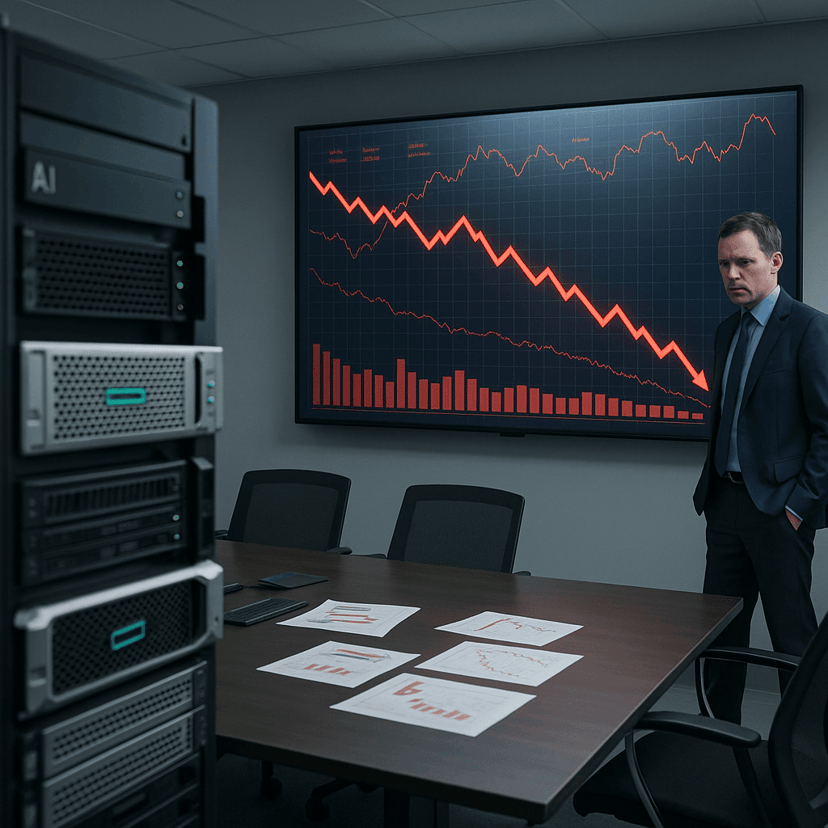
Nvidia delivered another earnings beat with revenue surging 56% to $46.74 billion, but investors are fixated on the bigger question: can the chip giant unlock a $50 billion China opportunity that remains tangled in geopolitical uncertainty? CEO Jensen Huang's projection of $4 trillion in AI infrastructure spending by 2030 signals the market is just getting started.
Nvidia just proved the AI gold rush is far from over, but the company's biggest growth catalyst might be locked behind geopolitical barriers. The chip giant's Q2 results delivered exactly what Wall Street expected and then some—revenue surging 56% to $46.74 billion while adjusted earnings per share hit $1.05, topping analyst estimates of $1.01 according to LSEG data.
Yet investors barely blinked at the beat. Instead, all eyes turned to CEO Jensen Huang's bombshell projection during the earnings call: AI infrastructure spending will balloon from today's $600 billion annually to between $3 trillion and $4 trillion by decade's end. "As the AI revolution went into full steam, as the AI race is now on, the capex spend has doubled to $600 billion per year," Huang told analysts Wednesday. "The opportunity ahead is immense."
[Embedded image of Jensen Huang presenting earnings data]
That massive spending forecast comes as Nvidia navigates its most complex geopolitical challenge yet. The company's China business—potentially worth $50 billion and growing 50% annually according to Huang—remains in limbo following the Trump administration's April decision to block sales of Nvidia's China-specific H20 chip. The August deal between Huang and President Trump to restart China sales by giving the government 15% of regional revenue hasn't been finalized, leaving a massive question mark over next quarter's numbers.
"There was more noise around this quarter and the guidance and what's implied than I can remember ever on an Nvidia quarter, let alone on any other megacap tech company," Deepwater Management's Gene Munster told CNBC. "Of course, a lot of that noise is related to all the mechanics around China."
The China uncertainty explains why Nvidia's stock fluctuated despite solid fundamentals. Data center revenue of $41.1 billion fell short of estimates for the second straight quarter, though it still grew 56% year-over-year. More concerning for growth bulls: the segment's sequential growth slowed to 5% versus 10% in the prior quarter, suggesting the breakneck expansion pace might be moderating.
[Video iframe showing Nvidia's data center growth trajectory]
But Huang's long-term vision paints a different picture. His $3-4 trillion infrastructure spending projection assumes AI buildout is still in early innings, with current investments representing only "the top four hyperscalers." That massive capex wave would need to flow through somewhere—and Nvidia has captured the lion's share of AI chip spending over the past three years.
Analysts remain bullish despite the crosscurrents. "We believe Nvidia's results are consistent with its previous objectives and are in no way indicative of a slowdown in industry-wide AI interest or investments," Benchmark analysts wrote Thursday, maintaining their buy rating. JPMorgan analysts echoed that sentiment, noting the results show "the playbook remains the same" with "multiple levers at play to drive upside."
The wild card remains China. Nvidia management said the company could ship between $2 billion and $5 billion in H20 revenue during Q3 "if the geopolitical environment permits." That's not included in the company's $54 billion revenue guidance for next quarter (plus or minus 2%), which already beats analyst expectations of $53.1 billion according to LSEG.
Huang hinted at even bigger possibilities, telling analysts there's a "real possibility" Nvidia can sell its advanced Blackwell processor in China. That would represent a significant upgrade from the H20 chip specifically designed for Chinese regulatory requirements, potentially unlocking even more of that $50 billion market opportunity.
The broader AI infrastructure thesis gets validation from Nvidia's customer base. While data center growth moderated sequentially, the 56% year-over-year expansion shows enterprise and cloud providers are still in heavy investment mode. Huang's timeline suggests this spending cycle has years left to run, with five years remaining until his 2030 projection deadline.
Nvidia's Q2 results showcase a company hitting its operational stride while navigating unprecedented geopolitical complexity. The core AI infrastructure story remains intact—Huang's $4 trillion spending projection suggests the current boom has years left to run. But the China wildcard could either supercharge growth or remain a perpetual question mark. With $54 billion in guidance that excludes any Chinese sales, investors have a clear baseline with massive upside potential if trade tensions ease. The AI revolution is indeed at "full steam," but Nvidia's biggest growth engine might still be stuck at the starting gate.