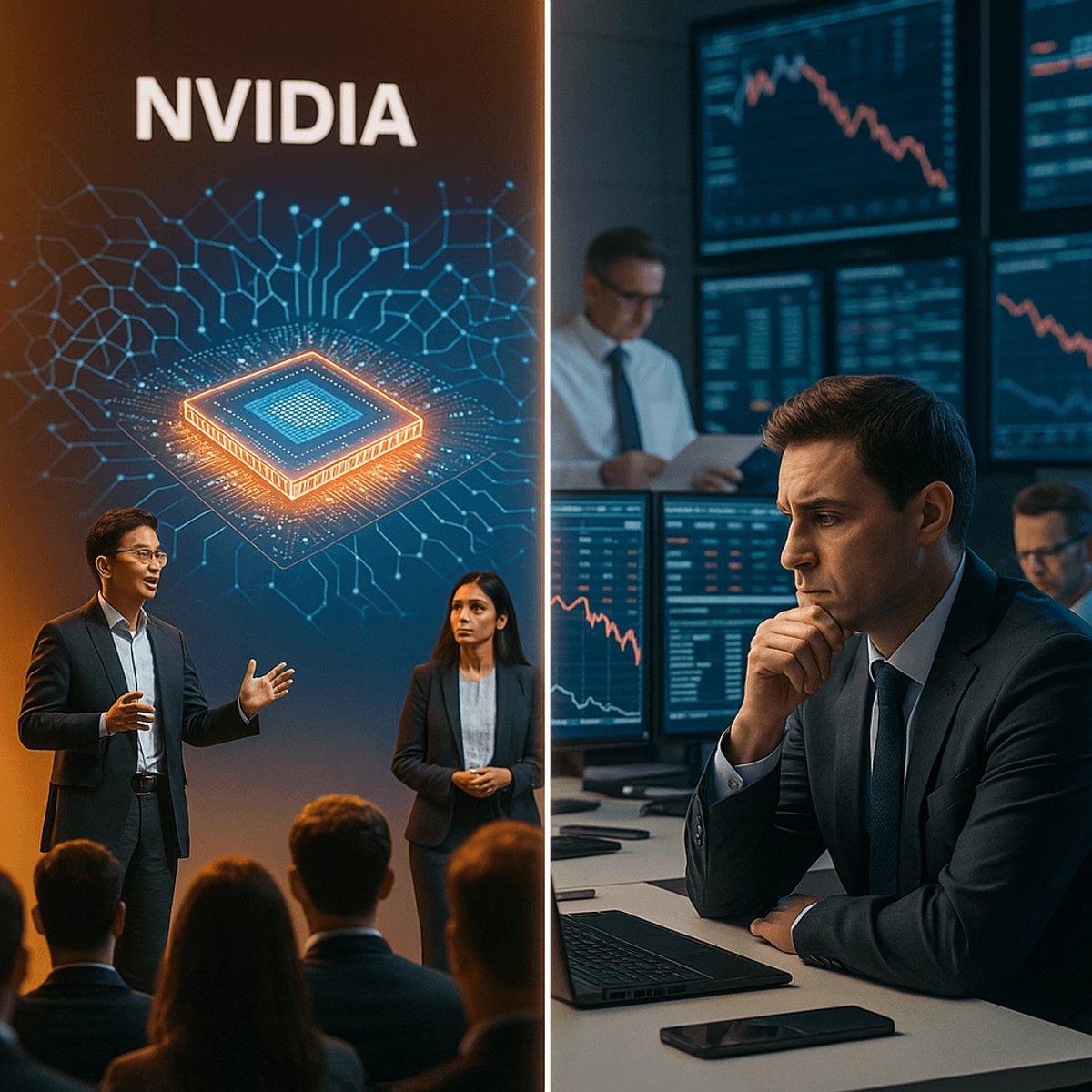
Nvidia's latest GTC conference just exposed a widening gap between industry optimism and investor anxiety. While the chipmaker showcased its latest AI innovations to thousands of attendees, Wall Street analysts walked away unconvinced, raising fresh questions about whether the AI boom has peaked. The disconnect reveals a growing tension: those building AI infrastructure remain bullish, but those funding it are starting to hedge their bets amid mounting concerns about an AI bubble.
Nvidia just wrapped its highly anticipated GTC conference, but the reception from Wall Street tells a story the company probably didn't want to hear. Despite a showcase packed with cutting-edge AI chips and partnerships, financial analysts left the event more worried than reassured about the sector's sustainability.
The timing couldn't be more critical. Nvidia has become the poster child for the AI revolution, with its market cap swelling to unprecedented levels as companies race to build AI infrastructure. But that meteoric rise has also made it ground zero for bubble concerns. When the company gathers thousands of developers, executives, and journalists for its annual showcase, investors watch every signal for signs of overheating.
This year's conference highlighted that gap in stark terms. While attendees inside the event halls buzzed with excitement about new chip architectures and AI capabilities, traders and analysts on the outside remained unconvinced that the growth trajectory can continue at its current pace. The skepticism isn't about Nvidia's technology - few doubt the company's engineering prowess - but rather about whether customer demand can justify the valuations.
The industry participants at GTC told a different story entirely. Developers, enterprise buyers, and AI researchers showed little concern about bubble talk, instead focusing on practical deployment challenges and the next wave of AI applications. Their confidence stems from direct experience: they're seeing real workloads, real revenue opportunities, and real technical problems that still need solving with more powerful hardware.
But Wall Street operates on different metrics. Investors are looking at capital expenditure cycles, return on AI investments, and signs that the current spending spree might slow. The disconnect between what Nvidia showed at GTC and what analysts wanted to hear speaks to a fundamental question facing the entire AI sector: is this sustainable growth or euphoric speculation?
The conference featured the usual parade of announcements - new chip designs, software partnerships, customer testimonials. Yet none of it seemed to address the core worry keeping institutional investors up at night. When companies like Microsoft, Google, and Meta are spending tens of billions on AI infrastructure, the market wants proof that those investments will generate returns, not just impressive demos.
What's particularly telling is that this skepticism is emerging even as Nvidia continues to post extraordinary revenue growth. The company's chips remain the gold standard for AI training and inference, with competitors still struggling to match its ecosystem advantages. Yet investors are increasingly asking what happens when the current buildout phase ends and the market shifts to proving ROI.
The GTC conference also revealed how Nvidia is trying to expand beyond just selling chips. The company showcased software platforms, AI services, and developer tools - all attempts to create recurring revenue streams and deeper customer lock-in. But these initiatives take years to mature, and Wall Street is focused on nearer-term concerns about market saturation.
Industry insiders at the event pushed back against bubble narratives, pointing to enterprise AI adoption that's still in early innings. They argue that current spending is building foundational infrastructure for decades of AI applications, similar to how cloud computing required massive upfront investment before showing its full potential. The question is whether public markets have the patience to wait for that vision to materialize.
The split between conference attendees and market analysts also reflects different risk tolerances. Engineers and product teams are paid to imagine what's possible and build toward it. Investors are paid to price in probability and downside scenarios. Right now, those two perspectives are diverging sharply when it comes to AI infrastructure spending.
The disconnect between Nvidia's GTC conference enthusiasm and Wall Street's muted response captures the AI sector's defining tension right now. Industry builders remain convinced they're constructing essential infrastructure for the next computing era, while financial markets are increasingly nervous about valuations and sustainability. This gap matters because it could affect how much capital flows into AI development over the next year. If investor skepticism hardens into broader market concern, even companies with strong fundamentals like Nvidia could face headwinds that slow the pace of AI innovation. The next few quarters will reveal whether the industry's optimism or Wall Street's caution proves more prescient.