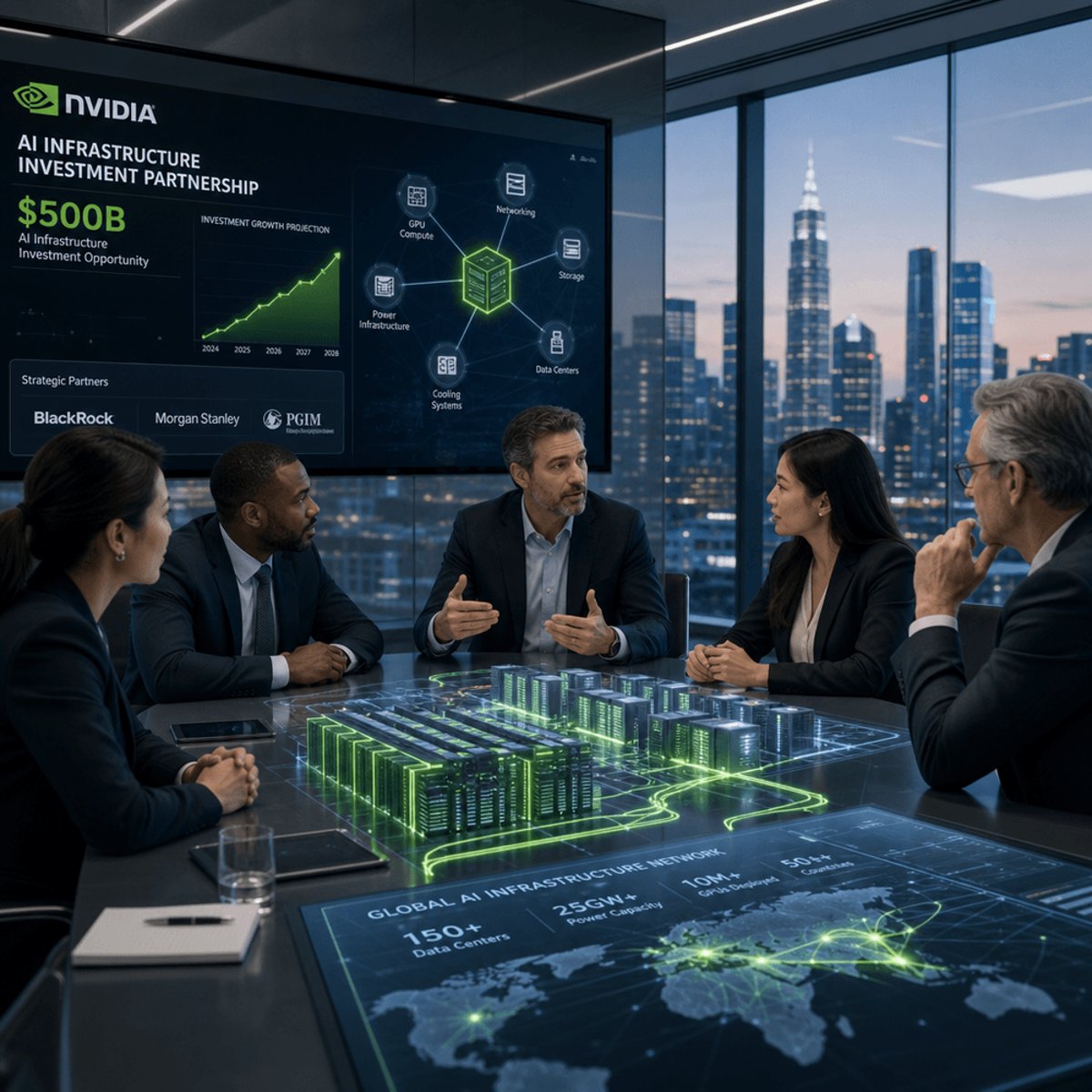
NVIDIA just redefined how AI infrastructure gets built. The chipmaker announced partnerships with six Wall Street giants—Apollo, BlackRock, Blackstone, Brookfield, Goldman Sachs, and KKR—to mobilize over $500 billion in third-party capital for AI factory buildouts. In a move that blurs the lines between tech infrastructure and institutional finance, NVIDIA is essentially creating a new investable asset class around compute power itself.
NVIDIA just convinced Wall Street that AI compute is the new real estate. CEO Jensen Huang announced that the company has forged partnerships with six institutional investment powerhouses to create what he's calling an entirely new asset class around AI infrastructure. The scale is staggering—over $500 billion in third-party capital earmarked for building out AI factories.
The partnership roster reads like a who's who of global finance. BlackRock, the world's largest asset manager with $10 trillion under management, is joining forces with private equity titans Apollo, Blackstone, and KKR, alongside alternative investment giant Brookfield and investment banking heavyweight Goldman Sachs. Together, they're establishing independent financing platforms designed to fund the physical infrastructure backbone of the AI revolution.
"We have moved from an era in which companies build their own data centers to one where AI compute infrastructure becomes an investable asset," Huang wrote in NVIDIA's official blog announcement. It's a fundamental shift in how AI scaling gets financed, moving massive capital expenditures off corporate balance sheets and into the portfolios of institutional investors.
The timing couldn't be more strategic. As AI demand explodes and companies race to secure compute capacity, the traditional model of enterprise capex is buckling under the weight. Building state-of-the-art AI data centers requires billions in upfront investment, specialized infrastructure, and years of planning. NVIDIA's solution is to essentially securitize that compute capacity, letting institutional money flood into what was previously corporate infrastructure spending.
This isn't just about NVIDIA selling more chips, though that's certainly part of the equation. The company is positioning itself as the architect of an entirely new financial instrument. Think of it like how cell towers became an asset class in the 2000s, or how cloud infrastructure spawned dedicated REITs. NVIDIA is applying that playbook to GPU clusters and AI factories.
For the institutional investors, the appeal is clear. They get exposure to what many view as the most transformative technology shift since the internet, with hard assets backing their investments. AI compute has predictable, contracted revenue streams from enterprise customers desperate for capacity. It's infrastructure with software-era growth rates.
The $500 billion figure represents capital mobilization "over time," not immediate deployment. But the scale signals just how massive the AI infrastructure buildout is expected to be. For context, the entire global data center construction market was valued at around $200 billion annually before this announcement. NVIDIA and its financial partners are essentially creating a parallel financing ecosystem just for AI-specific infrastructure.
What makes this particularly shrewd is how NVIDIA maintains its position as the critical supplier regardless of who owns the infrastructure. Whether companies build their own AI factories or lease capacity from these new financing platforms, they're still buying NVIDIA GPUs. The company gets to expand its total addressable market while de-risking customer concentration.
The competitive implications ripple across the tech landscape. Microsoft, Amazon, and Google have been spending tens of billions on their own AI infrastructure. Now they face a new category of well-capitalized competitors backed by Wall Street's deepest pockets. Independent AI infrastructure providers could emerge as serious alternatives to hyperscaler cloud platforms.
For startups and mid-sized enterprises, this could democratize access to cutting-edge AI compute. Instead of negotiating with cloud giants or raising massive rounds to build proprietary infrastructure, they could potentially lease capacity from these institutional-backed AI factories. It's the difference between buying a building and signing a lease, applied to compute power.
The announcement also signals institutional finance's wholehearted embrace of AI as a fundamental infrastructure layer rather than a speculative technology trend. When BlackRock and Brookfield commit capital at this scale, they're making decade-long bets on AI compute demand. Their due diligence teams have clearly concluded this isn't a bubble but a secular shift in how computing gets provisioned.
There are still major questions. How will these financing platforms structure ownership and returns? What happens if AI demand doesn't materialize at projected rates? How will they navigate the geopolitical complexities of AI infrastructure, especially given chip export restrictions and national security concerns? NVIDIA's announcement is long on vision but short on operational details.
What's undeniable is that this represents a watershed moment for the AI industry. NVIDIA has successfully convinced the world's largest institutional investors that AI compute infrastructure deserves to sit alongside airports, power plants, and telecommunications networks as a core asset class. That's not just a financing innovation, it's a fundamental reframing of AI's role in the global economy.
NVIDIA's $500 billion financing platform fundamentally changes who pays for AI infrastructure and how it gets built. By bringing institutional capital into what was previously corporate capex, the company is simultaneously expanding its addressable market, de-risking customer concentration, and creating an entirely new asset class. For the AI industry, this means more infrastructure capacity built faster. For institutional investors, it means exposure to AI's growth with hard asset backing. And for NVIDIA, it cements the company's position not just as a chip supplier but as the architect of AI's financial infrastructure. The question now isn't whether AI compute becomes an investable asset class, but how quickly capital flows in and who captures the returns.