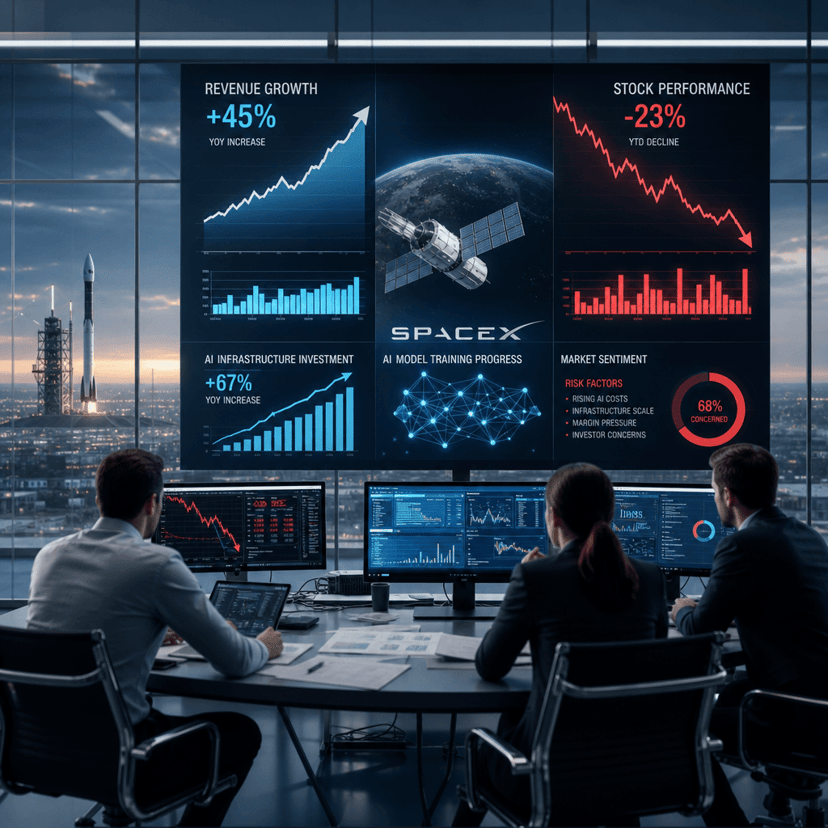
SpaceX shares plunged 9% in Wednesday trading as investors recoiled from the company's aggressive AI spending surge, even as CEO Elon Musk doubled down with an accelerated timeline to hit $1 trillion in annual revenue. The sharp selloff marks a rare moment of skepticism toward Musk's ambitions, with Wall Street questioning whether the company's AI infrastructure buildout will pay off before it drains cash reserves. It's a familiar tension playing out across tech - the race to dominate AI is expensive, and SpaceX just became the latest bellwether to feel the heat.
SpaceX just hit turbulence. The rocket maker's shares nosedived 9% in Wednesday's session after the company disclosed a major ramp-up in AI-related capital expenditures that caught investors off guard, according to CNBC. It's a striking reversal for a company that's been Wall Street's darling in the private markets, and it underscores how quickly sentiment can shift when AI spending enters the picture.
The selloff came despite CEO Elon Musk's attempt to rally confidence with an updated revenue forecast. During the earnings discussion, Musk said SpaceX would reach $1 trillion in annual revenue by 2030, pulling forward the timeline from a previous 2031 projection. That's an audacious claim for a company whose current revenue sits in the tens of billions, but Musk has never been one to shy from bold predictions. The problem is, investors aren't buying the optimism this time.
What spooked the market wasn't the ambition - it was the price tag. SpaceX is pouring capital into AI infrastructure at a pace that raised red flags among analysts who've watched similar spending sprees derail growth trajectories at other tech firms. The exact figures remain undisclosed since SpaceX is privately held, but sources familiar with the earnings call suggested the AI investments represent a material acceleration from prior quarters. That's money flowing into data centers, compute clusters, and machine learning systems designed to optimize everything from Starlink satellite operations to Starship manufacturing.
The irony isn't lost on observers. Musk has simultaneously been driving AI development at Tesla with the company's Full Self-Driving program and at his newer venture, xAI, which is building large language models to compete with OpenAI. Now SpaceX is joining the AI arms race, creating a three-front capital battle that's stretching even Musk's financial bandwidth. Some analysts wonder if the SpaceX spending is partly driven by synergies with xAI, though neither company has confirmed integration plans.
Wall Street's reaction reflects a broader anxiety rippling through tech investing right now. AI infrastructure costs are ballooning across the industry - Microsoft and Google have each committed tens of billions to data center buildouts, while Amazon is racing to keep pace. But those are public giants with diversified revenue streams. SpaceX, for all its success, is still heavily dependent on launch contracts and Starlink subscriptions. Adding a massive AI spending line raises legitimate questions about cash flow sustainability.
The 9% single-day drop is significant for a private company whose shares trade on secondary markets. It suggests institutional holders are reassessing risk premiums, especially given the compressed timeline Musk laid out for hitting that trillion-dollar revenue milestone. To get there in four years would require roughly 40% compound annual growth - achievable if Starlink scales globally and Starship becomes the workhorse Musk envisions, but far from guaranteed.
What makes this moment particularly telling is the timing. We're seeing a shift in how investors value AI spending. A year ago, any mention of AI investments sent stocks soaring. Now, the market is demanding proof of returns. Meta faced similar skepticism last quarter when it disclosed higher-than-expected infrastructure costs, though it managed to calm nerves with strong ad revenue. SpaceX doesn't have that luxury of immediate monetization - its AI bets are longer-term plays that may not surface in financials for years.
Musk's accelerated revenue target could be an attempt to reframe the narrative. By moving the goalpost forward, he's signaling confidence that the AI investments will unlock new revenue streams faster than anticipated. Perhaps that means AI-optimized satellite manufacturing that cuts costs, or autonomous systems that reduce operational overhead at scale. But without detailed disclosures, investors are left to trust the vision rather than scrutinize the numbers.
The selloff also highlights a growing divide between how public and private tech companies are being evaluated. Public market investors have become more skeptical of open-ended AI spending without clear ROI timelines, while private markets have traditionally given visionary founders more rope. SpaceX's stock reaction suggests that patience is wearing thin even in private markets, especially when valuations have climbed as high as they have for Musk's rocket company.
SpaceX's 9% drop is more than just a bad trading day - it's a warning shot about the limits of AI spending enthusiasm. Musk's moved-up revenue target shows he's still betting big, but the market's response makes clear that investors want results, not just roadmaps. The next few quarters will reveal whether SpaceX's AI infrastructure gamble unlocks the operational efficiencies needed to justify the spend, or whether it becomes a cautionary tale about overextension. For now, Wall Street is watching with skepticism, and that's a shift Musk will need to address if he wants to keep capital flowing into his most ambitious ventures.