Nvidia just dropped a bombshell on its biggest customers. The AI chip giant has quietly warned major buyers that prices for servers packed with its GPUs could surge more than 15%, according to Bloomberg News. The move signals mounting cost pressures in the AI infrastructure boom and could ripple across the entire enterprise AI landscape, hitting everyone from Microsoft and Amazon to startups racing to scale their models.
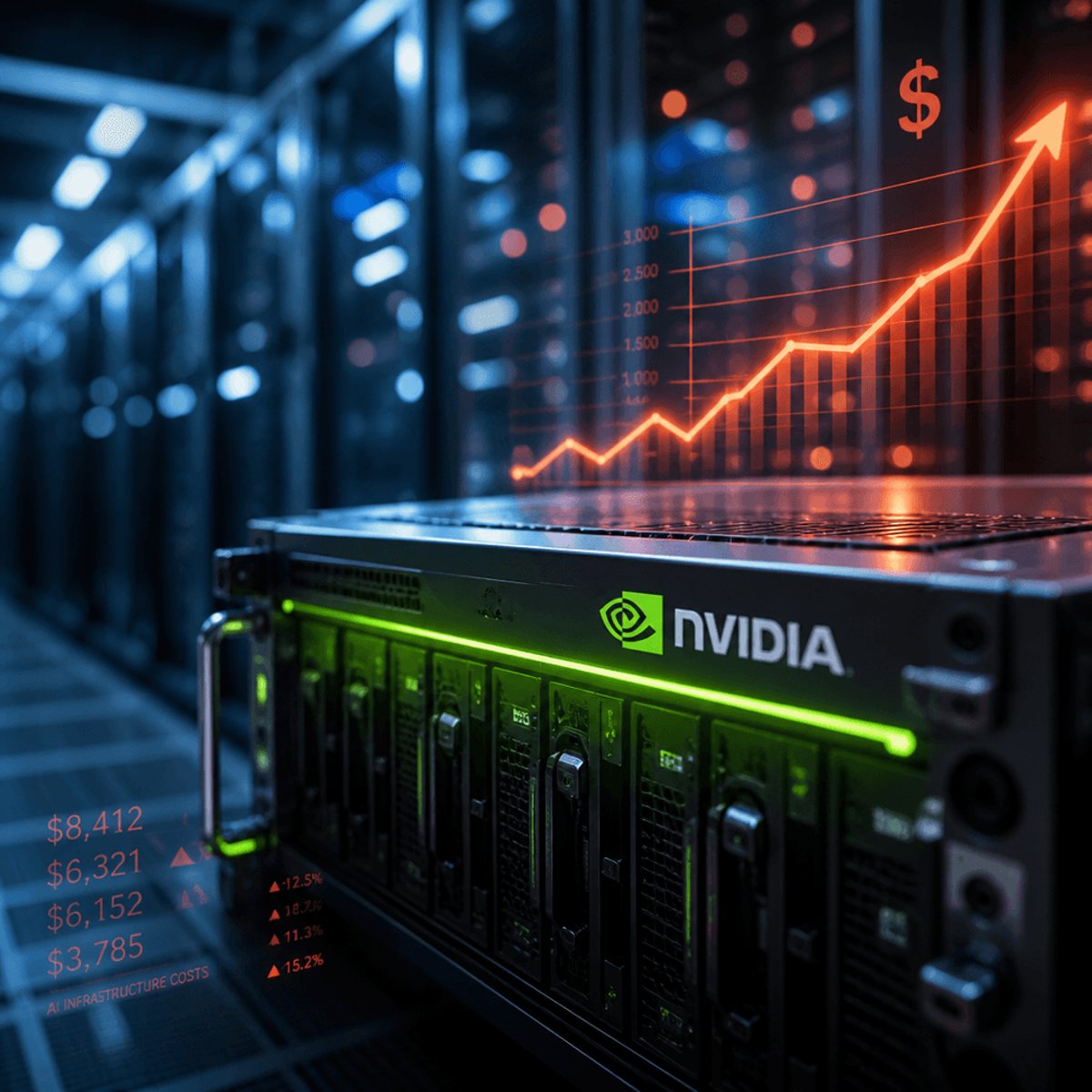
Nvidia is preparing its biggest customers for sticker shock. The chipmaker has notified some of its largest clients that AI server prices could climb more than 15%, Bloomberg News reports, marking a significant cost increase for companies already spending billions on AI infrastructure.
The timing couldn't be more critical. Major tech companies are locked in an arms race to build out AI capabilities, with Microsoft, Amazon, and Google each pledging tens of billions in data center investments. These hyperscalers rely heavily on Nvidia's H100 and upcoming Blackwell chips to power everything from large language models to recommendation systems. A 15% price bump translates to hundreds of millions in additional costs for the biggest buyers.
Nvidia dominates the AI chip market with an estimated 80% share, giving it substantial pricing power. The company's GPUs have become the de facto standard for training and running AI models, creating a supply-constrained environment where customers often wait months for chip allocations. That scarcity has allowed Nvidia to maintain premium pricing even as competitors like AMD and custom chip efforts from hyperscalers try to chip away at its dominance.
The price increase affects complete server systems containing Nvidia's AI accelerators, not just the chips themselves. These systems typically include multiple GPUs, specialized networking gear, and cooling infrastructure designed to handle the intense computational loads of AI workloads. A single high-end AI server can cost upwards of $250,000, meaning a 15% hike adds roughly $37,500 per unit.
For enterprise buyers, the math gets ugly fast. Companies building private AI infrastructure or securing capacity through cloud providers will face steeper bills. Startups that have raised funding based on specific AI infrastructure budgets may need to rethink their scaling plans or seek additional capital. The ripple effects could slow AI adoption among smaller players who can't absorb the added expense.
Nvidia's move comes as the company continues to post record financial results driven by insatiable AI demand. The chipmaker has consistently beaten Wall Street expectations, with data center revenue growing triple digits year-over-year in recent quarters. But supply chain pressures, including advanced packaging constraints at partners like TSMC, have kept production tight relative to demand.
The price hike also reflects broader economic pressures. Component costs, manufacturing expenses, and logistics have all crept higher, squeezing margins across the hardware industry. Nvidia appears to be passing some of those costs along to customers rather than absorbing them, betting that demand remains strong enough to sustain higher prices.
Competitors are watching closely. AMD has positioned its MI300 series as a more cost-effective alternative to Nvidia's offerings, though it still lags in software ecosystem maturity and market adoption. Cloud providers like Amazon Web Services with custom Trainium and Inferentia chips may find their internal alternatives more attractive if Nvidia pricing continues climbing.
The increase could also accelerate efforts to optimize AI workloads and improve efficiency. Companies may invest more heavily in model compression, quantization techniques, and inference optimization to squeeze more performance from existing hardware rather than buying additional capacity at inflated prices. That shift could benefit software startups focused on AI efficiency tools.
What remains unclear is whether Nvidia will implement these increases uniformly or use tiered pricing based on order volumes and customer relationships. The company has historically offered preferential terms to its biggest buyers, and hyperscalers with massive recurring orders likely have more negotiating leverage than smaller enterprise customers.
The warning also raises questions about Nvidia's competitive positioning as alternatives mature. While the company maintains a commanding lead today, sustained price increases could motivate customers to diversify their AI infrastructure investments and reduce dependence on a single supplier. That dynamic played out in previous tech cycles where dominant suppliers eventually faced margin pressure from determined competitors.
For now, though, Nvidia holds most of the cards. Customers need its chips to remain competitive in AI, and viable alternatives remain limited. The 15% price increase is a test of just how far that leverage extends and whether the AI infrastructure boom can absorb higher costs without flinching.
Nvidia's 15% price warning marks a pivotal moment in the AI infrastructure buildout. For hyperscalers and enterprises alike, the calculus just got more complicated - pay up to secure critical GPU capacity or bet on alternatives that aren't quite ready for prime time. The move underscores Nvidia's market power but also its vulnerability to customer frustration and competitive pressure. As AI budgets balloon and CFOs scrutinize every dollar, this price hike could be the catalyst that finally pushes more buyers to diversify beyond Nvidia's ecosystem. The question isn't whether competitors will seize the opportunity, but whether they can deliver alternatives fast enough to matter.