OpenAI just shattered the cloud computing landscape with a $38 billion, seven-year deal that gives it access to hundreds of thousands of Nvidia GPUs through Amazon Web Services. The massive partnership signals the end of Microsoft's exclusive grip on the AI giant's infrastructure, marking a pivotal shift in how the world's most valuable AI company powers its models.
OpenAI just rewrote the rules of AI infrastructure with a deal that sends shockwaves through the entire cloud computing industry. The $38 billion, seven-year partnership with Amazon Web Services doesn't just give the ChatGPT maker access to "hundreds of thousands" of Nvidia GPUs - it officially ends Microsoft's stranglehold on OpenAI's computing power.
The timing couldn't be more dramatic. Just last week, OpenAI completed its for-profit restructuring, a move that fundamentally changed its relationship with Microsoft. Under the new arrangement, Microsoft loses its exclusive cloud provider status and its first right of refusal to host OpenAI's AI workloads - privileges it's held since its initial investment.
"All capacity targeted to be deployed before the end of 2026, and the ability to expand further into 2027 and beyond," according to Amazon's press release. OpenAI will start using AWS compute "immediately," marking the most significant shift in AI infrastructure since the field's inception.
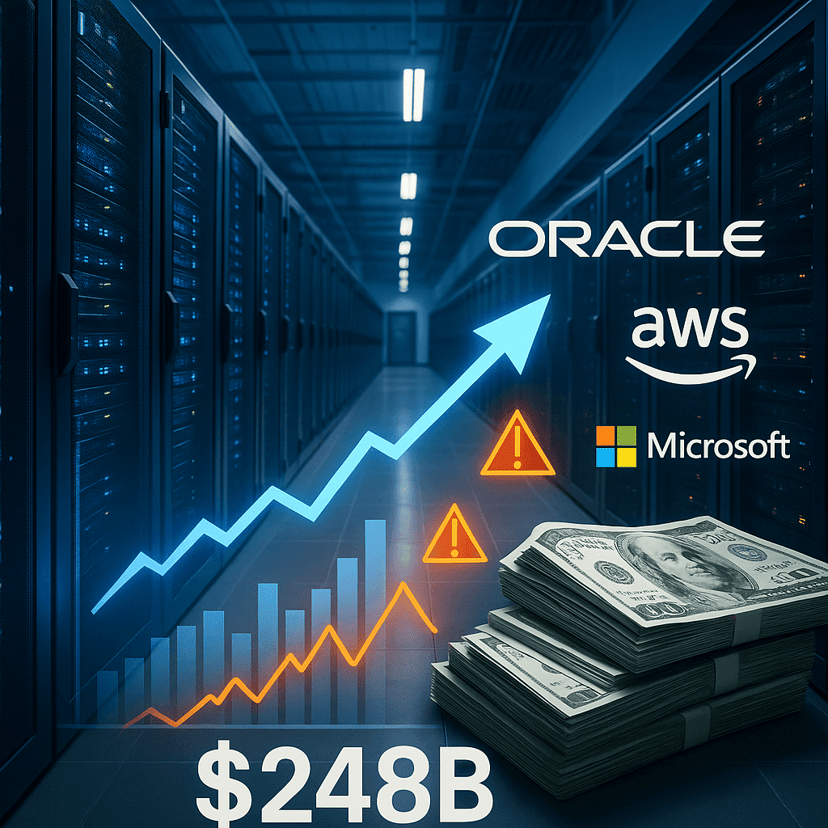
But here's where the numbers get truly staggering. While the $38 billion AWS deal makes headlines, it's actually dwarfed by OpenAI's other commitments. The company maintains a $250 billion contract with Microsoft's Azure services and has a reported $300 billion deal with Oracle. Combined, these partnerships represent nearly $600 billion in cloud computing commitments - a sum that underscores just how expensive training cutting-edge AI models has become.
The strategic implications ripple far beyond OpenAI's balance sheet. Amazon has been aggressively courting AI companies while simultaneously pouring billions into Anthropic, OpenAI's primary competitor. This dual approach - backing both sides of the AI race while providing infrastructure to all players - positions AWS as the Switzerland of artificial intelligence.
For Microsoft, losing exclusivity stings, but the company isn't walking away empty-handed. The $250 billion Azure commitment ensures Microsoft remains OpenAI's largest cloud partner by dollar volume. However, the symbolic loss of exclusivity signals a maturing relationship where OpenAI no longer needs to rely on a single benefactor.
Industry insiders see this as OpenAI hedging against the massive computational demands of future AI models. Training GPT-5 or whatever comes next will require unprecedented amounts of computing power, and no single cloud provider - not even Microsoft - has infinite capacity. By spreading workloads across AWS, Azure, and Oracle, OpenAI ensures it won't hit infrastructure bottlenecks during critical training runs.
The deal also reveals how quickly the AI infrastructure game is evolving. Just two years ago, OpenAI was entirely dependent on Microsoft's Azure. Today, it's orchestrating a multi-cloud strategy worth more than half a trillion dollars. This shift reflects both OpenAI's growing bargaining power and the cloud providers' desperate race to capture AI workloads.
What makes this particularly fascinating is the timing alongside OpenAI's corporate restructuring. The company's transition to a for-profit entity gives it newfound flexibility to negotiate with multiple partners simultaneously. No longer bound by the constraints of its nonprofit origins, OpenAI can play cloud providers against each other to secure better terms and redundancy.
The Nvidia angle can't be ignored either. Access to "hundreds of thousands" of GPUs through AWS represents a massive chunk of global AI compute capacity. In a market where Nvidia chips are more precious than gold, securing guaranteed access through 2027 provides OpenAI with a crucial competitive advantage.
For the broader AI industry, this deal sets a new template. Expect other major AI companies to follow OpenAI's lead in diversifying their infrastructure partnerships. The days of putting all your computational eggs in one cloud basket are officially over.
OpenAI's $38 billion AWS partnership marks more than just another big tech deal - it signals the maturation of the AI industry's infrastructure layer. By breaking free from Microsoft's exclusive grip and orchestrating a multi-cloud strategy worth nearly $600 billion, OpenAI is future-proofing itself against the astronomical computational demands ahead. This move will likely spark a wave of similar diversification strategies across the AI landscape, as companies realize that in the race to artificial general intelligence, betting on a single cloud provider is a luxury they can no longer afford.