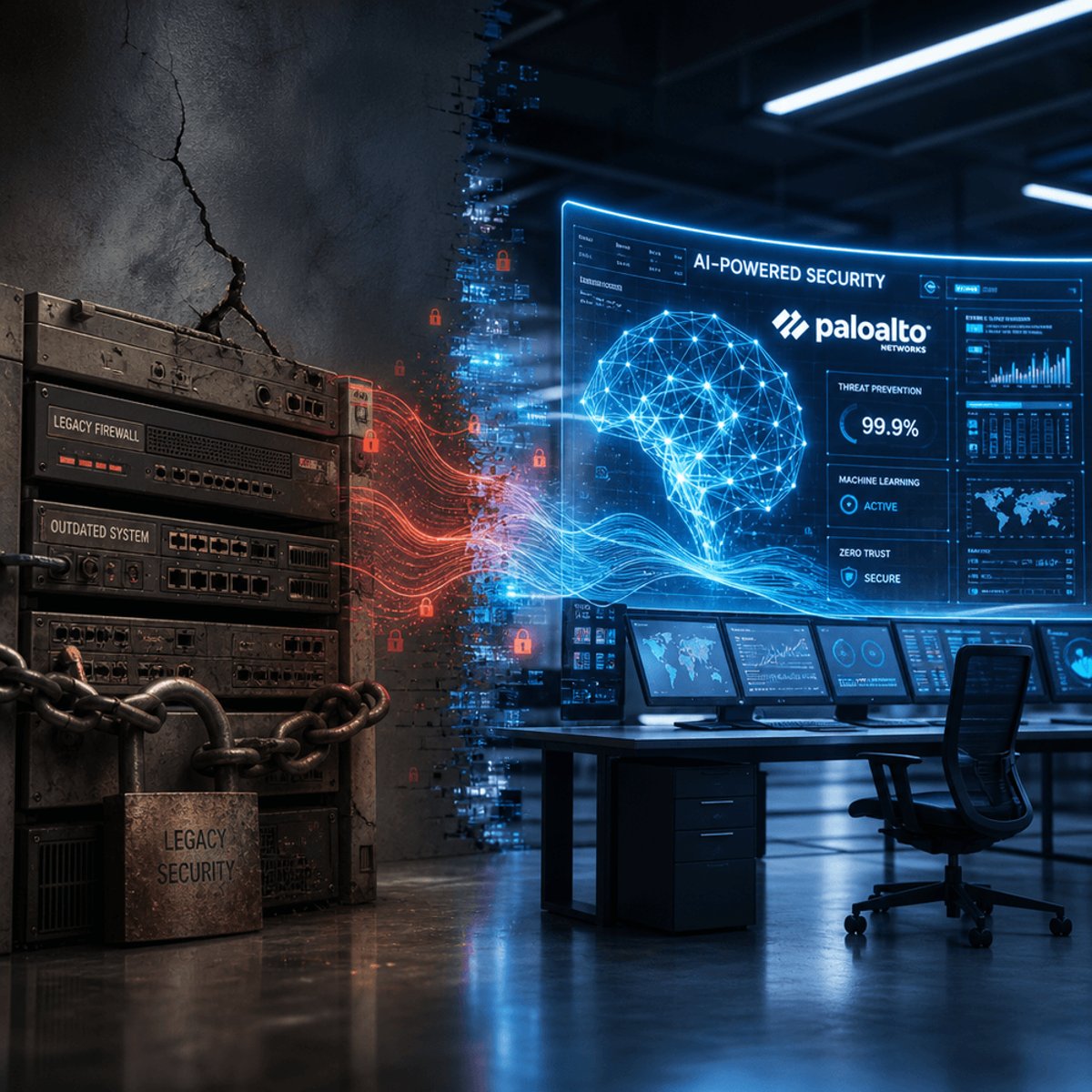
Palo Alto Networks CEO Nikesh Arora just put a staggering number on the industry's AI problem: roughly $1 trillion worth of cybersecurity infrastructure sitting inside enterprises today simply wasn't built to withstand AI-powered attacks. The comments, reported by CNBC, land as security teams everywhere scramble to figure out whether their decades-old defenses can survive a new generation of automated, machine-driven threats.
Nikesh Arora, the CEO of Palo Alto Networks, just dropped a number that's likely to keep a lot of CISOs up at night. Speaking about the state of enterprise defenses, Arora said AI is forcing companies to confront roughly $1 trillion worth of cybersecurity infrastructure that simply isn't equipped to handle modern, AI-powered attacks, according to CNBC. That's not a typo. Trillion, with a T.
The claim cuts right to the center of a debate that's been simmering across the security industry for a couple of years now: is the stuff protecting corporate networks actually ready for a world where attackers themselves are using AI to probe, adapt, and strike faster than human analysts can respond? Arora's answer, at least implicitly, is no. And if he's right, that trillion-dollar figure represents an enormous wave of spending that's about to hit the enterprise software market.
It's worth remembering why Arora's voice carries weight here. Since taking over Palo Alto Networks, he's turned the company into one of the largest pure-play cybersecurity vendors on the planet, pushing an aggressive strategy of acquisitions and platform consolidation that's reshaped how enterprises buy security tools. The company has spent years arguing that fragmented, bolt-on security stacks, the kind most large organizations still run, are fundamentally weaker than integrated, AI-native platforms. This latest comment fits neatly into that narrative, whether or not that's a coincidence.
The timing also isn't random. Enterprise security teams have spent the better part of two years watching AI reshape the threat landscape on both sides of the fight. Attackers are increasingly using large language models to write more convincing phishing emails, automate reconnaissance, and even generate malware variants faster than signature-based defenses can catch them. Meanwhile, most of the infrastructure defending against those attacks, firewalls, legacy endpoint tools, on-prem appliances, was designed for a much slower, more predictable threat environment. That mismatch is exactly what Arora appears to be pointing at.
For competitors, this is both an opportunity and a warning shot. Companies like CrowdStrike, Microsoft, and Fortinet have all been racing to bolt AI capabilities onto their own platforms, framing it as the next must-have feature rather than a nice-to-add extra. If Arora's trillion-dollar estimate holds up, it suggests the total addressable market for AI-native security replacements is bigger than most analysts have been modeling, and every major vendor is going to want a slice of that modernization spend.
There's a broader pattern here too, one that echoes what's happened across other corners of enterprise tech over the past few years. Cloud migration forced a similar reckoning a decade ago, when companies realized on-prem systems couldn't keep pace with distributed, always-on business operations. AI looks like it's triggering a comparable shift in security, except the stakes are arguably higher because the downside of falling behind isn't just inefficiency, it's breaches, ransomware, and data theft that can take down entire businesses overnight.
What happens next probably depends on how fast enterprises actually move. Big infrastructure overhauls tend to happen in fits and starts, budget cycles, board approvals, vendor evaluations all take time, even when the threat is urgent. But Arora's comments put a very public number on the problem, and numbers like that have a way of forcing boardroom conversations that might otherwise get pushed to next year. Expect rival CEOs to start throwing around their own estimates soon, and expect the AI security pitch to get a lot louder across earnings calls this quarter.
Whether or not the exact trillion-dollar figure holds up to scrutiny, Arora's comments capture something real: enterprise security is entering another one of those uncomfortable transition periods where old infrastructure suddenly looks dangerously outdated. For IT and security leaders, it's a nudge to start auditing just how AI-ready their defenses actually are. For investors and rivals watching Palo Alto Networks, it's a preview of the pitch that's likely to dominate security sales conversations for the next few years.