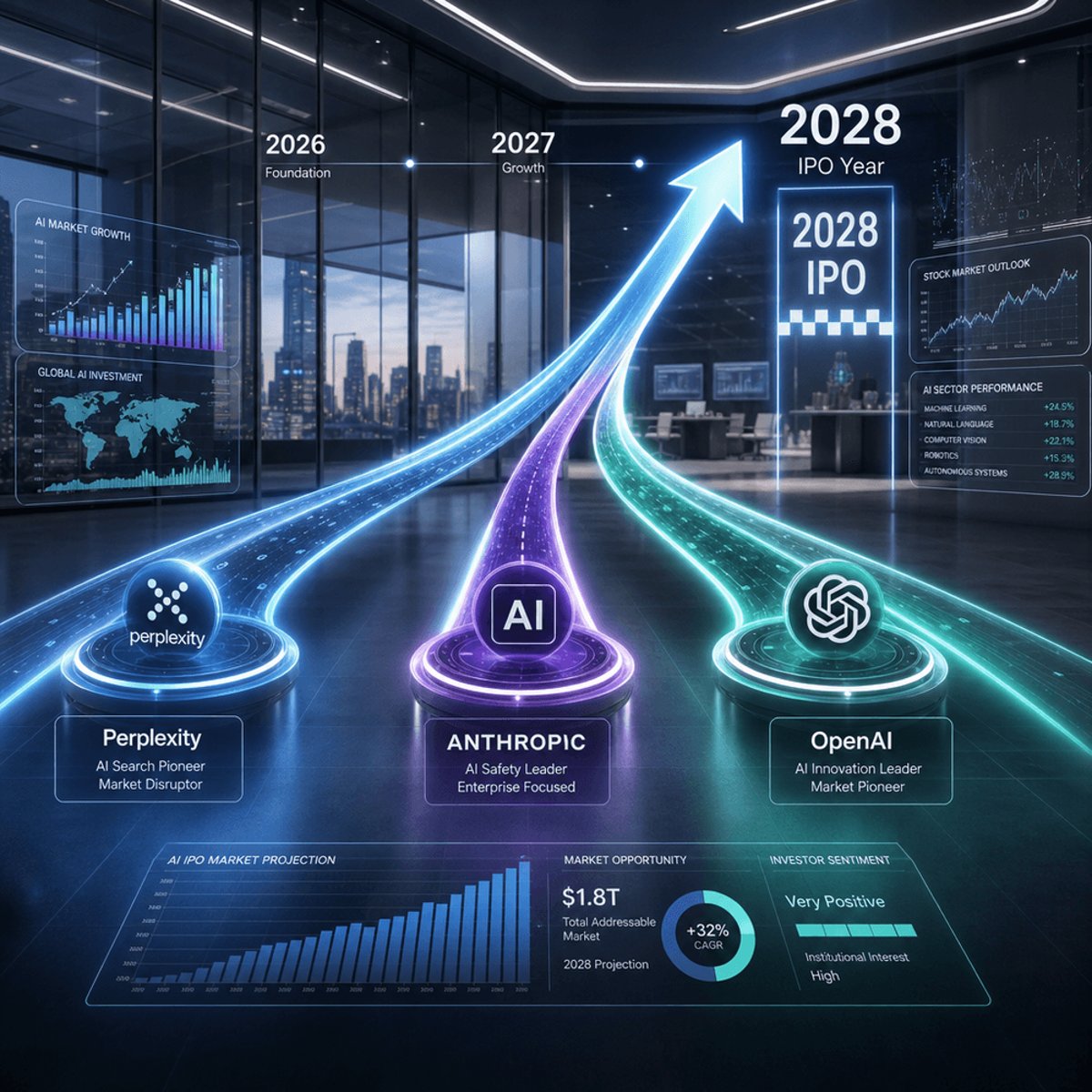
Perplexity is planting its flag in the AI IPO calendar. CEO Aravind Srinivas told CNBC the AI search startup plans to go public in 2028 - regardless of what competitors Anthropic or OpenAI do first. The declaration comes as Anthropic confidentially filed to go public, kicking off what could be the biggest wave of AI IPOs since the generative AI boom started. Srinivas' commitment signals confidence that Perplexity can build a standalone public company even as bigger rivals test the waters.
Perplexity just drew a line in the sand. CEO Aravind Srinivas told CNBC that his AI-powered search startup will go public in 2028, full stop - no matter what Anthropic or OpenAI do between now and then. It's a bold statement from a company trying to carve out its own lane while the AI giants dominate headlines.
The timing isn't accidental. Anthropic just confidentially filed paperwork to go public, according to reports, and OpenAI has been dancing around the IPO question for months. The market's clearly warming up to AI exposure, and investors are hungry for ways to bet directly on the technology that's been reshaping enterprise software and consumer behavior since ChatGPT's breakout moment.
Perplexity's positioning itself differently than the foundation model makers. While Anthropic and OpenAI built their businesses on large language models and API access, Perplexity wrapped AI into a consumer search experience that competes more directly with Google. That's a narrower but potentially clearer path to monetization - something public market investors tend to like.
Srinivas' confidence isn't coming from nowhere. The company's been steadily growing its user base and recently pushed deeper into enterprise with citation-focused features that appeal to researchers and professionals. That's the kind of product-market fit that can support an independent public company, even if the AI infrastructure layer gets crowded.
But 2028 is a long time in AI years. Two years ago, most of these companies didn't exist in their current form. Two years from now, the competitive landscape could look completely different. Google's already fighting back with AI Overviews baked directly into search results. Microsoft's pushing Copilot everywhere. And whoever goes public first among the AI unicorns will set the valuation benchmarks for everyone else.
That's where Perplexity's declaration gets interesting. By committing to a timeline now, Srinivas is essentially saying the company doesn't need to wait and see how Anthropic or OpenAI perform as public companies. Either he's incredibly confident in Perplexity's trajectory, or he's managing investor expectations about an exit timeline that's already been discussed internally.
The AI IPO pipeline is filling up fast. Beyond Anthropic's filing, OpenAI's been rumored to be considering a listing for over a year. Databricks and other AI infrastructure plays are getting closer to IPO readiness. If the market stays receptive, 2026 and 2027 could see a wave of AI debuts that rivals the cloud software boom of the 2010s.
For Perplexity, the calculus is whether it can get big enough fast enough to stand out in that crowd. The company's reportedly been raising capital at increasingly higher valuations, but going public means proving the business model works at scale with full financial transparency. That's a different game than showing growth metrics to venture investors in private rounds.
The public markets have been brutal to tech companies that can't demonstrate clear paths to profitability. AI companies face extra scrutiny around compute costs and whether their unit economics actually work. Perplexity will need to show it can monetize search queries efficiently enough to justify public company margins - something even Google took years to perfect.
Still, there's something refreshing about a CEO putting a stake in the ground. Too many startups keep IPO plans deliberately vague, leaving employees and investors guessing about liquidity timelines. Srinivas is telling everyone exactly when to expect an exit opportunity, which creates accountability but also pressure to deliver.
What happens next depends partly on how the first AI unicorns perform as public companies. If Anthropic's debut goes well, it could open the floodgates. If investors balk at the valuations or the business models look shakier under public scrutiny, the whole AI IPO wave could stall. Perplexity's 2028 timeline gives the company a front-row seat to watch and learn.
Perplexity's 2028 IPO commitment is either visionary confidence or carefully managed expectations - probably both. By declaring independence from whatever Anthropic and OpenAI do, Srinivas is betting that Perplexity can build a defensible enough position in AI-powered search to stand alone as a public company. The next two years will test whether the company can grow fast enough to justify that timeline while keeping costs under control enough to satisfy public market investors. Either way, the AI IPO race is officially on, and Perplexity just announced it's running regardless of who crosses the finish line first.