Samsung is turning blood donation into an immersive experience. The electronics giant partnered with healthcare company Abbott to deploy Galaxy XR headsets at donation sites, letting donors escape into Zen gardens while giving blood. After launching Korea's first XR-powered blood drive on June 2 at Samsung Digital City in Suwon, the companies are now scaling globally with upcoming activations in the U.S. and Malaysia, potentially reshaping how millions experience a routine medical procedure.
Samsung just found an unexpected use case for its Galaxy XR headset - one that could actually save lives. The company teamed up with global healthcare firm Abbott to reimagine blood donation, transforming what's typically an anxiety-inducing experience into something closer to a meditation session.
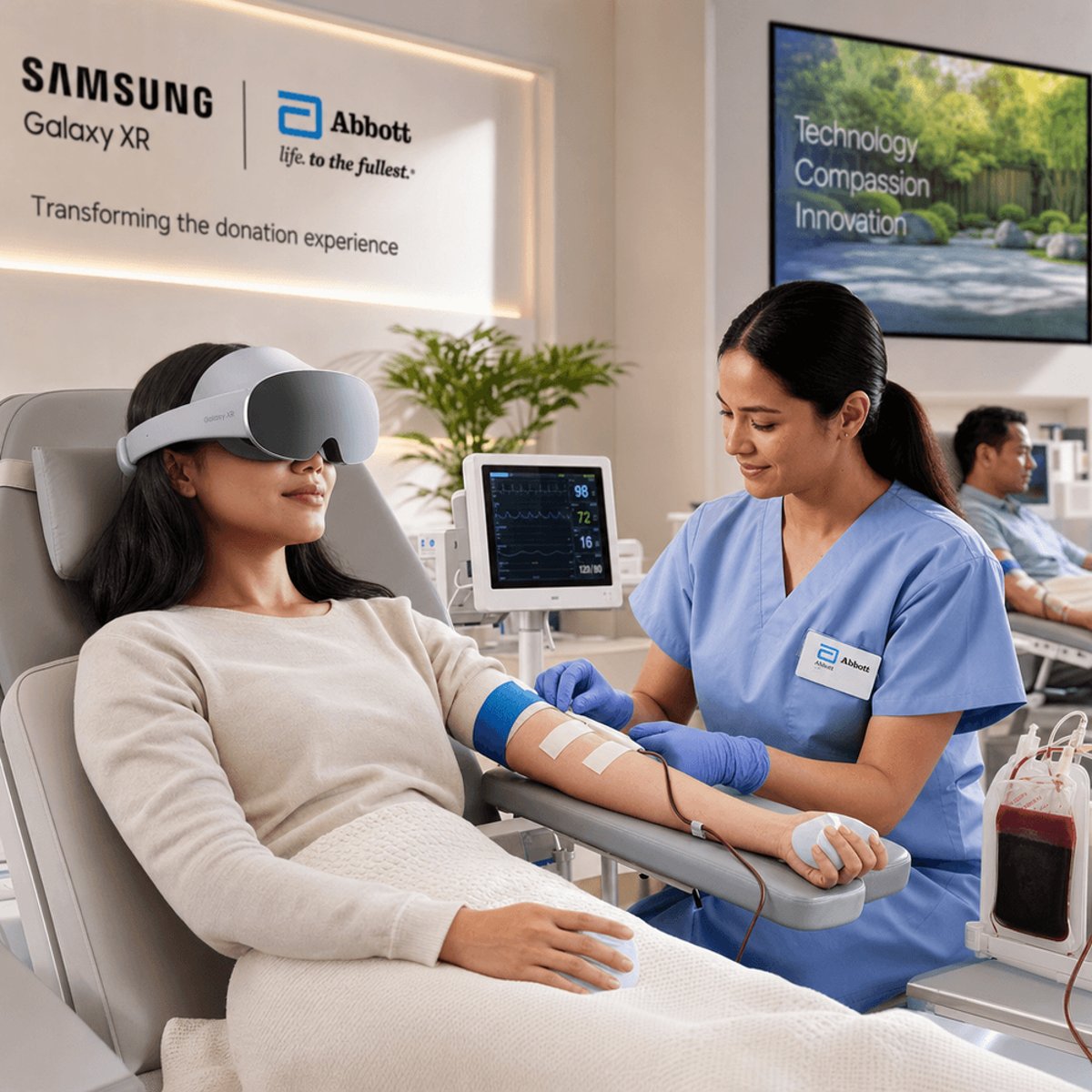
On June 2, the partners ran Korea's first XR-powered blood drive at Samsung Digital City in Suwon, timed around World Blood Donor Day. Samsung employees strapped on Galaxy XR headsets while Korean Red Cross personnel drew blood, immersing themselves in custom meditation content instead of staring at needles and plastic tubes.
The experience itself is deliberately simple. After putting on the headset, donors enter a Zen garden environment where they plant virtual flower seeds using only their gaze - no controllers, no hand gestures. Over three to five minutes, flowers and trees bloom around them while music created with the Chicago Symphony Orchestra plays in the background. It's designed to be calming enough that medical staff can monitor donors without disruption.
"As the boundary between the physical and digital worlds continues to blur, blood donation no longer has to be a stressful experience," James Park, EVP of Samsung's Global Mobile B2B Team, said in a company statement. "Through this initiative, we hope to demonstrate how Galaxy XR can extend beyond entertainment and productivity to create lasting social value."
The partnership builds on Abbott's existing footprint in blood donation campaigns. Since 2016, the healthcare company has worked with Red Cross organizations across nearly 30 countries. Now it's layering Samsung's XR technology on top of that infrastructure, betting that better donor experiences could help address persistent blood supply challenges.
"Samsung Galaxy XR, powered by Android XR, represents a significant advancement for our mixed reality blood donation program," Miguel Carrazza of Abbott's Transfusion Medicine division said. "It's well-suited for healthcare settings, allowing medical staff to monitor donors more easily while helping them stay naturally engaged."
Early feedback from Samsung employees who participated suggests the approach works. Geunwoo Park from the Networks Business, who donates at least once yearly, said the XR component made the process "more enjoyable because there was something engaging to watch." Gangsu Kim from the Visual Display Business, making his 20th donation, called out the gaze-based interaction as "especially fascinating."
But the real test comes next. From June 15-18, Samsung and Abbott will host a four-day blood drive at Augmented World Expo in Long Beach, California, bringing the Galaxy XR donation experience to thousands of attendees from across the XR industry. It's a strategic venue - if the technology can win over XR professionals, who presumably have higher standards for immersive experiences, it has a shot at broader adoption.
Later in June, the initiative heads to the International Society of Blood Transfusion Congress in Kuala Lumpur, Malaysia, where more than 100 blood bank decision-makers from around the world will get hands-on access. That's where the business model gets interesting - these are the people who could greenlight XR deployments at donation centers globally.
The timing aligns with Samsung's broader push into enterprise XR applications. While consumer XR has struggled to gain traction beyond gaming and entertainment, healthcare represents a potentially massive B2B market. Blood donation alone accounts for millions of procedures annually worldwide, and anxiety remains a significant barrier to donor participation.
What makes this different from typical VR distraction therapy is the integration with Abbott's existing donation infrastructure and the focus on gaze-based controls. Donors don't need to learn new interfaces or hold controllers - they just look around. Medical staff can easily check on them without removing headsets. It's designed for scale, not novelty.
The broader question is whether XR can move beyond demo projects into actual healthcare workflows. Samsung and Abbott are clearly betting yes, but they'll need to prove the technology reduces donor anxiety enough to justify the hardware costs and operational complexity. The upcoming AWE and ISBT events should provide real-world data on whether XR-enhanced blood donation is a compelling use case or just good PR.
Samsung and Abbott are making a calculated bet that XR can solve a real healthcare problem - donor anxiety - while opening up a new enterprise market for Galaxy XR. The upcoming deployments at AWE and the ISBT Congress will reveal whether blood banks see this as transformative technology or expensive distraction therapy. If the model works, it could establish a template for XR in medical settings beyond gaming and entertainment, turning what's essentially a PR-friendly pilot into a legitimate B2B revenue stream. But first, they'll need to prove the ROI justifies strapping headsets on thousands of donors worldwide.