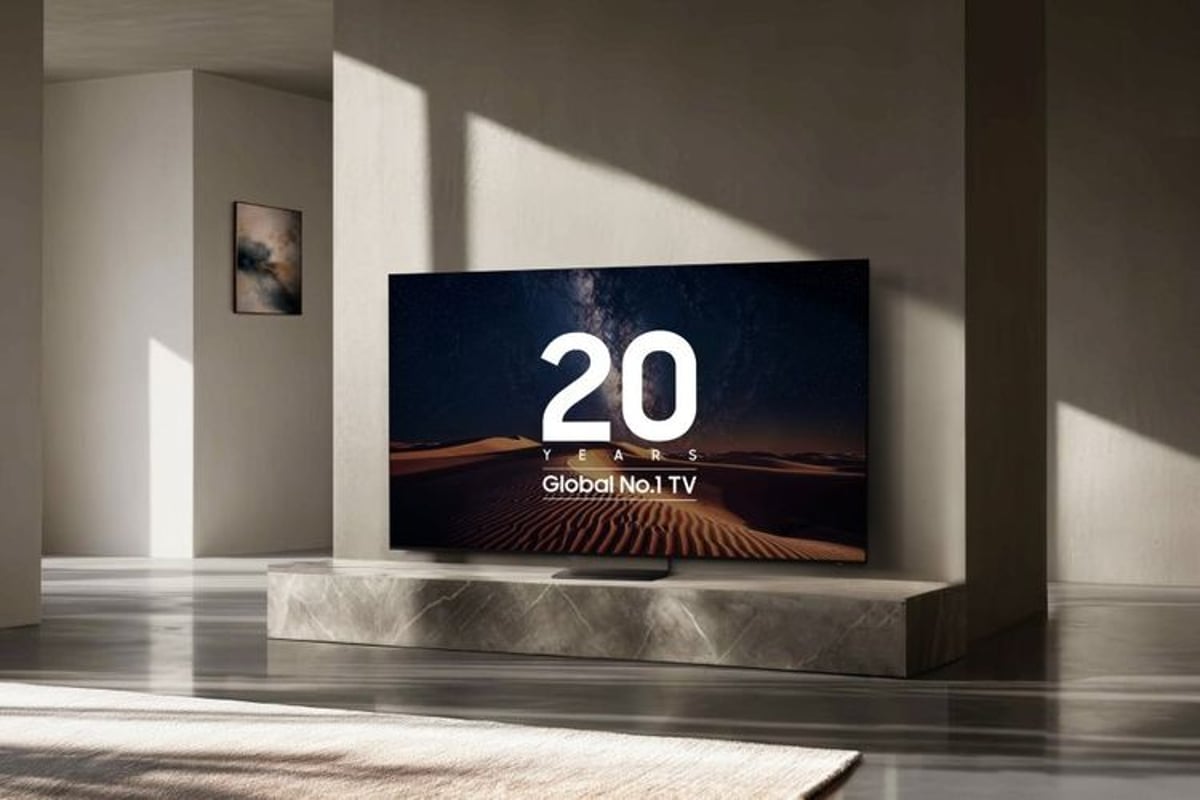
Samsung just hit a milestone that underscores its dominance in consumer electronics. The company announced it's held the number one spot in global TV sales for 20 consecutive years, capturing 29.1% of the worldwide television market in 2025 according to market research firm Omdia. It's not just about volume - Samsung also dominated the premium segment with over half the market for TVs priced above $2,500, driven by its Neo QLED, OLED, and lifestyle TV lineups.
Samsung is celebrating a rare achievement in consumer electronics - two decades at the top of the global television market. The company announced today it's maintained the number one position for 20 consecutive years, a streak that started in 2006 and shows no signs of breaking.
The numbers tell the story of complete market dominance. According to research firm Omdia, Samsung captured 29.1% of the global TV market in 2025. But it's in the premium segments where Samsung's lead becomes overwhelming - the company holds 54.3% of the market for TVs priced over $2,500, and 52.2% for sets above $1,500.
"When consumers choose a TV, they're choosing a brand they can trust for years to come," SW Yong, President and Head of the Visual Display Business at Samsung, told the company's newsroom. "Our 20-year leadership in the global TV market reflects that trust - built on decades of engineering excellence and premium innovation."
That innovation timeline reads like a history of modern television. Samsung first claimed the top spot in 2006 with its design-forward Bordeaux TV, then accelerated the industry's shift to LED displays in 2009. The move to Smart TVs in 2011 transformed televisions from passive screens into connected entertainment hubs, setting the stage for today's streaming-dominated viewing habits.
But Samsung's real differentiator came when it started thinking beyond pure picture quality. The 2015 launch of The Serif reimagined the TV as furniture, turning what had been a black rectangle into a design statement. Two years later, The Frame took that concept further, creating an entirely new category - art TVs that display paintings and photography when not showing content.
On the technology front, Samsung introduced QLED quantum dot displays in 2017, then pushed resolution boundaries with 8K TVs delivering 33 million pixels in 2018. The 2020 debut of MICRO LED technology brought self-emissive displays to ultra-large screens, competing directly with OLED on contrast and color accuracy while pushing brightness to new levels.
Today's lineup shows Samsung doubling down on multiple fronts. The company is expanding its Micro RGB models and investing heavily in AI-powered TVs that use advanced processors to optimize picture quality, sound, and personalization in real time. Samsung's also scaling its Mini LED offerings across more screen sizes and price points, bringing premium display performance to mid-tier buyers.
The OLED and Neo QLED lineups continue to evolve with larger screen options and refined processing. Samsung's approach stands out for its breadth - rather than betting exclusively on one display technology, it's advancing multiple paths simultaneously. That strategy hedges against market shifts while giving retailers and consumers options across different price tiers.
The premium TV market has become increasingly competitive as LG, Sony, and Chinese manufacturers like TCL and Hisense push into higher-end segments. But Samsung's maintained its lead through a combination of brand recognition, retail presence, and consistent product launches that generate buzz.
The milestone comes at an interesting time for the TV industry. After years of declining average selling prices, premium segments are growing as consumers invest in home entertainment. The shift to streaming has made picture quality and smart features more important than ever, playing to Samsung's strengths in processor technology and software integration.
What's notable about Samsung's 20-year run is the consistency across different technology cycles. The company led through the transition from plasma to LED, from HD to 4K to 8K, and from dumb screens to smart platforms. That adaptability suggests Samsung's positioned to maintain leadership as the industry moves toward AI-enhanced viewing experiences and potentially new display technologies.
For competitors, dislodging Samsung will require more than matching specs. The company's scale gives it advantages in component costs, retail relationships, and marketing budgets. Its two-decade track record has built consumer trust that's hard to disrupt with a single breakthrough product.
Samsung's 20-year reign as the world's top TV brand reflects more than just market share - it shows sustained execution across technology transitions, design innovation, and premium positioning. With 29.1% global share and over half the premium market locked down, the company's lead looks secure heading into an era where AI-powered features and advanced display technologies will define the next generation of home entertainment. For consumers, Samsung's dominance means a safe bet on a brand with proven longevity. For competitors, it's a reminder that catching the leader requires more than good products - it takes decades of consistent innovation and brand building.