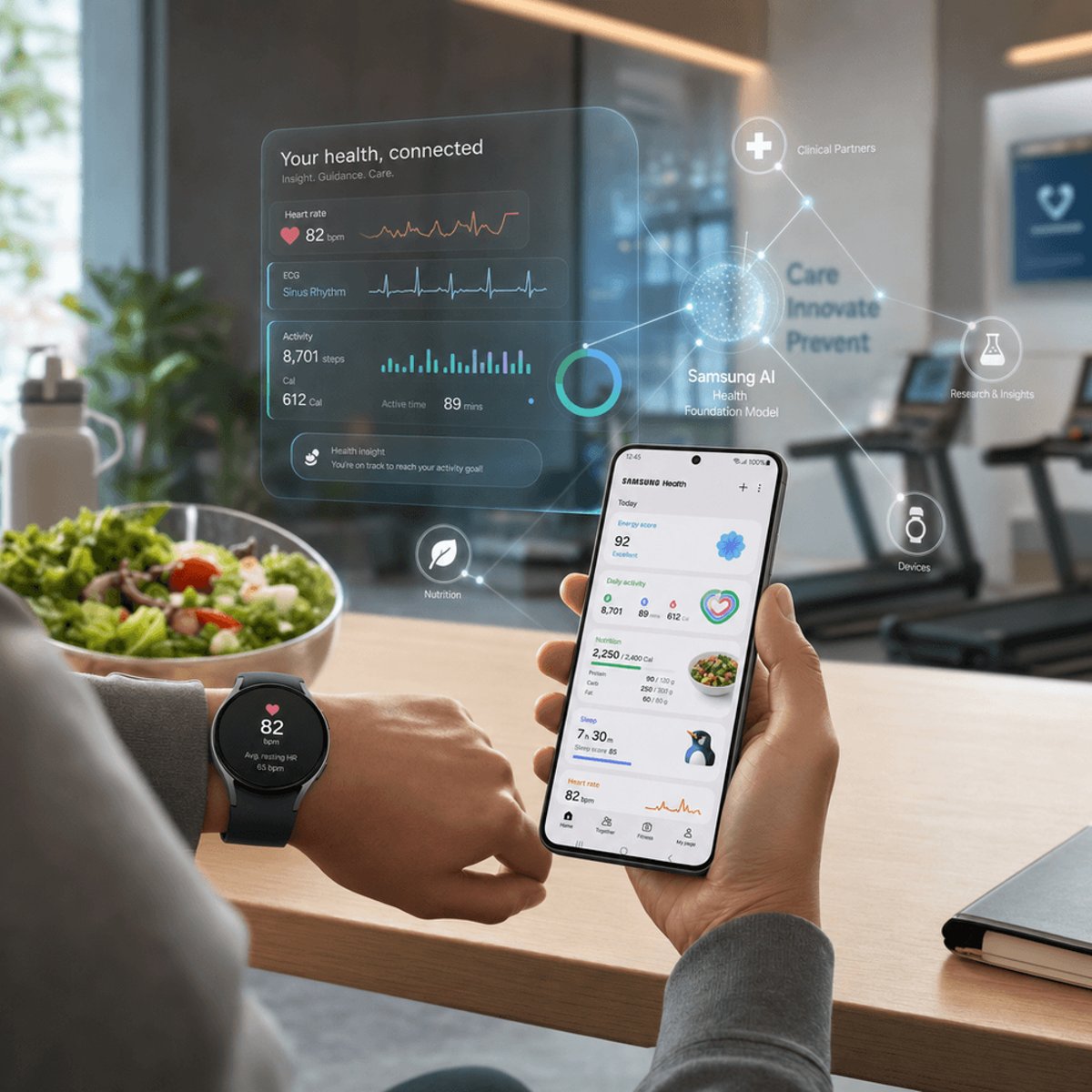
Samsung just laid out its most ambitious health play yet - not another wearable, but an entirely different approach to prevention. At Galaxy Unpacked July 2026 in London, the company revealed its 'Connected Care' strategy, bringing together partners like iFIT and clinical institutions across Europe to close what Dr. Hon Pak, Samsung's SVP of Digital Health, calls the 'missing miles' - the gap between tracking health data and actually acting on it. The announcement signals Samsung's pivot from hardware maker to health ecosystem orchestrator, powered by AI foundation models that read biosignals like language.
Samsung isn't playing small with health tech anymore. At Galaxy Unpacked July 2026 in London, the company sketched out a future where wearables don't just measure - they intervene, predict, and most importantly, change behavior. It's a pivot from reactive tracking to preventive action, and it runs on partnerships as much as algorithms.
Dr. Hon Pak, Senior Vice President and Head of Digital Health at Samsung's Mobile eXperience Business, opened the company's Health Forum panel with a paradox that anyone with a smartwatch will recognize. 'We live in the most measured era in human history - billions of people track their sleep, their stress, their heart rate every single day. And yet chronic disease keeps rising. More data, it turns out, hasn't resulted in better health.'
He calls it the 'missing miles' problem. The first mile is detection - most of what shapes health happens outside the clinic, and until recently, continuous monitoring wasn't connected to physicians. The last mile is harder: even with a diagnosis and a plan, it's the individual who has to act day after day. And life is busy. Change is hard. That gap, Pak argues, is where Samsung can make a difference. The company's devices sit with people throughout their day - on wrists, in pockets, across connected ecosystems - capturing not just numbers, but context.
'We don't just see a number - we see what's around it: whether this is a moment you're ready to change something or a moment you need support,' Pak said. 'Being there, at the point where personal decisions actually get made, is hard for a hospital or any other company to measure or act upon.'
But Samsung isn't going it alone. The Connected Care vision announced in London brings together nutrition, fitness, clinical research and AI partners to close both gaps. It's an ecosystem play, and the connective tissue is artificial intelligence.
Kartik Poria, Head of Product at Samsung Food, zeroed in on the moment everyone knows. 'It's Tuesday, six o'clock. You're tired, you're staring into the fridge and everything you know about eating well loses to whatever's quickest. That moment is what we're going after - because what you eat, day after day, is one of the biggest levers we have on preventing chronic disease.'
Samsung Health and Samsung Food are now integrated to tackle nutrition from both sides. Samsung Health surfaces what's happening beneath the surface - meal logs, BMI, the Antioxidant Index and AGEs Index. Samsung Food brings a global recipe library and meal planning grounded in behavior change science, learning habits and making the healthier pattern easier. 'We're not adding another thing to manage - we're making the healthy choice the easy one, for the night you've got the energy to cook and the night you don't,' Poria said.
On the fitness side, iFIT CEO Kevin Duffy described how the company's expert-led programs are becoming accessible through Samsung Health. iFIT workouts now integrate with Galaxy Watch, letting users track key metrics during guided sessions. A new Fitness Index gives users a single score reflecting physical fitness with personalized recommendations. Looking ahead, Samsung's Health Assistant will surface the most relevant workout at the right moment based on a user's Fitness Index, goals and activity history.
'Exercise is not just about being active - it's about understanding your body, building sustainable habits and having the right guidance at the right time,' Duffy said. 'By combining iFIT's expert-led experiences with Samsung Health's connected insights, we can help more people make movement a meaningful part of their everyday lives.'
But content and insights alone don't close the last mile. Pak noted that Samsung designs for real life, recognizing that people slip and miss goals most of the time. Those moments are precisely when timely, contextualized support matters most. The real measure isn't how often the system nudges someone, but how many healthy actions actually happen - a doctor's low-salt advice quietly showing up as items in a grocery cart or a workout that meets a person where they actually are that day.
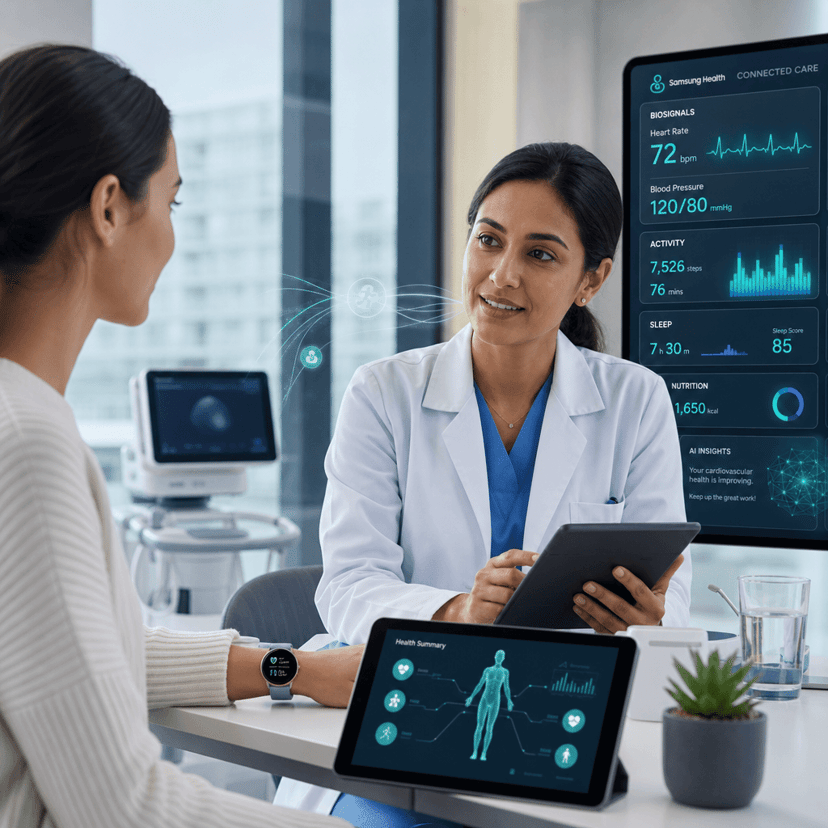
Trust, though, is the linchpin. Wearable data is now common, but few clinicians have been able to build it into daily care. Closing that gap requires evidence, workflow integration and privacy guarantees.
Rohit Ail, Head of the Technology Incubation Lab at Samsung R&D Institute UK, spoke to how his team generates clinical evidence in real-world settings. 'Our goal is to meet the standards expected by clinicians, researchers and regulatory bodies and that means generating evidence in real-world clinical environments. This commitment builds on Samsung's growing body of clinical research and validation evidence.'
He referenced ongoing collaborations across Europe, including partnerships with the NHS and clinical validation studies with leading hospitals. With San Cecilio University Hospital in Spain and Gemelli in Italy, Samsung is working on identifying and managing cardiovascular disease risk using AI and decision-support technologies. With Fondazione IRCCS in Italy, the focus is on understanding and addressing late effects faced by adolescent and young adult cancer survivors through AI-based digital phenotyping.
On privacy, Ail noted that Samsung considers user data to belong to the user, with the company acting as custodian. 'Trust begins with protecting users' data. Samsung takes a three-layer approach: Samsung Knox for device-level security, GDPR-compliant infrastructure and alignment with the European Health Data Space framework.' Samsung R&D Institute UK has also developed a Decentralized Clinical Trial framework, in which participant identities remain under the control of healthcare organizations and data is pseudonymized from the outset.
If everyday reach and clinical trust are two pillars, intelligence is what binds them. Pak introduced foundation models as a genuine turning point - a shift from population averages to something truly personal.
Otávio Penatti, Head of the Health AI R&D Team at Samsung R&D Institute Brazil, explained what a health foundation model actually means. 'A health foundation model is an AI model that uses self-supervised learning to learn meaningful features from unlabeled biosignal data. At Samsung, we are advancing health foundation model research across multiple global research teams, combining expertise in biosignal intelligence, wearable AI and personalized health insights.'
Building on the success of large language models, Samsung can now interpret complex biosignals - ECG, ACC and PPG - not as isolated data points, but as a structured biological language. These signals can be measured through wearable devices in everyday situations. By applying foundation models to understand these biological patterns, Samsung aims to provide more accurate predictions and continuous, personalized health insights.
To close the panel, Pak asked each participant for a one-sentence vision of Connected Care in the era of AI five years from now. Poria from Samsung Food: 'In five years, eating well won't run on willpower - it'll feel like having a chef and a dietitian in your pocket, turning what your body needs into what's for dinner, day after day.' Duffy from iFIT: 'A coach that knows your body and adapts every workout to who you are that day.' Ail from Samsung UK: 'Care that clinicians trust and patients control - evidence-based and private by design.' Penatti from Samsung Brazil: 'AI that understands the body's language and acts before problems begin.'
Pak tied the threads together: everyday behavior, clinical trust and personal AI - three focus areas, one goal of closing the first and last mile to scale prevention while meeting people where they are. 'The future of health is connected, trusted and proactive - and it's a road we're glad to be traveling together.'
Samsung's Connected Care announcement signals a strategic shift from hardware metrics to behavioral outcomes, positioning the company as an orchestrator rather than just a device maker. By weaving together iFIT's fitness content, Samsung Food's meal intelligence and clinical validation from European health institutions, the company is building an ecosystem where AI foundation models turn biosignals into actionable guidance. The real test won't be the sophistication of the algorithms or the breadth of partnerships - it'll be whether Samsung can actually close that last mile Pak described, turning tracked data into sustained behavior change at scale. With clinical trials underway across cardiovascular risk and cancer survivor care, and a privacy framework designed to meet European regulatory standards, Samsung is betting that the future of preventive health runs on trust, context and partnerships as much as sensors and silicon.