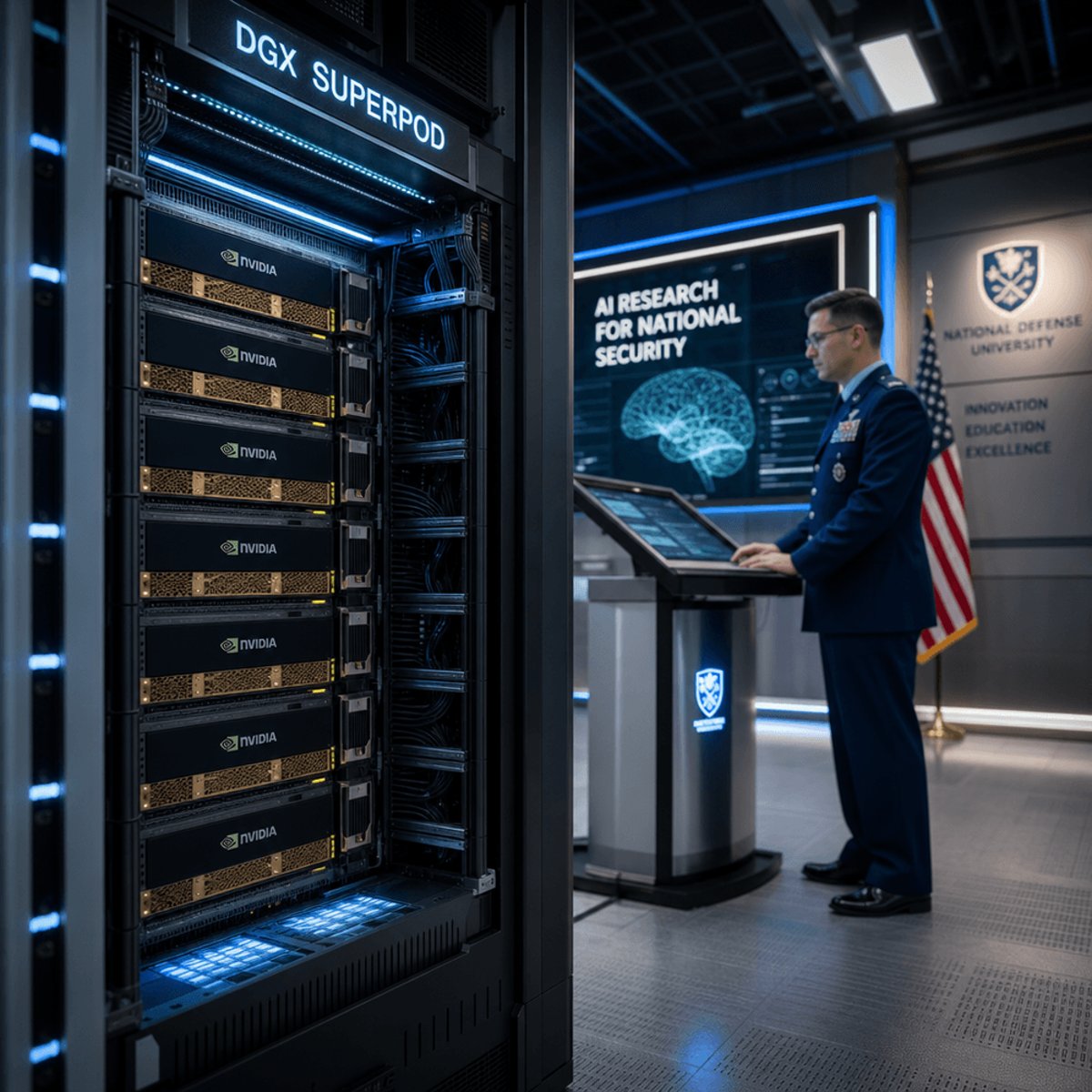
NVIDIA founder and CEO Jensen Huang traveled to the Naval Postgraduate School in Monterey, California today to personally commission the institution's new DGX GB300 system, marking a significant expansion of AI infrastructure into U.S. military education. The deployment brings one of the world's most powerful AI platforms into the hands of researchers, students, and faculty at the Defense Department's premier graduate university, signaling an accelerated push to integrate advanced computing capabilities into national security research and training.
NVIDIA just planted its most powerful AI hardware inside one of America's most strategic educational institutions. CEO Jensen Huang showed up in person at the Naval Postgraduate School in Monterey to flip the switch on a DGX GB300 system, the company's latest flagship AI supercomputer that typically powers the most demanding research labs and enterprise deployments worldwide.
The commissioning ceremony marks more than just another hardware sale. It's a statement about where AI infrastructure is heading and who's getting access to cutting-edge compute power. The Naval Postgraduate School serves as the U.S. military's flagship graduate university, training officers and defense researchers in everything from cybersecurity to autonomous systems. Now they've got the same horsepower that OpenAI and Meta use for their most ambitious projects.
Huang's personal involvement isn't routine. The NVIDIA chief typically reserves such appearances for major customer wins or strategic partnerships. His presence in Monterey signals how seriously the company takes government and defense sector expansion, especially as commercial AI markets face increasing competition from AMD and Intel's accelerator programs.
The DGX GB300 represents NVIDIA's current top-tier offering, built around the company's latest Blackwell architecture. These systems typically cost well into seven figures and deliver the kind of computational muscle needed for training large language models, running complex simulations, or processing massive datasets in real-time. For a military graduate school, that translates into capabilities for advanced logistics modeling, AI-assisted intelligence analysis, and next-generation autonomous systems research.
This isn't NVIDIA's first dance with government customers, but the visibility of this deployment is noteworthy. Defense contractors and intelligence agencies have quietly accumulated massive NVIDIA GPU clusters for years, but those deals rarely come with CEO photo ops and press releases. The public commissioning suggests both NVIDIA and the Pentagon want to send a message about AI readiness and technological superiority.
The timing is equally significant. As U.S.-China tech competition intensifies, particularly around semiconductor access and AI capabilities, high-profile AI infrastructure deployments at military institutions serve dual purposes. They provide genuine research capabilities while also functioning as strategic signaling. China has invested heavily in military AI research, and visible American investments in this space counter that narrative.
For the Naval Postgraduate School's students and faculty, the system opens research possibilities that were previously theoretical. Running sophisticated AI models locally, without cloud dependencies or security concerns about data leaving DoD networks, fundamentally changes what's feasible for thesis projects and defense research initiatives. Graduate students working on autonomous naval systems or AI-assisted decision-making can now iterate on models that would have taken weeks to train using conventional computing clusters.
The move also reflects broader trends in how government agencies are procuring AI infrastructure. Rather than building custom supercomputers from scratch or relying entirely on classified facilities, there's a growing willingness to adopt commercial AI platforms with appropriate security modifications. NVIDIA has been positioning itself for exactly this shift, offering government-specific configurations of its DGX systems with enhanced security features and on-premises deployment options.
What makes this particularly interesting is the educational angle. By placing frontier AI hardware in a graduate school environment, rather than solely in operational military facilities, the Pentagon is betting on training the next generation of defense technologists on the same tools they'll use in their careers. It's workforce development with very expensive hardware.
NVIDIA's decision to put its most powerful AI system into a military graduate school, complete with a CEO appearance, tells you where the company sees growth opportunities beyond its hyperscaler customers. As government agencies accelerate AI adoption for everything from logistics to intelligence analysis, expect more high-profile deployments at strategic institutions. The real question isn't whether defense organizations will invest in AI infrastructure - they clearly will - but whether academia can keep pace with operational demands once these systems are actually running at scale. For now, the Naval Postgraduate School just leapfrogged most universities in raw AI computing power, and that gap is likely to widen as military AI budgets continue growing.