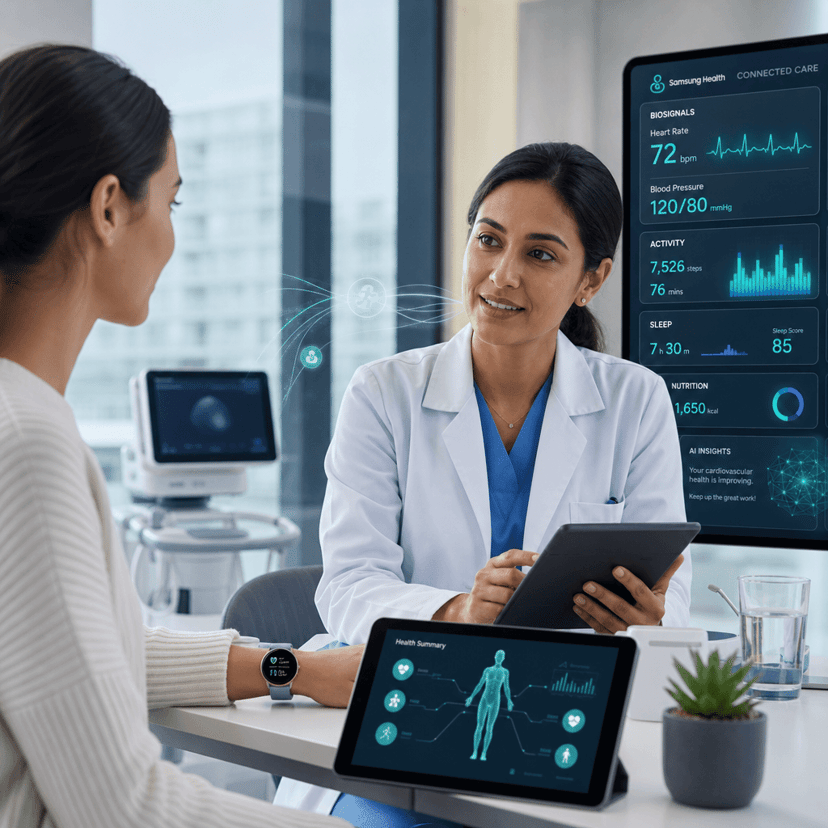
Samsung just laid out its most ambitious health play yet. At Galaxy Unpacked in London, the company unveiled Connected Care - a preventive health platform that weaves together wearables, AI foundation models, and clinical partnerships across Europe's hospital systems. The pitch? Close the gap between tracking your sleep and actually improving your health, turning billions of daily biometric readings into actionable medical insights that work outside the clinic.
Samsung has been in the wearables game for years, but what Dr. Hon Pak described on stage in London signals a fundamental shift in ambition. The Senior VP leading Samsung's Digital Health Team framed the problem bluntly: we live in the most measured era in human history, yet chronic disease keeps climbing. Billions track their sleep and heart rate daily. The data flows. Nothing changes.
Pak calls this the paradox of the 'missing miles.' The first mile is detection - health happens outside the doctor's office, but until recently, continuous monitoring wasn't connected to physicians. The last mile is action - even with a diagnosis and care plan, it's the individual who has to execute day after day. Life gets busy. Change is hard. Samsung's bet is that it's uniquely positioned to close both gaps because its technology lives with people throughout their day - across Galaxy Watch, phones, and a connected ecosystem that understands not just raw numbers, but the context around them.
'We don't just see a number - we see what's around it: whether this is a moment you're ready to change something or a moment you need support,' Pak explained. That contextual layer - being present when personal decisions actually get made - is territory hospitals and health systems can't easily reach.
But Samsung isn't going it alone. The company is stitching together an ecosystem it calls Connected Care, bringing partners like iFIT and its own Samsung Food platform into a unified experience. The connective tissue? AI foundation models trained on biosignal data.
Kartik Poria, Head of Product at Samsung Food, located the last mile problem in a moment everyone recognizes: 'It's Tuesday, six o'clock. You're tired, you're staring into the fridge and everything you know about eating well loses to whatever's quickest.' Samsung Health already surfaces metabolic indicators - BMI, Antioxidant Index, AGEs Index from meal logs. Samsung Food adds a global recipe library and meal planning grounded in behavioral science. The goal isn't another tracking app. It's making the healthy choice the easy one, for the night you've got energy and the night you don't.
On the fitness side, iFIT CEO Kevin Duffy described how the platform's expert-led workouts now integrate directly with Galaxy Watch, surfacing a Fitness Index - a single score that synthesizes cardiovascular health, strength, mobility, and stress management. Looking ahead, Samsung's Health Assistant will pull together that score, activity history, and goals to suggest the most relevant workout at the right moment. 'Exercise is not just about being active - it's about understanding your body, building sustainable habits and having the right guidance at the right time,' Duffy said.
The harder question is whether any of this closes the behavioral gap. Samsung's answer is to design for real life - acknowledging that people slip and miss goals constantly, and those moments are precisely when timely, contextualized support matters most. The real measure, Pak argued, isn't how often the system nudges someone, but how many healthy actions actually happen: a doctor's low-salt advice quietly showing up as items in a grocery cart, or a workout that meets someone where they actually are that day.
But preventive care at scale requires clinical trust, and that's a matter of evidence. Rohit Ail, Head of the Technology Incubation Lab at Samsung R&D Institute UK, detailed ongoing collaborations across Europe. With San Cecilio University Hospital in Spain and Gemelli in Italy, Samsung is working on identifying cardiovascular disease risk using AI and decision-support tools. With Fondazione IRCCS in Italy, the focus is understanding late effects in adolescent and young adult cancer survivors through AI-based digital phenotyping. Partnerships with the NHS and other leading hospitals are generating real-world clinical validation.
On privacy, Ail was explicit: Samsung treats user data as belonging to the user, with the company acting as custodian. That means Samsung Knox for device-level security, GDPR-compliant infrastructure, and alignment with the European Health Data Space framework. The R&D team has also developed a Decentralized Clinical Trial framework where participant identities stay under healthcare organization control and data is pseudonymized from the start.
If everyday reach and clinical trust are two pillars, intelligence is what binds them together. Otávio Penatti, Head of the Health AI R&D Team at Samsung R&D Institute Brazil, explained what a health foundation model actually means in practice. 'A health foundation model uses self-supervised learning to learn meaningful features from unlabeled biosignal data,' he said. Think of it as applying the large language model playbook to the body: interpreting complex biosignals like ECG, ACC, and PPG not as isolated data points, but as a structured biological language.
These signals get measured through wearables in everyday situations. By applying foundation models to understand biological patterns, Samsung believes it can deliver more accurate predictions and continuous, personalized health insights - a shift from population averages to something truly individual.
Pak closed the panel by asking each participant for a one-sentence vision of Connected Care five years out. Poria: 'Eating well won't run on willpower - it'll feel like having a chef and a dietitian in your pocket.' Duffy: 'A coach that knows your body and adapts every workout to who you are that day.' Ail: 'Care that clinicians trust and patients control - evidence-based and private by design.' Penatti: 'AI that understands the body's language and acts before problems begin.'
The vision Samsung sketched in London is ambitious: everyday behavior, clinical trust, and personal AI converging to close the first and last mile, scaling prevention while meeting people where they are. Whether it can actually bend the chronic disease curve remains to be seen, but the pieces - wearable reach, clinical partnerships, and foundation models trained on biosignal data - are now on the board.
Samsung's Connected Care play is a bet that the company with devices in billions of pockets can finally close the loop between data collection and behavior change. The clinical partnerships across Europe's hospital systems, combined with foundation models trained on biosignal data, represent a serious attempt to move wearable health beyond tracking into preventive medicine. Whether it works at scale depends on execution - turning contextual nudges into sustained habit change, and earning clinician trust through evidence generated in real-world settings. But the infrastructure is taking shape: AI that interprets the body's signals, partnerships that validate those insights clinically, and an ecosystem that meets people in the moments decisions actually get made.