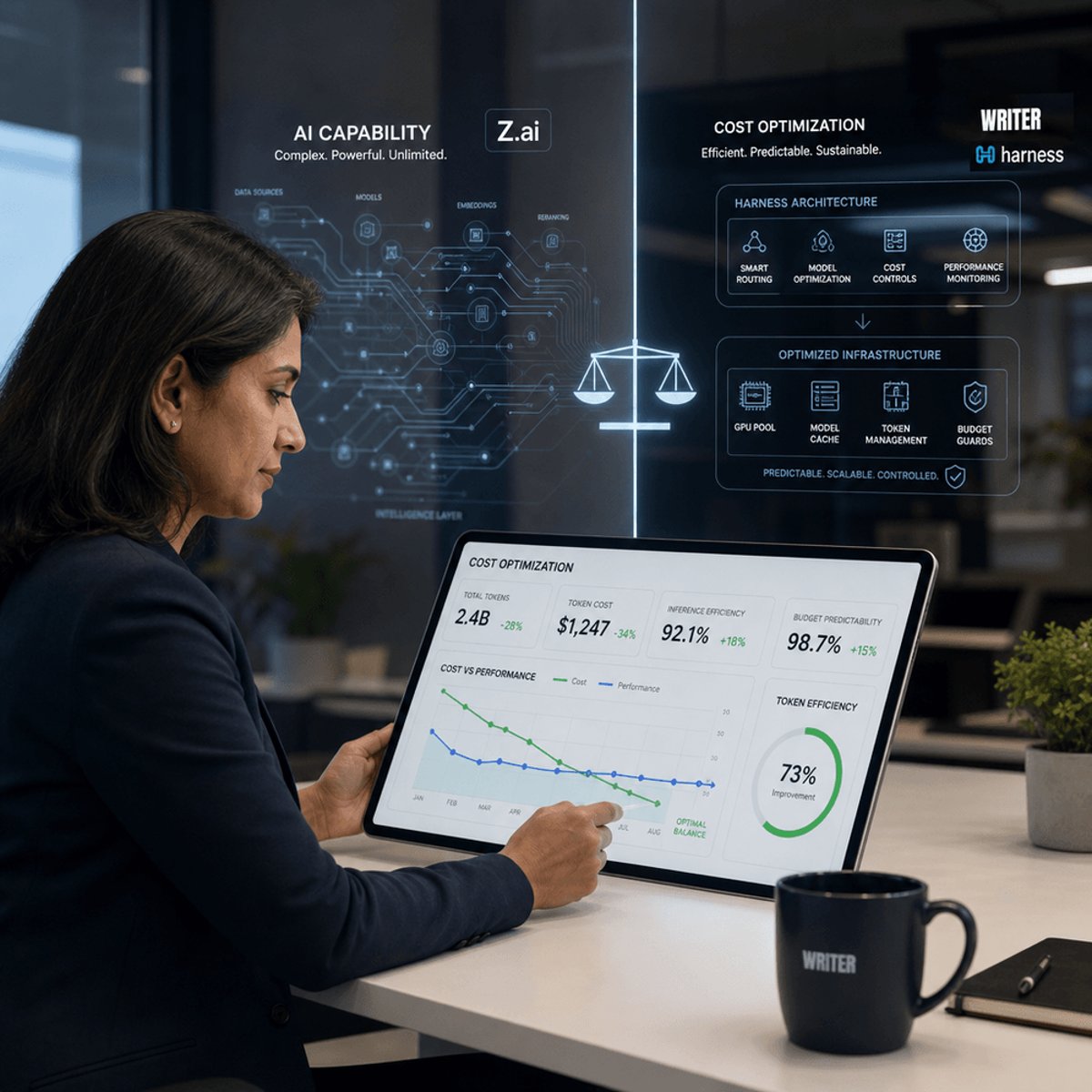
Enterprise AI platform Writer just fired a warning shot at runaway inference costs. The company unveiled a new AI model built on Z.ai's open-source GLM-5.2 foundation, promising deployment-ready capabilities at a fraction of current token prices. With enterprises increasingly caught between AI adoption pressure and budget realities, Writer's move signals a broader industry shift toward cost-conscious model development. The launch comes with an upgraded 'harness' system designed to keep token spending in check - a feature that could reshape how companies think about scaling AI workloads.
Writer is betting that enterprise AI's next battleground won't be raw performance - it'll be cost per token. The company just rolled out a new model built on Z.ai's open-source GLM-5.2 foundation, engineered specifically to slash the inference costs that have become AI's hidden budget killer.
The timing couldn't be sharper. While tech giants race to build ever-larger models, enterprises are quietly hitting a wall. Token costs for production AI deployments have ballooned from pilot-project curiosities to line items that make CFOs nervous. Writer's approach - taking an open-source foundation model and applying targeted post-training - represents a different calculus entirely.
"Built as a post-training variation on Z.ai's open source model GLM-5.2, Writer says the new system should provide deployment-ready capabilities at a much lower price," according to TechCrunch. That's the pitch, anyway. But the real story is what Writer's calling the 'upgraded harness' - infrastructure designed to contain token costs before they spiral.
The harness concept addresses something most AI vendors don't talk about: cost predictability. Enterprise buyers can benchmark model accuracy all day, but budgeting for production usage when token consumption varies wildly? That's where pilots die. Writer's system aims to put guardrails around inference spending, letting companies scale AI workloads without budget surprises.
This launch also highlights the maturing dynamics of the enterprise AI stack. Instead of training massive proprietary models from scratch, Writer took Z.ai's GLM-5.2 - already battle-tested in the open-source community - and customized it for enterprise use cases. It's faster, cheaper, and lets them focus resources on the cost-management layer where enterprises actually feel pain.
The GLM-5.2 foundation gives Writer some credibility here. Z.ai's model has gained traction for balancing capability with efficiency, making it a logical base for cost-focused customization. By handling the post-training rather than reinventing the wheel, Writer can iterate on deployment economics without the compute bill of foundation model development.
But Writer isn't operating in a vacuum. Every major AI platform is watching token costs squeeze margins and spook enterprise buyers. The difference is most are trying to optimize existing architectures. Writer's harness approach suggests they're treating cost containment as a first-class feature, not an afterthought.
For enterprise buyers already running AI workloads, this represents a potential shift in procurement conversations. Instead of asking "How accurate is your model?" the question becomes "How predictably can you bill me?" That's a wedge Writer clearly wants to own.
The broader implication: we're watching the enterprise AI market split into performance maximalists and cost realists. Writer's betting the realists have deeper pockets and longer contracts. If token economics continue tightening, that might be the smarter bet.
Writer's GLM-5.2 launch isn't just another model announcement - it's a signal that enterprise AI economics are entering a new phase. As companies move from experimentation to production scale, cost predictability matters as much as capability. The upgraded harness system positions Writer to own that conversation, turning what's been a procurement headache into a competitive advantage. Watch for other enterprise AI vendors to follow suit with their own cost-containment plays. The token wars just got interesting, and this time the winners might be the ones who charge less, not those who promise more.