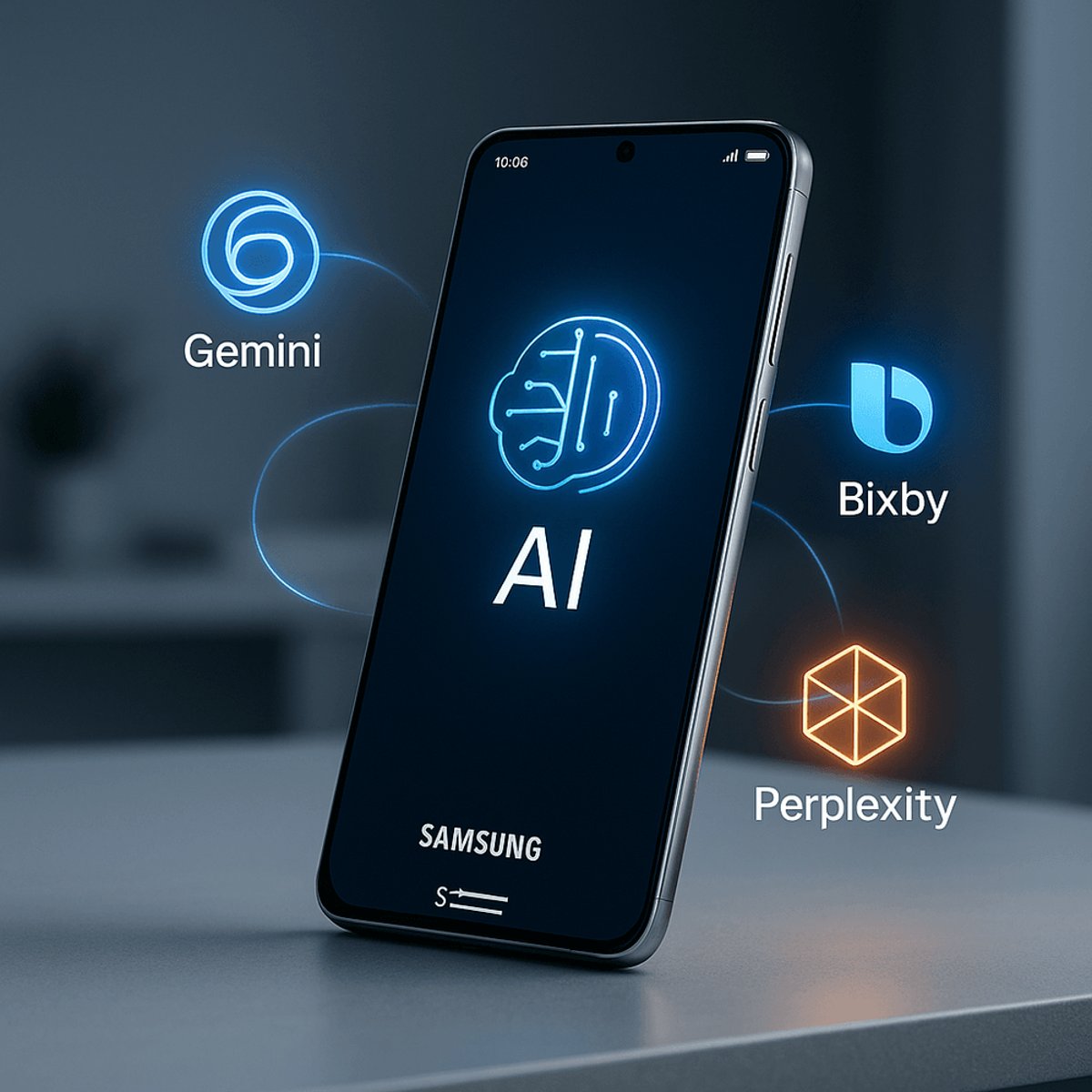
Samsung just launched the Galaxy S26 with something the smartphone world hasn't seen before - three separate AI assistants living side-by-side on a single device. The flagship features Google's Gemini, Perplexity, and an upgraded Bixby, giving Android users an early glimpse at what Apple's rumored Google-powered Siri overhaul could actually deliver when it arrives later this year.
Samsung just threw down the gauntlet in the AI assistant wars. The company's newly unveiled Galaxy S26 doesn't just feature one AI - it packs three distinct systems, giving users unprecedented choice in how they interact with their device. It's a bold bet that the future of smartphone AI isn't about picking winners, but about having the right tool for every job.
The S26 marks the first mainstream smartphone to integrate Google's Gemini AI at the system level, sitting alongside Samsung's own revamped Bixby and the AI-powered search engine Perplexity. According to CNBC, this triple-threat approach effectively turns Samsung's latest flagship into a living laboratory for what Apple might deliver when it finally integrates Gemini into Siri.
The timing couldn't be more strategic. Apple has been widely rumored to be negotiating a deal with Google to power Siri with Gemini technology, potentially replacing or augmenting the aging assistant that's long been criticized for lagging behind competitors. Samsung's implementation offers the clearest preview yet of how that partnership could work in practice - and what iPhone users might gain or lose in the transition.
What makes the S26's approach fascinating is how it handles the multi-assistant complexity. Rather than forcing users to choose one default AI, Samsung built a context-aware routing system. Need a quick fact check? Perplexity jumps in. Want to control smart home devices? Bixby handles hardware integration. Complex reasoning tasks or creative work? Gemini takes over. The phone learns user preferences over time, gradually getting better at predicting which assistant to activate.
This stands in stark contrast to the single-assistant model that's dominated smartphones since Siri's 2011 debut. Both Apple and Google have historically pushed users toward one default voice, building walled gardens around their respective AI ecosystems. Samsung's breaking that mold, essentially admitting that no single AI assistant excels at everything.
The upgraded Bixby represents Samsung's acknowledgment that it can't compete with Google's AI research firepower alone. Rather than abandoning its homegrown assistant entirely, Samsung carved out a niche - device control, Samsung ecosystem integration, and on-device processing for privacy-sensitive tasks. It's a pragmatic retreat from the dream of building an everything-assistant.
For Google, the S26 partnership represents a major distribution win. Gemini gets prominent placement on one of the world's best-selling Android phones, exposing millions to Google's latest AI capabilities. But it also reveals Google's willingness to share the stage - a notable shift from the company's typical platform control instincts.
The Apple implications are what's really turning heads in Cupertino. If Samsung can successfully juggle three AI assistants without confusing users, Apple's reported reluctance to integrate Gemini alongside Siri starts looking less like careful product design and more like corporate stubbornness. The S26 essentially proves the multi-assistant model can work.
Industry observers see Samsung's move as calculated pressure on Apple to accelerate its AI plans. With Samsung users getting hands-on experience with Gemini months before any potential iPhone integration, Apple risks looking slow to market on AI innovation - a particularly dangerous perception as generative AI becomes table stakes for premium smartphones.
The S26 launch also highlights the shifting power dynamics in mobile AI. OpenAI has been absent from Samsung's assistant lineup despite powering ChatGPT, which remains hugely popular as a standalone app. Samsung's bet on Gemini and Perplexity suggests the company sees Google's integration depth and Perplexity's search specialization as more valuable than OpenAI's raw conversational capabilities.
What remains unclear is whether mainstream users actually want multiple AI assistants or if they'll find the complexity overwhelming. Samsung's success with this experiment could determine whether Apple goes all-in on Gemini integration or maintains Siri as the primary interface with Gemini working behind the scenes. The S26 essentially serves as Apple's free market research.
For now, Samsung's carved out a unique position - the Android flagship where AI choice isn't just a feature, it's the entire strategy. Whether that resonates with buyers or creates assistant fatigue will likely influence the next generation of smartphone AI across the industry.
Samsung's triple-AI gambit on the S26 does more than introduce new features - it fundamentally challenges how we think about smartphone assistants. By proving multiple AIs can coexist without chaos, Samsung's handing Apple both a roadmap and a deadline. If this experiment succeeds, expect every flagship to follow suit. If it flops, Apple's singular Siri-Gemini integration will look prescient. Either way, the S26 just made 2026 the year smartphone AI finally grew up and admitted no single assistant can do it all.