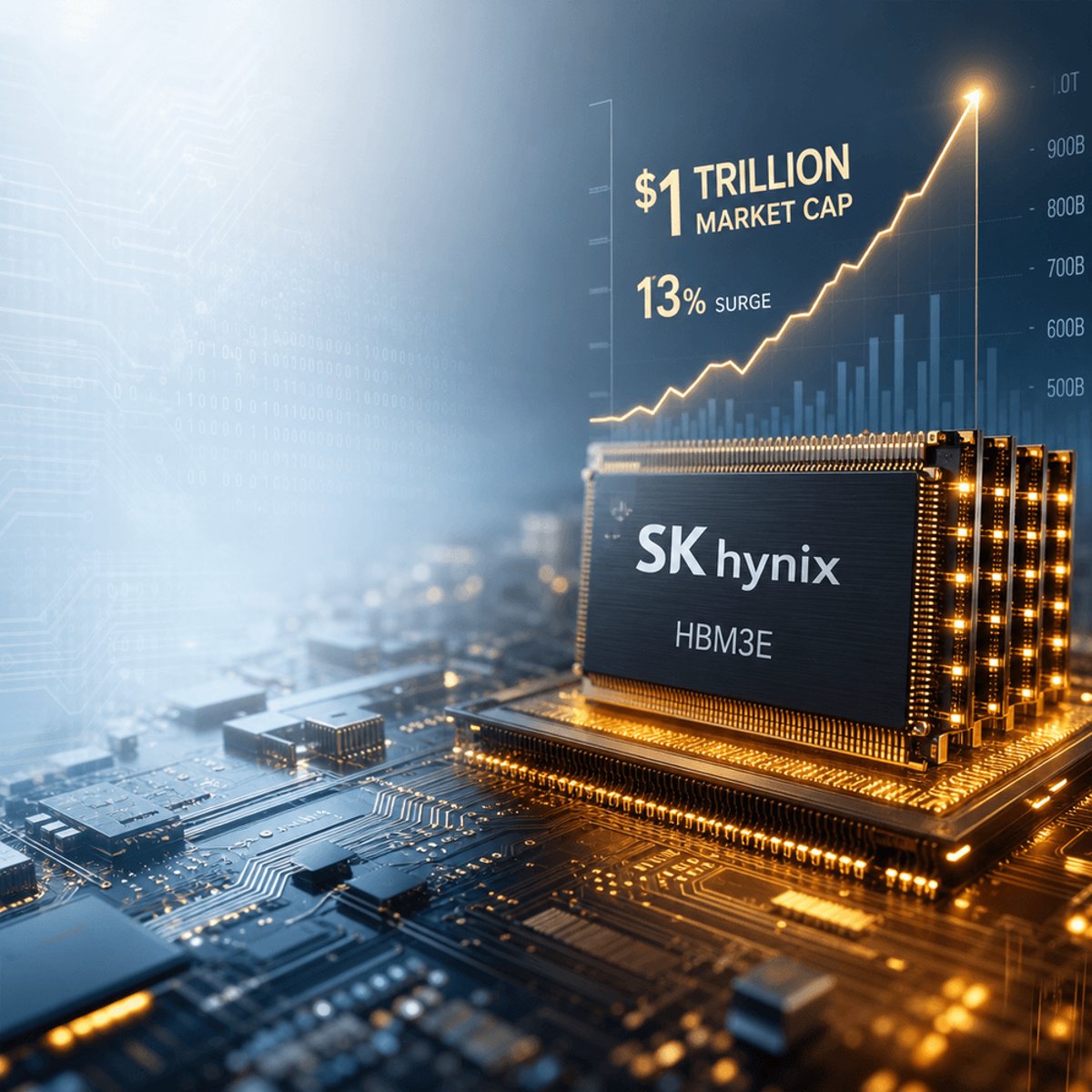
SK Hynix just pulled off one of the most explosive public market debuts in recent memory. The South Korean memory chip giant surged 13% in its first day of trading on the Nasdaq, instantly crossing the trillion-dollar market cap threshold. Chairman tells CNBC that AI chip demand from customers like Nvidia and Apple is 'enormous,' validating the company's dominance in high-bandwidth memory crucial for AI infrastructure.
SK Hynix just became the latest company to join tech's exclusive trillion-dollar club, and it did so with the kind of market enthusiasm typically reserved for consumer tech darlings. The memory chip maker's shares rocketed 13% in its Nasdaq debut, instantly valuing the South Korean semiconductor giant at over $1 trillion and sending a clear signal that Wall Street sees AI infrastructure as the next mega-trend.
The debut comes at a pivotal moment for the semiconductor industry. While consumer-facing companies like Apple and Microsoft typically grab headlines, SK Hynix has quietly positioned itself as the indispensable supplier to the AI revolution. The company's chairman didn't mince words in an exclusive interview with CNBC, confirming what investors have long suspected: 'demand is enormous.'
That demand is being driven primarily by Nvidia, which has become SK Hynix's largest customer for high-bandwidth memory chips. These HBM chips are the crucial component that allows AI processors to access data fast enough to train and run large language models. Without them, the entire generative AI boom would grind to a halt. Apple has also emerged as a major customer as it ramps up its own AI initiatives across iPhone, Mac, and cloud services.
The 13% first-day pop reflects something deeper than typical IPO enthusiasm. Investors are essentially betting that whoever controls the supply of advanced memory chips controls the future of AI. SK Hynix has spent years perfecting HBM technology, and it now commands roughly 50% of the global market for these specialized chips. That dominant position has translated into explosive revenue growth, with the company's AI-related chip sales reportedly tripling year-over-year.
But the valuation also reveals how dramatically the semiconductor landscape has shifted. Just three years ago, memory chip makers were seen as cyclical businesses subject to brutal boom-and-bust cycles. Now they're being valued like high-growth tech platforms. The trillion-dollar market cap puts SK Hynix in rarefied air alongside companies like Nvidia, Apple, and Microsoft - all of which depend on SK Hynix's technology to power their AI ambitions.
The timing of the listing couldn't be better. Nvidia is struggling to secure enough HBM supply to meet customer demand for its latest AI accelerators. That supply constraint has created a seller's market for SK Hynix, allowing the company to command premium pricing while maintaining long-term supply agreements. Industry analysts estimate that HBM chips now sell for 3-5 times the price of conventional memory chips, dramatically expanding SK Hynix's profit margins.
The company's relationship with Nvidia goes beyond simple supplier dynamics. SK Hynix engineers work directly with Nvidia's chip designers to co-develop next-generation memory solutions optimized for AI workloads. This deep technical partnership has created a moat that competitors are finding difficult to breach. Samsung and Micron are racing to catch up in HBM production, but SK Hynix maintains a roughly 12-month technology lead.
The chairman's comments about 'enormous' demand also hint at what's driving the company's confidence. OpenAI, Google, Meta, and virtually every major tech company are in an arms race to build larger AI models and deploy them at scale. Each new generation of models requires exponentially more memory bandwidth, creating a tailwind that could last years. Some analysts project the HBM market will grow from $10 billion today to over $50 billion by 2028.
But there are risks lurking beneath the euphoria. The memory chip business remains notoriously cyclical, and any slowdown in AI spending could hit SK Hynix hard. Geopolitical tensions between the U.S. and China also create uncertainty, as China represents a significant market for memory chips. Export controls and trade restrictions could limit SK Hynix's growth potential in the world's second-largest economy.
Still, today's debut suggests investors are willing to bet big on AI infrastructure. The 13% surge indicates strong institutional appetite for exposure to the picks-and-shovels of the AI gold rush. Unlike software companies that face competition and commoditization risks, semiconductor manufacturing requires billions in capital investment and years of technical expertise - creating natural barriers to entry that Wall Street loves.
SK Hynix's explosive Nasdaq debut and instant trillion-dollar valuation underscore a fundamental shift in how markets value semiconductor companies. The 13% first-day surge isn't just about one company's successful IPO - it's a bet that the AI infrastructure layer will generate sustained returns for years to come. With major customers like Nvidia and Apple locked into long-term supply agreements and HBM demand showing no signs of slowing, SK Hynix has positioned itself as the critical enabler of the AI era. But the real story here is what the valuation says about where smart money sees the future: not in the flashy AI models everyone's talking about, but in the specialized chips that make them possible.