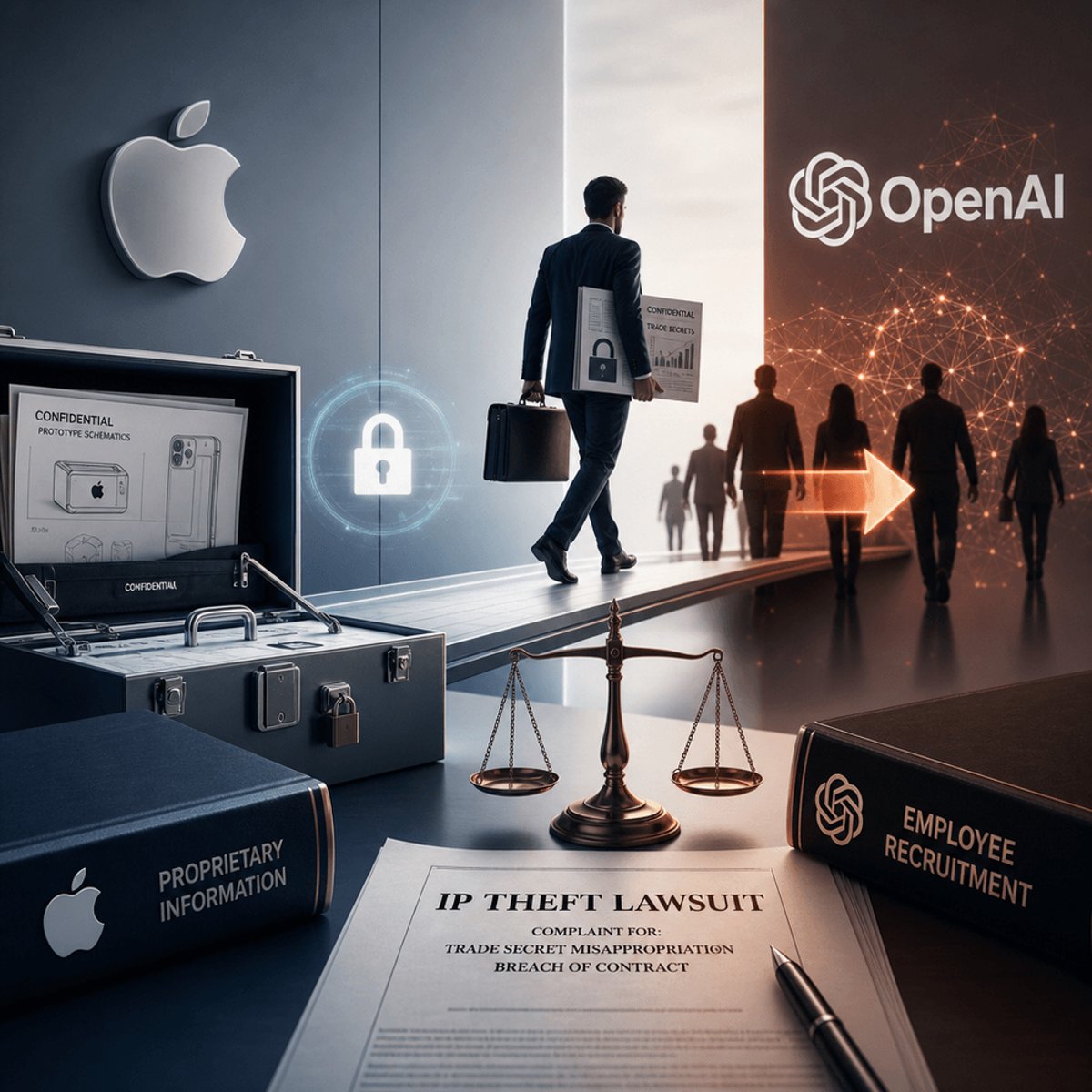
Apple just fired a legal shot that could reshape how AI companies recruit talent. The iPhone maker filed a lawsuit accusing OpenAI of systematically encouraging poached employees to bring confidential hardware designs, secret prototypes, and supplier relationships when they jumped ship. The complaint, which surfaced Friday, marks one of the most aggressive moves yet by a major tech company to protect its hardware IP from the AI industry's notoriously aggressive talent wars.
Apple isn't holding back. The Cupertino giant's lawsuit accuses OpenAI of doing more than just hiring away top talent - it alleges a deliberate campaign to extract Apple's most closely guarded hardware secrets through those departures. According to Wired's reporting, Apple claims OpenAI encouraged poached employees to bring over confidential presentations, secret prototypes, and critical supplier details.
The timing couldn't be more explosive. OpenAI has been quietly building hardware ambitions for months, with CEO Sam Altman reportedly meeting with manufacturing partners across Asia and exploring device partnerships. Now those plans crash headlong into Apple's legal firewall. The lawsuit suggests Apple believes OpenAI isn't just recruiting its people - it's mining them for intelligence that took years and billions to develop.
This goes way beyond typical non-compete disputes. Apple's allegations paint a picture of systematic IP extraction, the kind that could expose OpenAI to massive damages if proven. We're talking about hardware roadmaps, supplier pricing, manufacturing techniques, and prototype specifications - the crown jewels that let Apple maintain its legendary secrecy and supply chain dominance. If even a fraction of what Apple alleges is true, OpenAI handed its legal team a nightmare.
The AI company's valuation just got complicated. OpenAI recently hit valuations north of $80 billion in private markets, but trade secret litigation of this magnitude can crater investor confidence fast. Discovery alone could force OpenAI to expose internal communications about hiring practices and what new employees brought with them. That's the kind of transparency that makes VCs nervous and acquirers run for the hills.
Apple's move also signals how seriously traditional tech giants now view the AI talent exodus. Companies like Google, Microsoft, and Meta have watched hundreds of senior engineers decamp for AI startups, often taking institutional knowledge with them. Apple's lawsuit could embolden others to take legal action rather than just tightening NDAs and non-competes.
The hardware angle makes this particularly thorny. Software IP disputes often hinge on code comparisons and patent claims - messy but manageable. Hardware secrets encompass everything from thermal management tricks to supplier relationships to manufacturing tolerances. Apple alleges OpenAI now possesses details about how it sources components, negotiates with suppliers, and protects its supply chain from leaks. That's operational intelligence that can't be easily unlearned or returned.
OpenAI hasn't issued a formal response yet, but the company's in a bind. Denying knowledge of what employees brought over looks naive at best. Admitting they should have been more careful validates Apple's core argument. The safest play - claiming everything came from the employees' general expertise rather than specific documents - only works if discovery doesn't turn up smoking-gun emails about "bringing over" materials.
This lawsuit arrives as both companies navigate a delicate dance around AI integration. Apple has been widely reported to be exploring partnerships with OpenAI for on-device AI features, even as it develops its own models. That cooperation now seems impossible while litigation grinds forward, potentially forcing Apple to accelerate internal AI development or turn to competitors like Anthropic or Google.
The legal precedent here matters enormously for the entire AI industry. Courts have traditionally been sympathetic to trade secret claims when companies can prove deliberate theft rather than just knowledge transfer. If Apple can demonstrate that OpenAI specifically solicited confidential materials during recruitment, it could establish a new standard for how AI companies approach hiring from hardware giants. That would fundamentally reshape talent acquisition across Silicon Valley.
Beyond the immediate legal battle, this suit exposes deeper tensions about where AI companies fit in the tech ecosystem. Are they software companies that happen to need hardware, or are they becoming full-stack competitors that threaten everyone? OpenAI's rumored device ambitions suggest the latter, which makes Apple's aggressive legal response look less like paranoia and more like strategic defense.
Apple's lawsuit against OpenAI marks a watershed moment for the AI industry's talent wars. If the iPhone maker can prove its allegations, we're looking at potential damages that could reshape OpenAI's trajectory and send a chilling message to every AI startup that's been aggressively recruiting from hardware giants. But the bigger story here is about boundaries - where legitimate expertise ends and trade secret theft begins. That line has always been blurry in Silicon Valley, but this case could force courts to draw it in permanent ink. For now, OpenAI's hardware ambitions just hit a massive legal speed bump, and every AI company with former Apple employees is probably reviewing what they brought through the door.