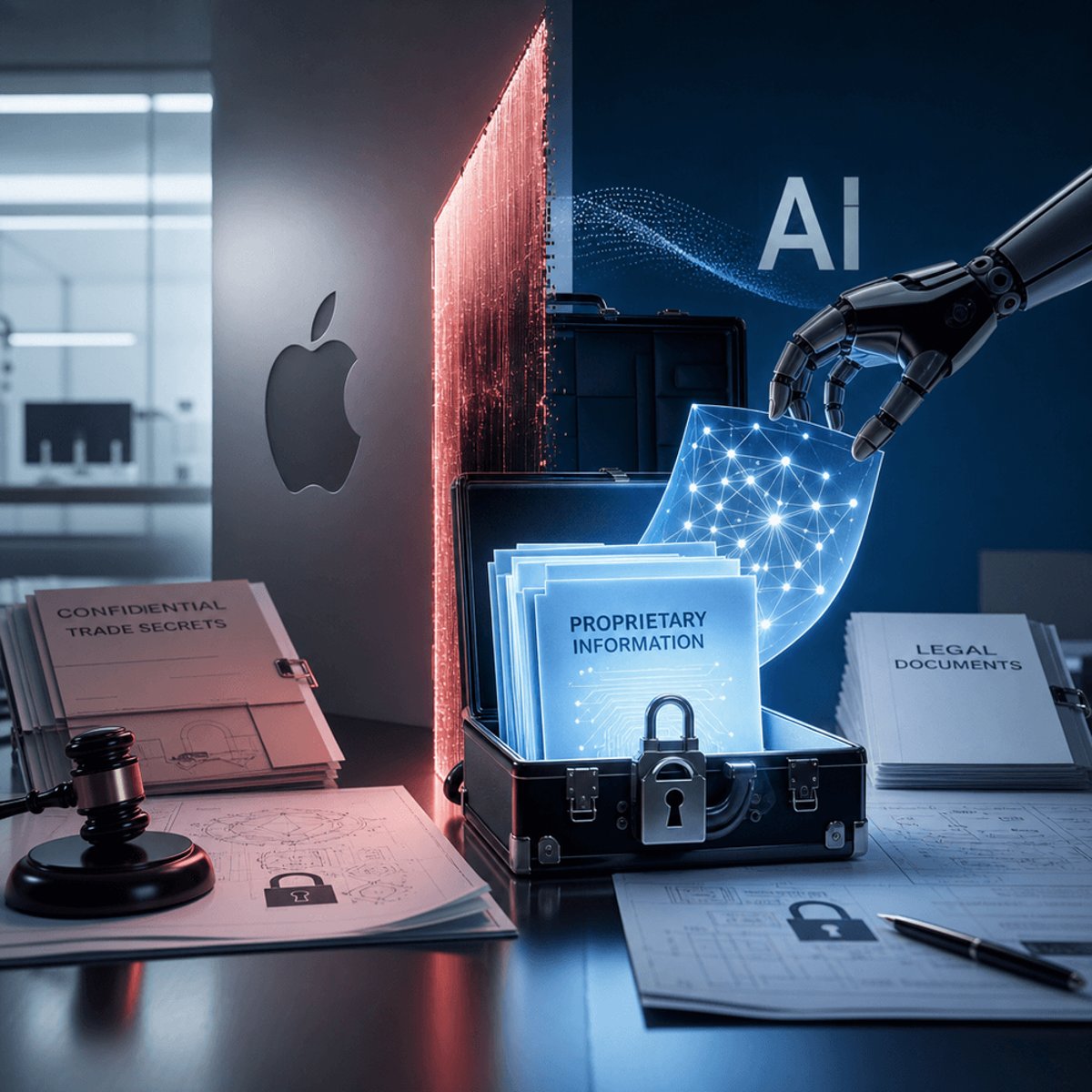
Apple just dropped a legal bombshell on OpenAI, filing a lawsuit that alleges the AI giant systematically stole trade secrets with direction from its senior leadership. The complaint, filed Friday, specifically points to a longtime former Apple employee now at OpenAI as central to the alleged misconduct. The suit marks a dramatic escalation in tensions between the tech titan and the AI startup, coming at a critical moment as both companies race to dominate the artificial intelligence landscape.
Apple isn't pulling punches in its latest legal filing against OpenAI. The Cupertino giant alleges that the AI company's senior leadership orchestrated a deliberate campaign to steal proprietary trade secrets, with a former Apple employee allegedly serving as the conduit for the theft.
The lawsuit, filed Friday in federal court, marks one of the most significant legal confrontations yet in the increasingly cutthroat AI industry. According to reporting by TechCrunch, Apple's complaint specifically alleges that the misconduct wasn't the work of a rogue employee but was instead directed from the top of OpenAI's organization.
At the center of Apple's allegations is a longtime former employee who made the jump to OpenAI. While the complaint doesn't publicly name the individual, sources familiar with the matter suggest this person held a senior technical role at Apple before departing for the AI startup. The timing and nature of the alleged theft could prove particularly damaging for OpenAI, which has cultivated an image of responsible AI development even as it races to maintain its lead over competitors like Google, Meta, and Microsoft.
The legal action comes at a fascinating inflection point for both companies. Apple has been steadily ramping up its AI capabilities, recently showcasing machine learning features across its product ecosystem. Meanwhile, OpenAI continues to push the boundaries of large language models and generative AI, commanding a reported valuation in the tens of billions despite being a relative newcomer compared to tech establishment players.
What makes this lawsuit particularly intriguing is what it reveals about the competitive landscape. Just months ago, industry observers speculated about potential partnerships between Apple and OpenAI as the iPhone maker sought to bolster its AI offerings. Those conversations now appear to be definitively off the table, replaced by allegations of corporate espionage.
The nature of the alleged trade secrets remains under seal, but they likely involve proprietary AI training methods, model architectures, or hardware optimization techniques that Apple has developed for its silicon chips. The company has invested heavily in neural engines and machine learning accelerators for its M-series and A-series processors, creating specialized technology that could give OpenAI significant advantages if improperly obtained.
For OpenAI, the lawsuit couldn't come at a more sensitive time. The company is reportedly in the midst of another funding round and faces increasing scrutiny over its corporate governance following previous leadership turmoil. Legal battles over intellectual property theft could spook investors and partners who've poured billions into the company's ambitious vision of artificial general intelligence.
Apple's decision to explicitly name senior leadership in its allegations suggests the company has substantial evidence of coordinated misconduct rather than opportunistic theft by a single employee. That strategic choice signals Apple is prepared for a protracted legal battle and isn't interested in a quiet settlement that would let OpenAI off the hook without accountability.
The tech industry has seen its share of trade secret lawsuits, from Waymo's case against Uber to various disputes in the semiconductor sector. But a direct confrontation between a company of Apple's stature and an AI darling like OpenAI raises the stakes considerably. The outcome could establish important precedents about employee mobility, trade secret protection, and competitive boundaries in the AI era.
Legal experts suggest Apple will need to prove not just that OpenAI obtained confidential information, but that the company knowingly used that information to gain unfair competitive advantage. That burden becomes easier to meet if Apple can demonstrate that senior leaders directed or encouraged the alleged theft, rather than simply failing to prevent it.
The lawsuit also highlights growing tensions around talent poaching in AI, where companies compete ferociously for researchers and engineers with specialized expertise. When those employees move between competitors, they inevitably carry knowledge and insights from their previous roles. Drawing the line between general expertise and protected trade secrets becomes increasingly difficult as AI capabilities become more central to every major tech company's strategy.
This lawsuit represents more than just another corporate legal dispute - it's a signal that the gloves are coming off in the AI wars. As companies pour billions into developing the next generation of artificial intelligence, the value of proprietary techniques and insider knowledge has never been higher. Apple's willingness to publicly accuse OpenAI's leadership of orchestrating trade secret theft suggests the iPhone maker believes it has a strong case and wants to send a clear message to the broader industry about protecting intellectual property. How this plays out in court could reshape not just the relationship between these two companies, but the entire landscape of AI development, talent mobility, and corporate competition in Silicon Valley's most important race.