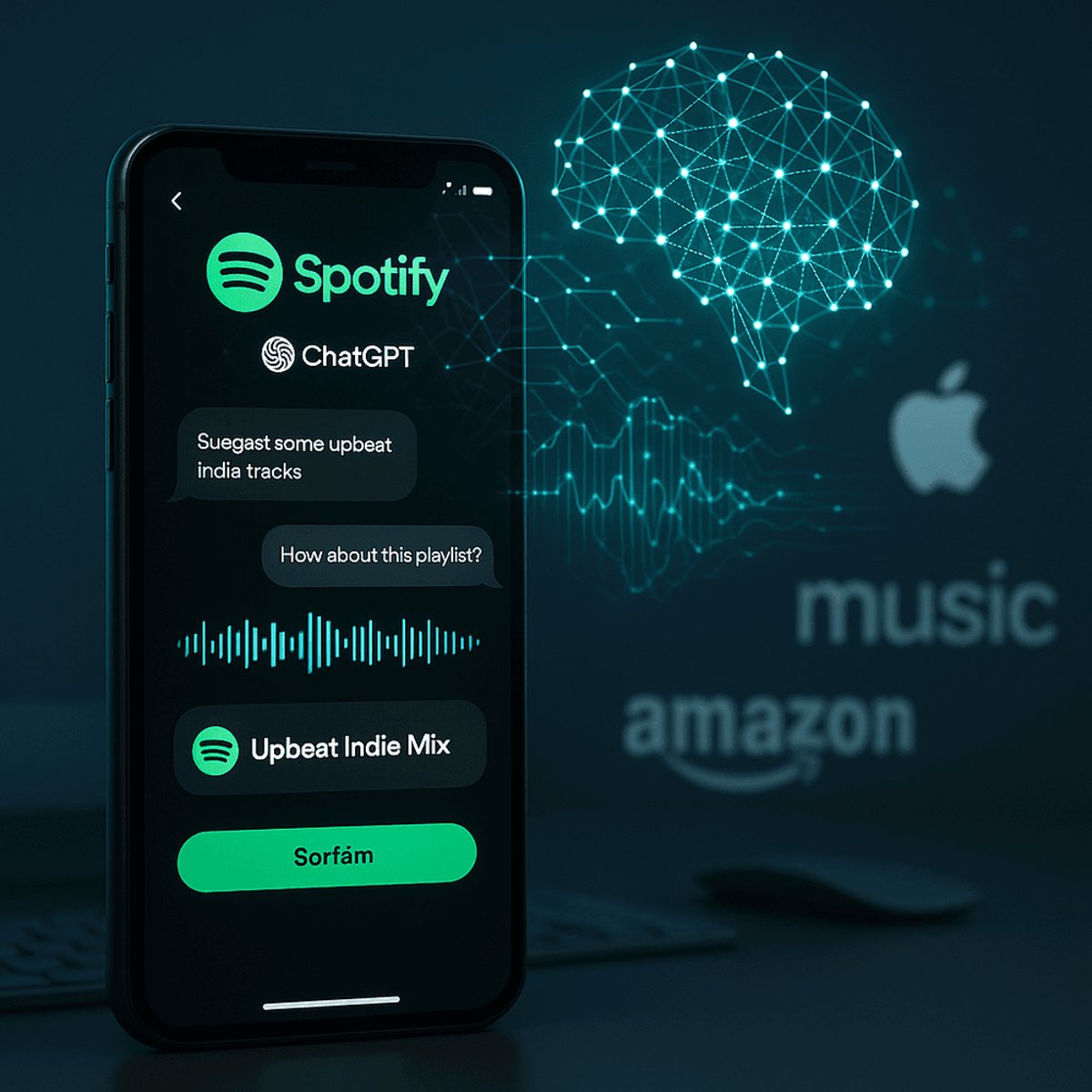
Spotify just made its biggest AI bet yet. The streaming giant partnered with OpenAI to integrate ChatGPT into its platform, a strategic move aimed at breaking free from the commoditized music streaming wars where Apple Music, Amazon Music, and YouTube Music all offer nearly identical catalogs at similar prices. With subscriber growth slowing across the industry, Spotify's turning to AI personalization as the new battleground for retention.
Spotify just threw down the gauntlet in streaming music's AI arms race. The company's partnership with OpenAI to integrate ChatGPT capabilities represents a fundamental shift in how music platforms compete - not on catalog size, but on how intelligently they can surface the right track at the right moment.
The timing reveals everything about the pressures facing streaming platforms. Apple Music, Amazon Music, and Spotify all license essentially the same 100 million songs at roughly the same $10.99 monthly price point. Differentiation has become nearly impossible through content alone, pushing platforms toward AI as the last frontier for competitive advantage.
Spotify's CEO Daniel Ek has long telegraphed this strategy. The company's been quietly building AI capabilities for years through its acquisition of audio intelligence companies and investments in machine learning recommendation engines. But partnering with OpenAI - the maker of ChatGPT - signals an acceleration of those ambitions at a critical moment for the industry.
Subscriber growth is slowing. The global streaming music market added just 12% new subscribers in 2025, down from 18% the previous year, according to industry data. That deceleration forces platforms to focus on retention and engagement rather than pure subscriber acquisition. AI-powered personalization becomes the stickiness factor that keeps users from churning to competitors.
The Spotify-OpenAI deal likely centers on conversational music discovery - letting users describe moods, activities, or even abstract concepts to generate playlists. Imagine asking "music for debugging code at 2am" or "songs that sound like a rainy Tuesday in November" and getting contextually intelligent results that go beyond simple genre matching. That's the kind of experience that Apple's Siri or Amazon's Alexa haven't cracked yet.
OpenAI's ChatGPT brings natural language understanding that could transform how people interact with music libraries. Instead of browsing pre-made playlists or typing artist names, users could have actual conversations about what they want to hear. The technology could analyze lyrics, musical elements, cultural context, and user history simultaneously to deliver genuinely novel discovery experiences.
But Spotify faces competition on multiple fronts. Apple has been integrating AI features into Apple Music through its own models, while Amazon leverages Alexa's conversational AI for music requests. YouTube Music taps into Google's search and recommendation infrastructure. The question isn't whether AI will define the next era of streaming - it's which platform builds the most compelling implementation first.
The partnership also reveals OpenAI's strategy of embedding ChatGPT across consumer applications. After deals with Microsoft and enterprise software providers, partnering with a platform that reaches 600 million monthly users gives OpenAI unprecedented access to consumer behavior data around music and audio content. That data becomes training fuel for future models.
Financially, the stakes are enormous. Spotify has struggled with profitability despite its market leadership, squeezed between music licensing costs and subscriber acquisition expenses. AI features that increase engagement and reduce churn could significantly improve unit economics without requiring renegotiation of expensive label deals. Every subscriber retained through better AI personalization drops straight to the bottom line.
The move puts pressure on Apple and Amazon to respond. Both companies have deep AI resources but haven't deployed them aggressively in music streaming. Apple's recent focus on spatial audio and hi-res streaming emphasizes audio quality over discovery intelligence. Amazon splits attention across multiple services. Spotify's singular focus on streaming gives it an execution advantage if it can move fast.
What remains unclear is how OpenAI's models will handle music recommendations compared to Spotify's existing algorithms. The company's Discover Weekly and Daily Mix features already use sophisticated machine learning. Integrating ChatGPT could either enhance those systems or create friction if the conversational AI conflicts with established recommendation patterns. Implementation details matter enormously.
Industry observers see this as the opening move in a broader AI transformation of digital media. If conversational AI proves effective for music discovery, expect similar integrations across podcast apps, audiobook platforms, and video streaming services. The technology could fundamentally change how people navigate vast content libraries across all media formats.
Spotify's ChatGPT partnership marks the moment streaming music shifts from a content war to an intelligence war. With catalogs essentially identical across platforms, the service that best understands what you want to hear before you know it yourself wins your subscription dollars. That race just got a lot more serious, and Apple and Amazon now face a uncomfortable question: can their AI match OpenAI's, or will they need partnership deals of their own? The answer will determine which streaming service dominates the next decade of digital music.