Every charity crypto token before 2026 failed the same test. Learn about the Philanthropic Token Trilemma and how WYDE's Causecoins finally cracked the code for sustainable crypto philanthropy.
Crypto philanthropy hit a major milestone in 2024. Donations exceeded $1 billion, a 386% increase from 2023. Fidelity Charitable received $786 million in cryptocurrency alone.
Yet here's the uncomfortable truth: not a single charity token project created perpetual, sustainable funding through trading fees before 2026.
Every one of them failed. Some spectacularly. Some quietly. But they all failed the same fundamental test.
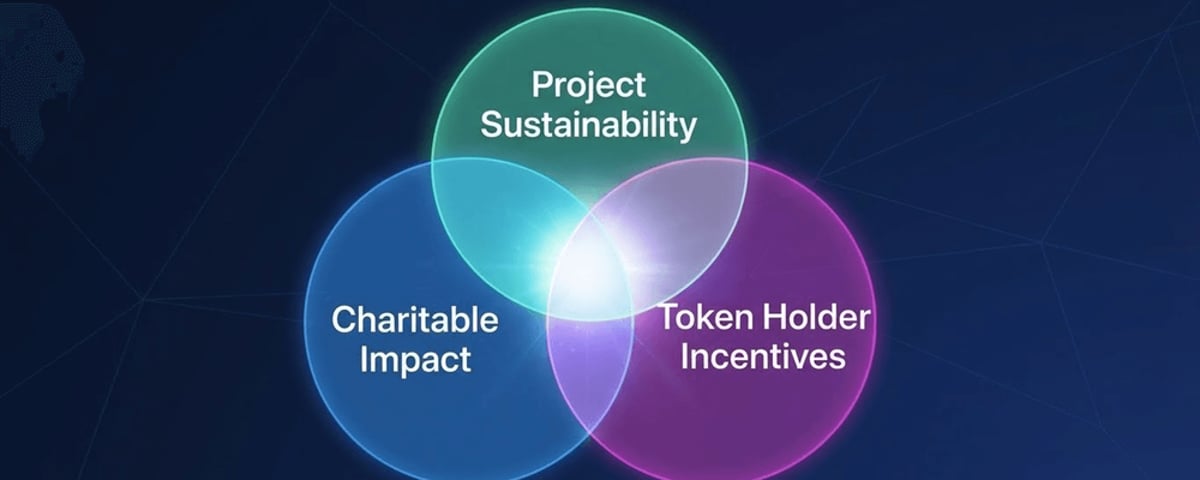
Why? Because they all fell victim to what I call the Philanthropic Token Trilemma.
What Is the Philanthropic Token Trilemma?
Like blockchain's famous scalability trilemma, charity tokens struggle to balance three essential pillars simultaneously:
-
Scalable Charitable Impact: Transparent donations that grow with real activity
-
Project Longevity: Dedicated funding for operations and multi-year survival
-
Token Holder Incentives: Financial rewards or governance rights that motivate participation
Every charity token before WYDE optimized for one or two pillars while completely ignoring the third. The result was always the same: collapse.
Projects that sent 100% of fees to charity had no money for development, marketing, or liquidity. They died within months.
Projects that rewarded holders generously had no charitable impact worth mentioning. They were memecoins with a conscience-washing veneer.
Projects that built real nonprofit partnerships but ignored holder incentives watched their communities evaporate when prices dropped.
The sweet spot where all three pillars converge? It just went live in December 2025.
The Graveyard of Good Intentions
The chart below tells a sobering story. Of the 15 largest charity crypto initiatives between 2021-2026, the majority either collapsed, failed, were cancelled, or refunded investors. The blue bars representing "completed" projects are almost all one-time fundraising events, not perpetual systems.
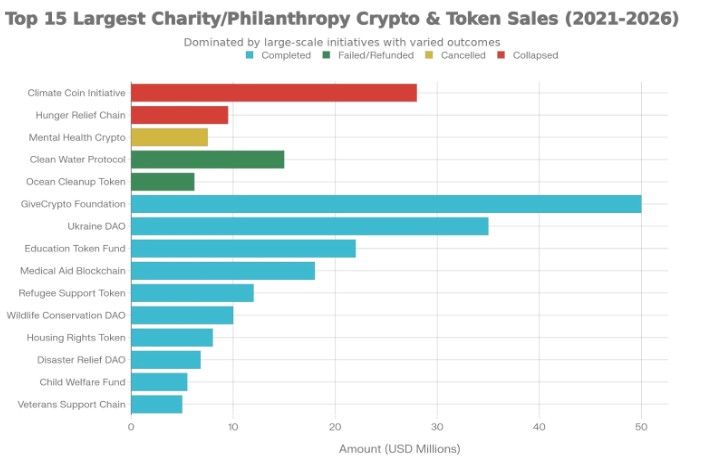
Figure 1: Top 15 Largest Charity/Philanthropy Crypto & Token Sales (2021-2026)
The Scam Epidemic
The worst failures were nothing short of fraud.
Save the Kids (2021) became crypto philanthropy's most infamous disaster. FaZe Clan influencers promoted this token claiming every trade would fund children's charities. The marketing was slick. The promises were bold.
The token crashed within days as insiders dumped their holdings. Anti-whale protections that were supposed to prevent large sales were removed at launch. False claims of $80,000 donated to Binance Charity. Binance confirmed they never received the funds. FaZe Clan suspended multiple members. Investors lost millions.
Orfano (2021) followed the same playbook. Marketed as donating 2% of transactions to children's charities, it featured a supposed $10,000 donation to Save the Children as proof of legitimacy. The BBC even ran a glowing profile of the founder as a "self-made crypto-millionaire giving back." Developers shut down the project and vanished with investor funds. The BBC quietly deleted their article. Another charity token, another rug pull.
Between 2021-2022, charity-adjacent projects stole over $175 million from investors. Rug pulls accounted for $2.8 billion or 37% of all crypto scam revenue in 2021. The charity angle wasn't a mission. It was a marketing tactic for thieves.
The Sustainability Crisis
Even legitimate projects with genuine intentions couldn't survive.
WWF-UK launched NFT tokens for wildlife conservation in February 2022. This wasn't some anonymous team. It was one of the world's most respected conservation organizations. They used energy-efficient Polygon blockchain. They had real nonprofit infrastructure.
Within 48 hours, environmental backlash forced cancellation. Only 174 tokens sold for $46,600 before they offered refunds. A major global charity couldn't make it work for two days.
GiveCrypto, backed by Coinbase and CEO Brian Armstrong, raised $3.5 million toward an ambitious $1 billion goal. Their mission was noble: direct cash transfers to people in need via cryptocurrency. They had resources, credibility, and institutional backing.
In July 2024, Coinbase announced they were winding down GiveCrypto entirely. Their honest assessment: "We were unable to create lasting impact with recipients, who returned to the same baseline after payment ceased." Seven years of effort. Zero sustainable model.
The FTX Foundation represented the most catastrophic failure. Sam Bankman-Fried positioned himself as crypto's most generous philanthropist, pledging billions to effective altruism causes. The FTX Future Fund disbursed $34 million to researchers and nonprofits.
Then FTX collapsed. Scientists found their grants evaporated overnight. Effective Ventures Foundation returned $26.8 million and listed its £17 million manor house for sale. Nonprofits that had built entire programs around promised FTX funding were left stranded.
The "Successful" One-Time Events
Even the projects marked as successes in the chart weren't sustainable systems. They were fundraising moments.
UkraineDAO auctioned an NFT of the Ukrainian flag for $6.5 million in February 2022. Ukraine received over $212 million in crypto donations during the first months of the war. Incredible. Meaningful. Historic.
But it was a one-time event driven by a humanitarian crisis, not a perpetual funding mechanism. Once the initial surge passed, donations slowed to a trickle. There was no ongoing trading activity generating continuous impact.
The Pineapple Fund donated $55 million in Bitcoin to 60 charities in 2017-2018. An anonymous donor liquidating their holdings for good causes. Admirable, but not replicable. Not systematic.
Every NFT charity auction, every crypto donation drive, every tokenized fundraiser faced the same limitation: they were events, not infrastructure.
When the mint sold out, donations stopped. When the crisis faded from headlines, funding dried up. When the anonymous whale finished giving, the well was empty.
No one built a system where normal trading activity automatically generated ongoing charitable impact. No one balanced the economics so the project could survive for decades while continuously funding causes.
Until WYDE.
How WYDE Finally Solved the Trilemma
WYDE is the world's first Impact Exchange. We built Causecoins where trading automatically funds verified nonprofits through smart contracts. No donation buttons. No fundraising campaigns. No reliance on altruistic whales.
Just trading. And with every trade, causes get funded.
The $EAT Token: Living Proof
Our flagship $EAT (End Hunger Token) launched December 10, 2025 on Base network and quickly listed on Coinbase. The mission: fund 1 billion meals addressing food insecurity affecting 47 million Americans.
By mid-January 2026, normal trading activity alone funded 4,184+ real meals through verified hunger relief partners like Feeding America and No Kid Hungry.
Not from a viral campaign. Not from a celebrity endorsement. Not from a crisis driving donations. Just people trading a token, and meals appearing in food banks.
That's the difference. Perpetual. Automatic. Sustainable.
The Breakthrough: Balanced Fee Distribution
Every failed charity token made the same mistake: they treated the trilemma as a zero-sum game. Send more to charity, and holders get less. Reward holders more, and charity suffers. Fund operations, and you're "taking from the cause."
WYDE rejected this false choice entirely.
Our innovation is equitable fee distribution: a 1-5% transaction fee split four equal ways:
This isn't charity versus profit. It's alignment. Holders benefit when trading volume increases. Trading volume increases when the project has resources for marketing and development. Marketing brings attention to the cause. Attention drives more trading. More trading funds more meals.
A virtuous cycle instead of a death spiral.
Legal Infrastructure Built for Decades
Previous charity tokens operated in legal gray zones. When regulators came knocking, projects folded. WYDE leverages Wyoming's Decentralized Unincorporated Nonprofit Association (DUNA) framework, a 2024 legal innovation specifically designed for blockchain governance of charitable missions.
This structure provides limited liability protection, voting rights for token holders, tax advantages (WYDE secured 501(c)(4) status in January 2026), and legal standing to contract and own assets.
Think DAO meets nonprofit with full legal recognition. Built for 10, 20, 100 year horizons. Not a weekend project hoping regulators don't notice.
Why This Moment Matters
The opportunity has never been larger. Over 52% of Americans aged 18-35 own digital assets. Yet 47% of crypto holders never donate to traditional charities.
They have capital. They care about causes. They lack infrastructure that matches how they actually behave online.
Projections suggest crypto donations could reach $2.5 billion in 2025 and potentially $89 billion by 2035 as blockchain markets expand and the Great Wealth Transfer moves $80+ trillion to younger generations.
People already trade trillions in tokens every year. Memecoins with zero utility generate massive volume. WYDE asks a different question: if people are already trading, why should those fees disappear into nothing instead of funding real outcomes?
The Bottom Line
For five years, crypto philanthropy was a graveyard of good intentions. Scams exploited the charity angle. Legitimate projects starved themselves of resources. One-time fundraisers celebrated brief victories before fading into irrelevance.
The Philanthropic Token Trilemma seemed unsolvable. Impact, sustainability, and holder incentives appeared mutually exclusive.
WYDE proved otherwise.
Through balanced fee structures, DUNA legal frameworks, verified 501(c)(3) partnerships, transparent on-chain tracking, and a model built for perpetual operation, we cracked the code.
$EAT's 4,184 meals funded in weeks from normal trading activity is the proof. Not a donation drive. Not a crisis response. Just infrastructure doing what infrastructure does: working automatically, day after day.
The Philanthropic Token Trilemma isn't unbreakable. It just required someone willing to build the right foundation instead of chasing the next viral moment.
That's what WYDE built. And we're just getting started.
About the Author: Aaron Rafferty is Co-Founder of WYDE, the world's first Impact Exchange, and a behavioral scientist focused on incentive design for social good. Follow @aaronjrafferty and @wydeorg on X.
Disclosure: This article is for informational and educational purposes only. It does not constitute financial, investment, tax, or legal advice. Always conduct your own research (DYOR) and consult qualified professionals before making investment decisions. Cryptocurrency investments carry significant risks including total loss of capital.