While tariffs and a soft freight market have battered America's trucking industry for years, a new customer has quietly become one of its biggest lifelines: the AI data center buildout. From HVAC units to fiber spools to server racks packed with semiconductors, nearly everything going into the country's exploding number of AI facilities has to arrive by truck, and that's turning warehouses of idle rigs into fully booked fleets.
There's an odd kind of good news story hiding inside America's AI infrastructure gold rush, and it's coming from an industry that rarely gets to celebrate anything these days: trucking. According to CNBC, the sprawling data centers going up across the country to power the AI boom are turning into an unlikely lifeline for a freight sector that's been stuck in a multiyear funk.
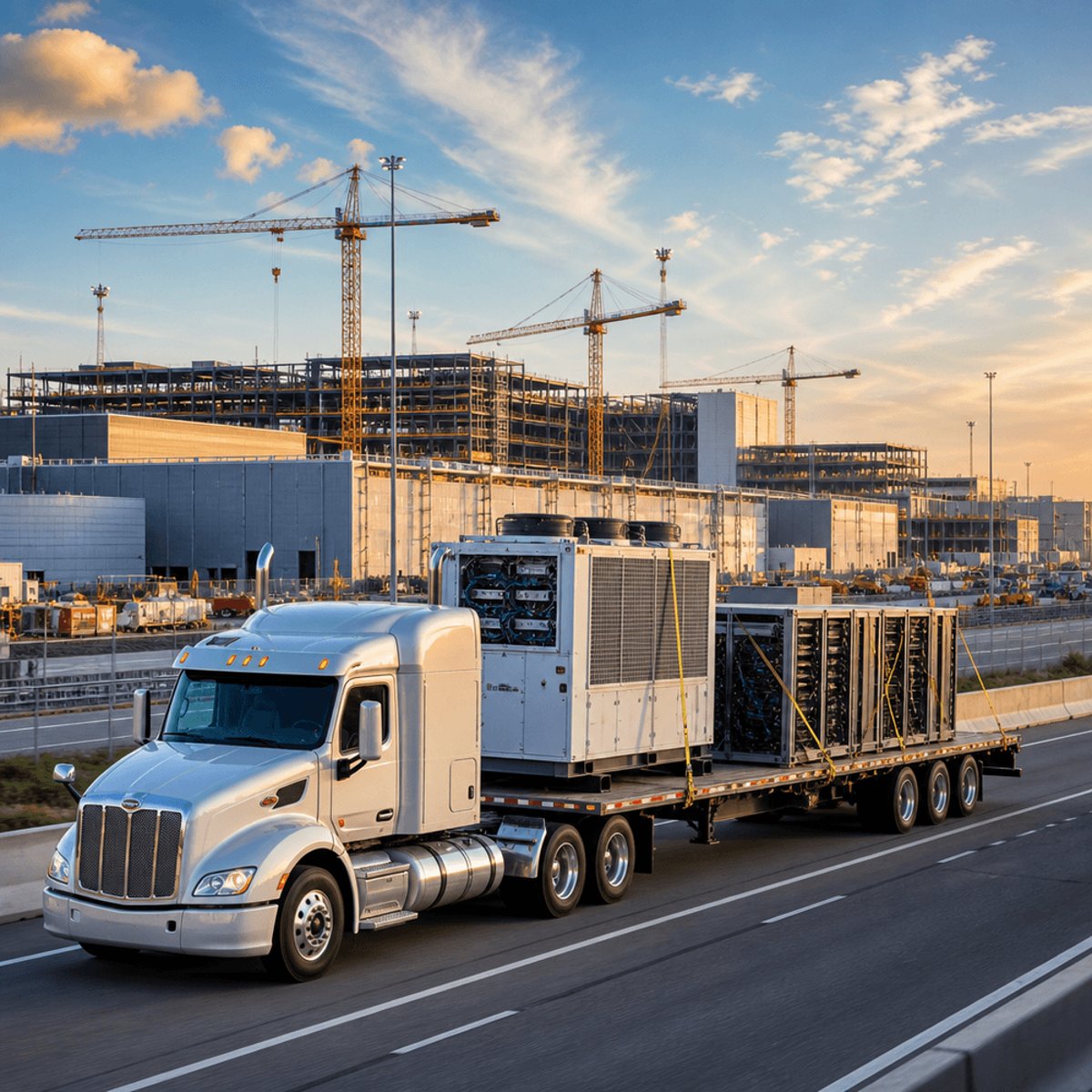
Here's the thing about a data center: it's not just racks of GPUs sitting in a warehouse. Building one means trucking in HVAC systems to keep the servers cool, miles of tubing and wiring, steel for the structure itself, and eventually the semiconductors and networking gear that make the whole thing run. Almost none of that moves by rail or air. It moves by truck, often on flatbeds and specialized carriers that can handle oversized industrial loads. And with Nvidia chips in short supply and every hyperscaler racing to stand up new capacity, that means a lot of trucks are suddenly very busy.
That's a big deal for an industry that's spent the better part of three years underwater. Freight rates cratered after the pandemic-era boom faded, and then tariffs on imported goods, equipment, and materials made things worse by shrinking the volume of consumer goods moving through ports and warehouses. Small carriers folded by the thousands. So when a new category of demand shows up that has nothing to do with retail cycles or consumer spending, truckers notice.
[embedded image: flatbed trucks hauling HVAC and server equipment near a data center construction site]
The scale here is hard to overstate. Amazon, Microsoft, Google, and Meta have collectively committed hundreds of billions of dollars to new data center campuses over the next few years, part of the broader AI infrastructure race that's reshaped capital spending across the tech industry. Every one of those campuses is, functionally, a massive logistics project before it's ever an AI project. Concrete, steel, cooling systems, and semiconductors all have to physically arrive on site, usually to rural or semi-rural locations that don't have existing rail or port access, which makes trucking the only realistic option.
"You've got sites in the middle of nowhere that suddenly need thousands of truckloads of specialized equipment delivered on tight construction schedules," one logistics executive told CNBC, describing the kind of demand data center buildouts are generating in regions like Virginia's data center alley, parts of Texas, and increasingly Ohio and the Midwest. That's a very different profile from typical freight, and it's paying well precisely because so few carriers are equipped to handle oversized, time-sensitive industrial loads.
Still, not everyone in the industry feels like they're riding the AI wave. Plenty of smaller, regional carriers that haul consumer goods and retail freight aren't seeing any of this benefit. Tariffs are still squeezing import volumes, e-commerce freight remains soft, and the data center boom is concentrated in specific corridors and specialized equipment categories that most general freight operators can't easily pivot into. It's created a split-screen economy inside trucking itself: a small, high-margin slice of the industry riding the AI infrastructure boom, and a much larger chunk still waiting for a broader freight recovery that hasn't arrived.
That divergence matters beyond trucking. It's a preview of how the AI buildout is rippling through the physical economy in uneven ways, boosting some sectors dramatically while leaving others flat. As AI capital spending shows no signs of slowing, and hyperscalers keep announcing new campuses on tighter timelines, the question isn't whether trucking demand tied to data centers will keep growing. It's whether that demand stays concentrated in a narrow slice of specialized carriers, or eventually spreads enough to lift the broader freight market that's still waiting for its own recovery.
The AI infrastructure race was always going to reshape more than just the tech industry's balance sheets, and trucking is turning out to be one of its more surprising beneficiaries. For an industry battered by tariffs and years of oversupply, hauling HVAC systems and semiconductors to the next AI campus is a rare bright spot, even if it's only reaching a narrow slice of specialized carriers for now. As hyperscalers keep breaking ground on new sites, expect the physical logistics behind AI to become just as closely watched as the chips and models themselves.