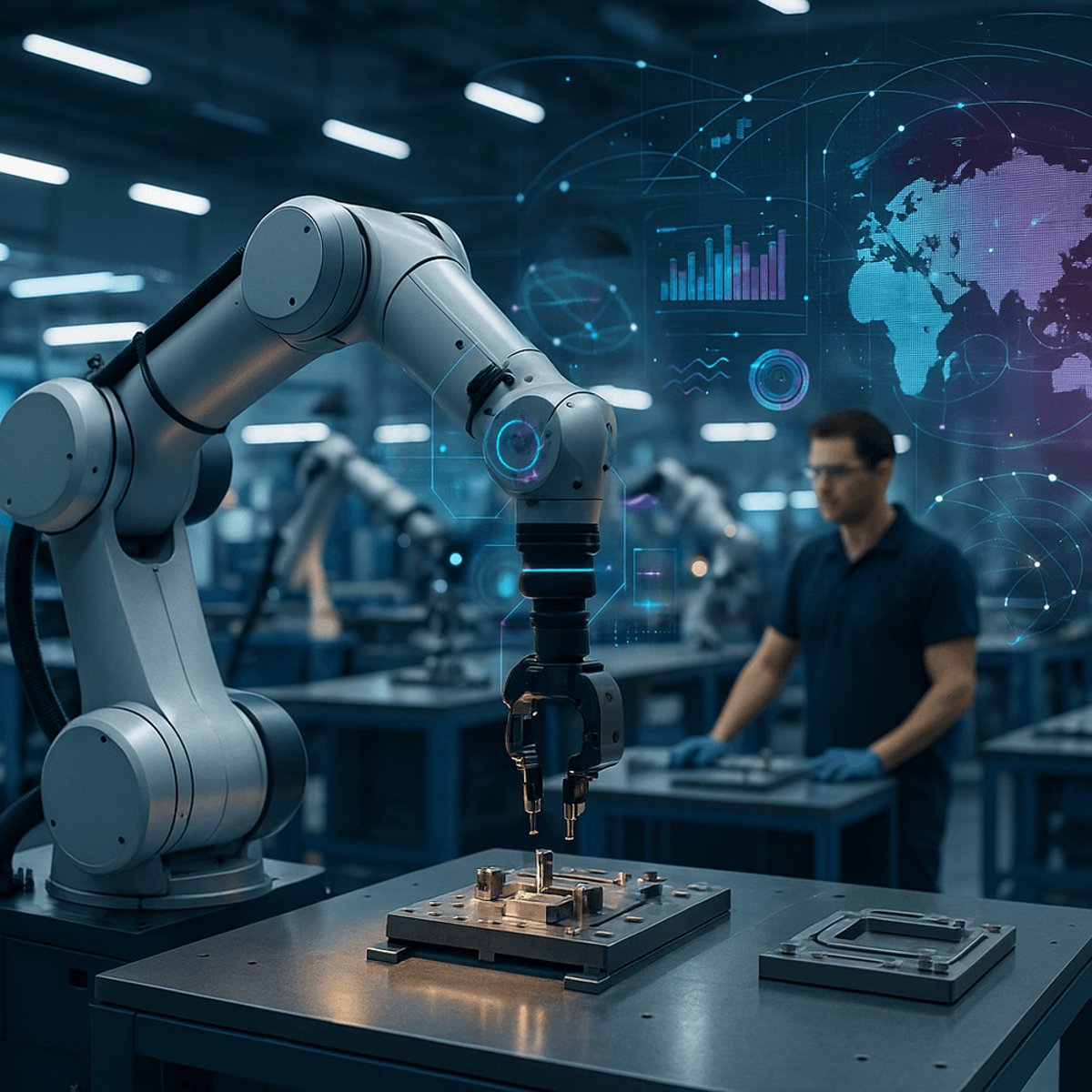
Google's robotics ambitions just took on geopolitical weight. Wendy Tan White, CEO of Alphabet subsidiary Intrinsic, is making a bold prediction that AI-enabled robotics could fundamentally alter which countries dominate global manufacturing. When labor costs stop being the deciding factor in where factories get built, the entire economic map changes. It's not just about automation anymore - it's about who controls the technology that makes human labor costs irrelevant.
Intrinsic, the robotics software company that Alphabet spun out of its X moonshot division, is building what CEO Wendy Tan White calls the Android of robotics. But her latest comments to CNBC suggest the stakes go way beyond creating a popular operating system. According to Tan White, AI-enabled robotics could fundamentally shift which nations hold manufacturing power - a prediction that carries enormous implications for trade policy, supply chains, and economic development.
The logic is straightforward but revolutionary. For decades, countries with low labor costs have dominated manufacturing. China's rise as the world's factory floor happened because companies could pay workers a fraction of what they'd shell out in Detroit or Stuttgart. Vietnam, Bangladesh, and Mexico followed similar playbooks. But if AI-powered robots can handle complex assembly tasks at costs that dwarf even the cheapest human labor, that entire calculus collapses.
Intrinsic has been quietly working on this problem since Google established it as a separate entity. The company develops AI software that lets industrial robots learn new tasks without extensive programming - think of it as making robots flexible enough to handle the kind of varied work that currently requires human adaptability. Tan White's background includes stints at Google's Robotics division and co-founding Movidius, a computer vision company Intel acquired for reportedly north of $350 million. She knows the hardware side and the AI side, which makes her economic predictions harder to dismiss as hype.
The manufacturing landscape is already showing early signs of this shift. Tesla has been pouring resources into factory automation at its facilities in Texas and Berlin, betting that highly automated US and European plants can compete with traditional low-cost manufacturing hubs. Amazon's warehouses increasingly rely on AI-guided robotics from companies like Amazon Robotics to handle tasks that once required armies of workers. These aren't just efficiency plays - they're strategic repositioning for a world where proximity to markets and access to AI talent matter more than access to cheap labor.
What makes Tan White's warning particularly significant is the timing. Global supply chains are already under massive strain from geopolitical tensions between the US and China, reshoring pressures, and the lingering aftermath of pandemic disruptions. Countries like India have been positioning themselves as the next manufacturing powerhouse, investing billions in infrastructure to attract factories leaving China. But if AI robotics mature faster than expected, that window could slam shut before India fully capitalizes on its labor cost advantage.
The technology isn't theoretical. Intrinsic already works with manufacturing partners to deploy its AI systems in real production environments. The company's approach focuses on making robots understand their tasks through machine learning rather than rigid pre-programming. This means a robot trained to assemble one product can adapt to a different product with minimal retraining - the kind of flexibility that's essential for modern manufacturing's quick product cycles.
But there's a catch that Tan White likely understands better than most: whoever leads in AI robotics infrastructure will hold enormous economic leverage. If Alphabet, Microsoft, or Chinese tech giants like Baidu control the software platforms that run tomorrow's factories, they effectively control manufacturing itself. It's the same dynamic that made Microsoft powerful when Windows dominated PCs, or Google when Android conquered smartphones, except now it's about physical production.
The geopolitical implications are already playing out in policy circles. The US CHIPS Act and similar industrial policies in Europe and Asia aren't just about semiconductors - they're about ensuring domestic access to the technologies that will define 21st century manufacturing. Countries that fall behind in AI and robotics risk becoming economically marginalized, unable to compete in high-value manufacturing and lacking the low labor costs that once provided an alternative path.
For Alphabet, Intrinsic represents a long-term bet that the company's AI advantages in areas like machine learning and computer vision can translate into dominance of a massive new market. The global manufacturing sector represents trillions in annual economic activity. Even capturing a fraction of that through software licensing could justify the years of investment Google has poured into robotics research.
Tan White's prediction isn't just about robots replacing workers - it's about technology replacing geography as the primary determinant of manufacturing power. Countries and companies that lead in AI robotics will have options that others don't: the ability to manufacture anywhere, respond faster to market changes, and operate at costs that make traditional labor arbitrage irrelevant. For nations that have built their economic development strategies around low-cost labor, that's an existential challenge. For tech giants like Alphabet that control cutting-edge AI, it's an opportunity to extend their influence from the digital world into physical production. The question isn't whether this shift will happen - the technology is already working in real factories - but how fast it arrives and who controls it when it does.