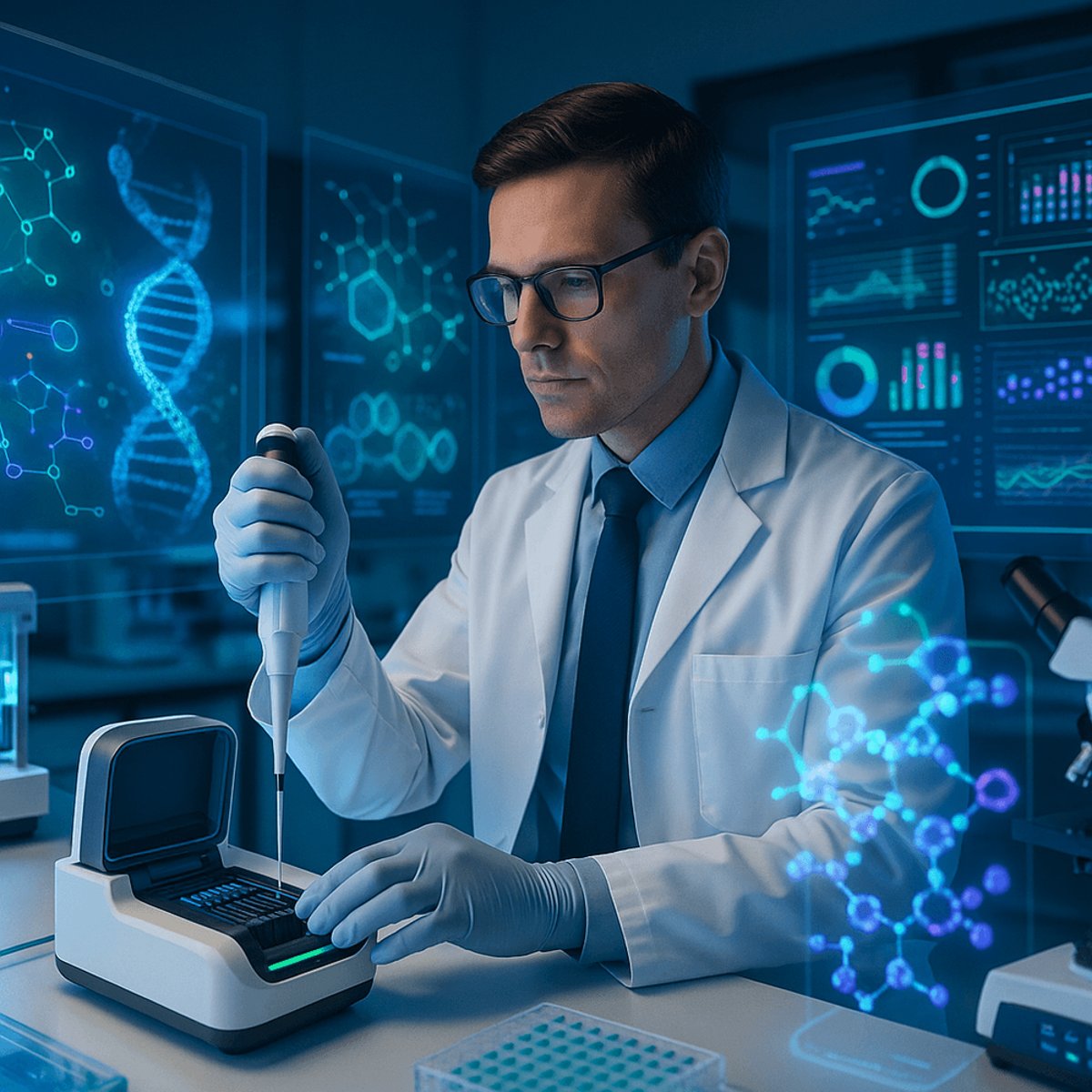
Modern biotech has the tools to cure thousands of rare diseases, but not enough scientists to do the work. That's changing fast as AI-powered automation transforms drug discovery and gene editing from labor-intensive research into scalable platforms. Speaking at Web Summit Qatar this week, executives from Insilico Medicine and GenEditBio revealed how their AI systems are filling talent gaps that have left rare disorders untreated for decades, potentially unlocking personalized therapies for millions of patients.
Insilico Medicine just unveiled what its CEO Alex Aliper calls "pharmaceutical superintelligence" - and the timing couldn't be more critical. Thousands of rare diseases still have zero treatment options, not because science lacks the capability, but because the industry lacks enough trained researchers to tackle them all. At Web Summit Qatar this week, Aliper laid out how AI is becoming the force multiplier that lets small teams punch above their weight.
The company recently launched its MMAI Gym platform, designed to train generalist large language models like ChatGPT and Gemini to perform as well as specialist models built for drug discovery. Insilico's goal is a multi-modal, multi-task AI that can solve different drug discovery challenges simultaneously with what Aliper describes as superhuman accuracy. "We really need this technology to increase the productivity of our pharmaceutical industry and tackle the shortage of labor and talent in that space," Aliper told TechCrunch in an interview.
The platform ingests biological, chemical and clinical data to generate hypotheses about disease targets and candidate molecules. By automating steps that once required legions of chemists and biologists, Insilico says it can sift through vast design spaces and nominate high-quality therapeutic candidates at dramatically reduced cost and time. The company recently deployed its AI models to identify whether existing drugs could be repurposed to treat ALS, a rare neurological disorder that affects roughly 5,000 people in the U.S. annually.
But the labor bottleneck doesn't end at drug discovery. Even when AI identifies promising therapies, many diseases require interventions at a more fundamental biological level - which is where GenEditBio enters the picture. The Boston-based startup is part of what its co-founder and CEO Tian Zhu calls the "second wave" of CRISPR gene editing, moving away from editing cells outside the body and toward precise delivery inside living tissue.
"We have developed a proprietary ePDV, or engineered protein delivery vehicle, and it's a virus-like particle," Zhu told TechCrunch. "We learn from nature and use AI machine learning methods to mine natural resources and find which kinds of viruses have an affinity to certain types of tissues." The company's goal is making gene editing a one-and-done injection directly into affected tissue - no ex vivo cell extraction required.
GenEditBio's NanoGalaxy platform maintains a massive library of thousands of unique, nonviral, nonlipid polymer nanoparticles that act as delivery vehicles for gene-editing tools. The AI analyzes data to identify how chemical structures correlate with specific tissue targets like the eye, liver or nervous system, then predicts which tweaks will help the vehicle carry its payload without triggering an immune response. The company tests its engineered protein delivery vehicles in wet labs, feeding results back into the AI to refine predictive accuracy for the next round.
This approach directly addresses scalability challenges that have kept gene therapies expensive and inaccessible. "It's like getting an off-the-shelf drug for multiple patients, which makes the drugs more affordable and accessible to patients globally," Zhu said. Her company recently received FDA approval to begin trials of CRISPR therapy for corneal dystrophy, marking a significant regulatory milestone for in vivo gene editing.
Yet both companies acknowledge they're running up against a fundamental constraint: data quality and diversity. Modeling the edge cases of human biology requires far more ground truth data than researchers currently possess. "The corpus of data is heavily biased over the western world, where it is generated," Aliper said. "I think we need to have more efforts locally, to have a more balanced set of original data, or ground truth data, so that our models will also be more capable of dealing with it."
Insilico is addressing this through automated labs that generate multi-layer biological data from disease samples at scale, without human intervention, feeding it directly into the AI-driven discovery platform. GenEditBio takes a different angle, arguing that the data AI needs already exists encoded in human DNA shaped by thousands of years of evolution. Only a small fraction of DNA directly codes for proteins - the rest acts like an instruction manual for gene behavior. That information has historically been difficult for humans to interpret but is increasingly accessible to AI models, including recent efforts like Google DeepMind's AlphaGenome.
The company tests thousands of delivery nanoparticles in parallel rather than sequentially, generating what Zhu calls "gold for AI systems" - data sets used to train models and support collaborations with outside partners. One of the next big leaps, according to Aliper, will be building digital twins of humans to run virtual clinical trials, though he cautions the technology is "still in nascence."
The stakes are high and getting higher. The FDA approves roughly 50 new drugs annually, a plateau that hasn't budged much in recent years even as chronic disorders rise with an aging global population. "There are still thousands of diseases without a cure, without any treatment options, and there are thousands of rare disorders which are neglected," Aliper said. "My hope is in 10 to 20 years, we will have more therapeutic options for the personalized treatment of patients."
The convergence of AI-driven drug discovery and next-generation gene editing could finally make that vision realistic. By automating the scientific grunt work that once required massive research teams, these platforms are turning rare disease treatment from an economically unviable niche into a scalable opportunity. For the roughly 400 million people worldwide living with rare diseases, that shift can't come soon enough.
The biotech industry is finally addressing a paradox that's persisted for decades - having the scientific capability to treat rare diseases but lacking the human resources to do so at scale. AI-powered platforms from companies like Insilico Medicine and GenEditBio are transforming drug discovery and gene editing from labor-intensive research into automated, scalable systems. As these technologies mature and data sets grow more diverse, the industry could shift from approving 50 drugs annually to unlocking personalized therapies for thousands of neglected conditions. The challenge now is generating enough high-quality, globally representative data to train AI models that work for all patient populations, not just those historically overrepresented in clinical research.