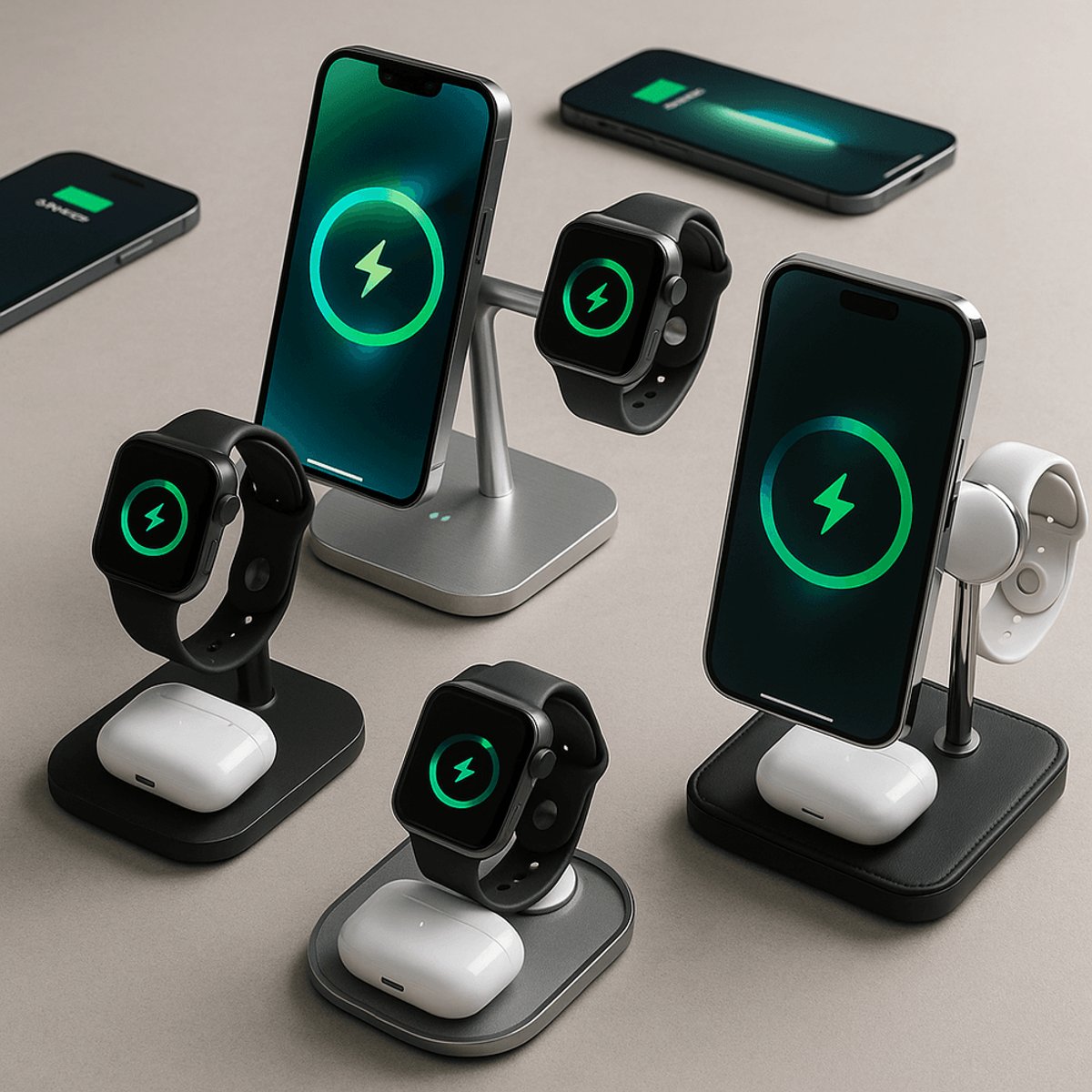
Wired has published its latest buying guide for 3-in-1 charging solutions tailored to Apple users. The comprehensive review, conducted by tech reporters Simon Hill and Julian Chokkattu, evaluates dozens of wireless charging stations designed to simultaneously power iPhones, Apple Watches, and AirPods. With the proliferation of charging accessories and new Qi2 certification standards, the guide helps consumers navigate an increasingly crowded market where charging speeds, build quality, and price points vary dramatically.
Wired just dropped its updated 2026 buyer's guide for anyone drowning in Apple charging cables. The tech publication put more than a dozen 3-in-1 wireless charging stations through rigorous testing, and the results reveal a market that's matured considerably since MagSafe's introduction.
The comprehensive review from reporters Simon Hill and Julian Chokkattu comes at a crucial time. As Apple continues pushing wireless charging across its product line and the new Qi2 wireless charging standard gains traction, consumers face a bewildering array of options. Prices span from budget-friendly $20 pads to premium $170 travel kits, but cost doesn't always correlate with quality.
According to the guide published on Wired, Qi2 certification has become the critical differentiator. The standard, which Apple helped develop, guarantees magnetic alignment and 15-watt fast charging for compatible iPhones - matching MagSafe performance but opening the door to third-party manufacturers. Products without this certification max out at 7.5 watts, significantly extending charge times.
Anker's MagGo Wireless Charging Station Pad earned recognition for versatility with older devices. The $70 charger offers Qi2-certified 15-watt charging for newer iPhones while maintaining backward compatibility with older models and even Android devices - a rarity in the category. The adjustable design supports Apple's StandBy mode in both portrait and landscape orientations, transforming an iPhone into a smart display.
But the reviewers found notable gaps in the market. Wasserstein created a niche product specifically for the Fitbit crowd - users who own iPhones and AirPods but prefer Fitbit trackers to the Apple Watch. The $50-56 charging station uses Lightning or USB-C plugs rather than wireless pads, with a dedicated Fitbit charger built in. It's a small market, but Wired's testing showed the approach works well despite concerns about long-term port wear.
The testing process revealed significant quality variations even among established brands. Several products from lesser-known manufacturers suffered from overheating issues during extended charging sessions. The Infinacore T3 Pro, despite Qi2 certification and a low price point, got warm enough during testing to raise battery health concerns. Weak magnets plagued multiple budget options, with devices slowly sliding out of alignment overnight.
Travel-focused designs emerged as a major category. Modern 3-in-1 chargers increasingly fold flat and come with carrying cases, targeting frequent travelers who want to consolidate gear. However, Wired's reviewers found that foldable designs often sacrifice charging speeds or introduce mechanical weak points. The UAG 3-in-1 Travel and Desktop Charger impressed with its build quality and included international plug adapters, but its $170 price tag without Qi2 certification made it a tough sell.
Premium materials command premium prices. Woodie Milano's Foldie combines Nappa leather with aluminum and glass for $131, folding neatly while looking distinctly upscale. But reviewers noted that users must supply their own wall charger - an increasingly common cost-cutting measure that manufacturers don't always communicate clearly.
The guide highlights a crucial consideration many buyers overlook: Apple Watch charging orientation. Some designs force the watch to lay flat, while others support Nightstand mode - the angled display that turns the watch into a bedside clock. For users who rely on their Apple Watch as an alarm, this seemingly minor feature becomes essential.
Compatibility concerns extend beyond just working with Apple devices. The reviewers tested each station with various iPhone models, AirPods generations, and Apple Watch sizes. Several otherwise solid chargers struggled with the larger Apple Watch Ultra or couldn't accommodate iPhones in thicker protective cases.
StandBy mode support - Apple's iOS 17 feature that turns a charging iPhone into an interactive display - factored heavily into recommendations. Chargers that hold iPhones at the wrong angle or don't offer landscape orientation can't take advantage of this functionality, limiting their usefulness for bedside setups.
Belkin and Anker dominated the recommendations, but not universally. While both manufacturers offer Qi2-certified options with solid build quality, specific models fell short. Anker's MagGo Wireless Charging Station Stand earned praise for its charging tree design and affordability at $80, but the offset Apple Watch pad proved slippery, requiring included adhesive stickers to prevent watches from tilting - an "inelegant solution," according to the review.
The testing also exposed a frustrating trend: unnecessary LEDs. Multiple chargers feature bright indicator lights that can't be disabled, creating light pollution in bedrooms. The Zike 3-in-1 Z557C Stand works perfectly well but includes a white LED that stays illuminated constantly - a deal-breaker for light-sensitive sleepers.
Budget options exist, but with significant compromises. The ESR HaloLock 3-in-1 Travel Wireless Charging Set costs just $20 and includes a cable, wall charger, and faux leather pouch. However, iPhone charging tops out at 7.5 watts, nearly doubling charge times compared to Qi2-certified alternatives.
Modular designs represent an interesting niche. Scosche's Baselynx 2.0 starts as a 2-in-1 stand for $75 but accepts add-on modules including an Apple Watch charger, USB-C ports, and even an AC outlet. The approach offers flexibility but gets expensive and bulky quickly as modules stack up.
Wired's exhaustive testing reveals a maturing but fragmented market for multi-device Apple charging solutions. The arrival of Qi2 certification provides a clear quality benchmark, but consumers still need to weigh factors like travel portability, StandBy mode support, and compatibility with their specific device mix. While premium options deliver superior materials and thoughtful design details, budget alternatives can serve basic needs - provided buyers understand the compromises in charging speed and build quality. For Apple users committed to the ecosystem, a well-chosen 3-in-1 charger consolidates bedside clutter and simplifies the nightly charging routine, but only if it matches individual usage patterns and device configurations.