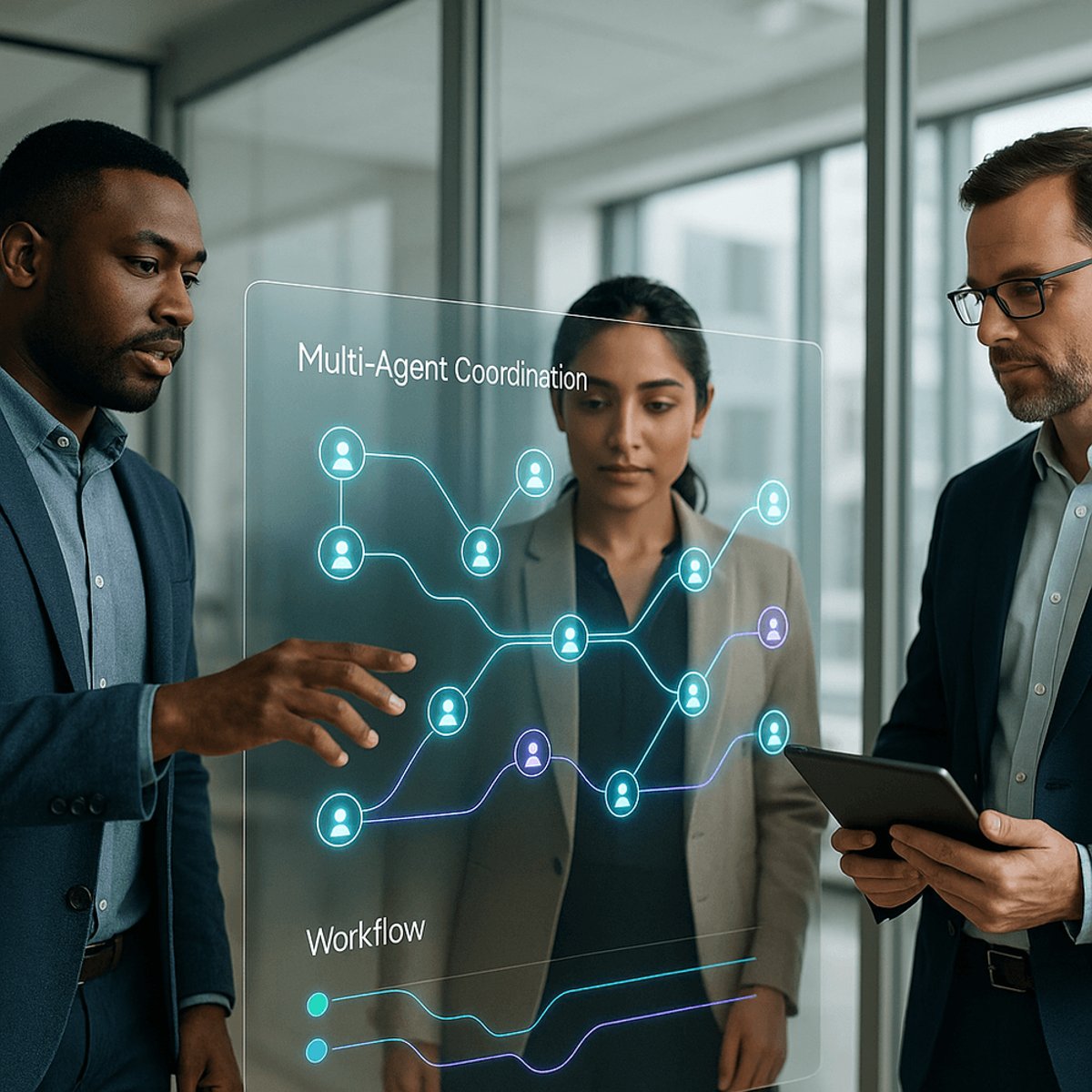
Anthropic just released Opus 4.6, introducing a breakthrough 'agent teams' capability that lets multiple AI agents coordinate on complex tasks simultaneously. The upgrade, arriving just three months after Opus 4.5's November debut, marks a strategic pivot for the company - transforming what was primarily a developer tool into a broader enterprise productivity platform. With a million-token context window and native PowerPoint integration, Anthropic is making a serious play for knowledge workers beyond the engineering department.
Anthropic is rewriting the rules of AI collaboration. The company dropped Opus 4.6 on Thursday, and the headline feature - agent teams - represents a fundamental shift in how AI assistants tackle complex work.
Instead of one AI agent plowing through tasks sequentially, Opus 4.6 lets you deploy multiple agents that divvy up the work and coordinate in real-time. "Instead of one agent working through tasks sequentially, you can split the work across multiple agents - each owning its piece and coordinating directly with the others," according to Anthropic's announcement. Scott White, Head of Product at Anthropic, told TechCrunch it's like having a talented human team working for you, with agents able "to coordinate in parallel [and work] faster." The agent teams feature is rolling out now in research preview for API users and subscribers.
This isn't just a technical flex - it's Anthropic acknowledging that its users have evolved way beyond the developer crowd. White revealed that the company noticed something unexpected: people who aren't professional software developers were flocking to Claude Code "simply because it was a really amazing engine to do tasks." Product managers, financial analysts, and workers from all kinds of industries started using what was essentially a coding tool because it just worked better than alternatives.
So Anthropic leaned into it. Opus 4.6 expands its context window to 1 million tokens - putting it on par with what the company's Sonnet versions 4 and 4.5 currently offer. That's enough headroom to handle sprawling codebases or process hefty documents without losing the thread. For enterprise teams juggling complex projects with mountains of documentation, that context capacity isn't just convenient - it's essential.
The PowerPoint integration might sound mundane, but it's actually quite clever. Previously, you could ask Claude to generate a PowerPoint deck, then you'd export it and manually edit in PowerPoint. Now Claude lives directly inside PowerPoint as a side panel. You're crafting the presentation right there with AI assistance at every step, tweaking slides without bouncing between tools. It's the kind of workflow improvement that saves hours on the aggregate.
What's interesting here is Anthropic's positioning. OpenAI and Google are locked in a race for raw model performance and consumer mindshare. Microsoft is embedding AI everywhere through Copilot. Meta is open-sourcing Llama to capture the developer ecosystem. Anthropic? They're going after the messy middle - knowledge workers who need AI that actually understands their workflow.
Opus 4.5 launched just last November, making this a remarkably fast iteration cycle. That pace suggests Anthropic is responding to real user feedback in near real-time, rather than sticking to a rigid roadmap. The agent teams feature, in particular, feels like a direct response to enterprise customers struggling to break down complex projects into manageable AI-assisted chunks.
The timing is sharp too. As enterprises move past the "let's try AI" phase into "how do we actually deploy this at scale," Anthropic is showing up with practical features that address real coordination challenges. Agent teams solve a problem that's been obvious to anyone trying to use AI for complex projects - one agent working alone eventually hits a wall on multifaceted tasks.
Competitively, this puts pressure on OpenAI to evolve beyond single-agent interactions with GPT-4 and whatever comes next. Google's Gemini has multimodal capabilities but hasn't emphasized this kind of task coordination. Anthropic is carving out differentiation not through raw benchmark performance but through workflow intelligence.
The research preview status for agent teams means Anthropic is being cautious - they're letting power users kick the tires before a full rollout. Smart move, given that multi-agent coordination can go sideways quickly if agents start working at cross purposes or duplicate effort. The company likely wants telemetry data on how teams actually get used in production before committing to general availability.
Anthropic is playing a different game than its rivals - less concerned with winning benchmarks, more focused on winning over the knowledge workers who actually pay enterprise bills. By evolving Opus from a developer-first tool into a genuine productivity platform with agent teams and native app integrations, they're building the kind of AI that slots into existing workflows rather than demanding users adapt to AI-first processes. The real test comes when those agent teams hit production at scale, but the early bet on practical collaboration over raw performance could prove prescient as enterprises move from experimentation to deployment.