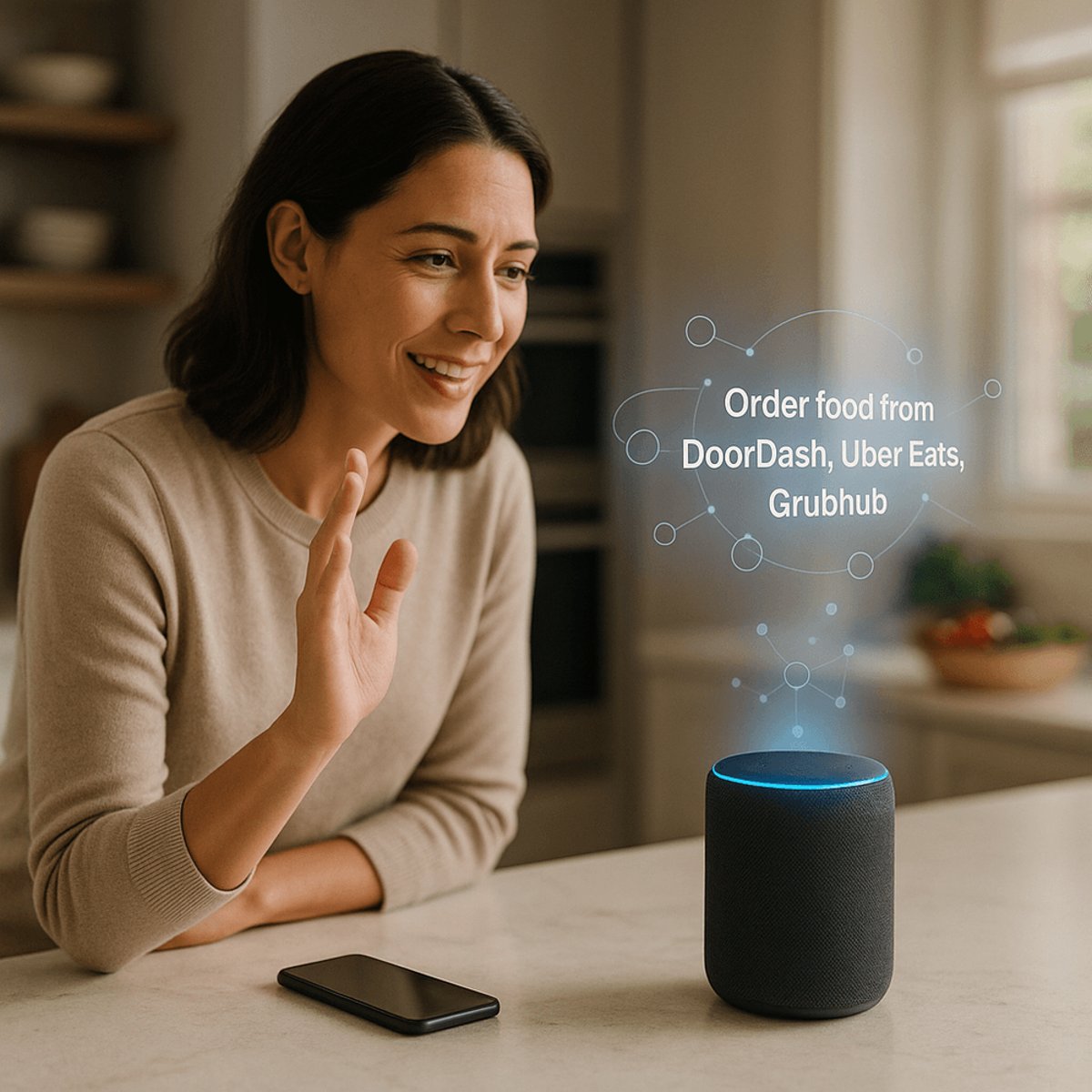
Amazon just made ordering takeout as easy as asking for it. The company's premium Alexa+ service now lets users browse menus, customize orders, and complete purchases through Grubhub and Uber Eats using natural conversation—no app switching required. The integration marks Amazon's latest push to make its AI assistant indispensable for everyday tasks, taking aim at the $80 billion U.S. food delivery market where voice ordering has historically struggled with clunky experiences.
Amazon is betting that talking to your kitchen counter is about to get a lot more useful. The company's premium Alexa+ service just gained the ability to place food delivery orders through Grubhub and Uber Eats, marking one of the most practical applications of conversational AI to hit the smart home yet.
The feature works exactly how you'd want it to—naturally. Instead of navigating rigid menu trees or repeating yourself multiple times, users can now tell Alexa to "order Thai food from that place on Main Street" and actually get somewhere. The AI handles restaurant discovery, menu browsing, customization requests, and checkout in a flowing conversation that adapts to how people actually talk.
According to Amazon's announcement, the integration uses what the company calls a "new interaction model" that eliminates the back-and-forth ping-pong that's plagued voice ordering since the early days of Alexa Skills. It's a subtle dig at the company's own previous attempts, which required users to launch specific skills and navigate painfully linear ordering flows.
The timing is strategic. Food delivery apps have trained consumers to expect frictionless ordering, but they've also created app fatigue. Americans now juggle an average of four different delivery apps according to industry data, each with different restaurant selections and pricing. Amazon is positioning Alexa+ as the universal interface that sits on top of that fragmentation.
For Grubhub and Uber Eats, the partnership offers a new customer acquisition channel at a time when both platforms are fighting to reduce their dependence on expensive in-app promotions. Voice ordering could theoretically capture impulse purchases and routine reorders—the "just get me dinner" moments when users don't want to scroll through menus on their phones.
But there's a catch. The feature is locked behind Alexa+, Amazon's subscription tier that launched alongside the company's generative AI overhaul of its assistant. While Amazon hasn't disclosed pricing or subscriber numbers for Alexa+, the company is clearly using integrations like this to justify the premium.
The technical execution matters here. Earlier voice ordering attempts from various platforms failed because they couldn't handle the complexity of restaurant menus—dietary restrictions, customizations, sides, drink options. Amazon appears to have solved this by building a more flexible conversational layer that can handle nested options without forcing users into rigid response patterns.
Amazon has been aggressively upgrading Alexa's capabilities since the generative AI wave hit. The company faces pressure from Google Assistant and increasingly capable smartphone AI features that threaten to make standalone smart speakers feel obsolete. Adding tangible utility like food ordering—something people do multiple times a week—gives Amazon ammunition to argue that dedicated smart home devices still have a role.
The integration also hints at Amazon's broader commerce ambitions. The company has long wanted Alexa to become a shopping interface, but voice commerce has struggled with product discovery and trust issues. Food delivery is a simpler use case—lower stakes, frequent repeat purchases, and limited selection paralysis. If Amazon can prove voice ordering works for takeout, it builds the foundation for more complex shopping scenarios.
What remains unclear is how the economics work. Does Amazon take a cut of orders placed through Alexa+? Are Grubhub and Uber Eats paying for the integration access? The company didn't address the business model in its announcement, but it's a crucial question for whether this feature becomes a sustainable advantage or just another promotional capability.
For now, the feature positions Amazon as the connective tissue between users and the fragmented delivery landscape. Whether that's enough to drive Alexa+ subscriptions—or change how people actually order food—will depend on execution quality and how quickly the novelty wears off once users encounter the inevitable edge cases where conversational AI still falls short.
Amazon is making a calculated bet that voice interfaces can finally crack the food delivery experience—if the AI is smart enough to understand how people actually talk. The Alexa+ integration with Grubhub and Uber Eats represents one of the most practical applications of conversational AI to reach consumers this year, moving beyond novelty commands to tackle a genuine friction point in daily life. Success hinges on whether the natural language processing lives up to the promise and whether enough users see value in paying for Alexa+ to access it. If Amazon pulls this off, it establishes a blueprint for voice commerce that extends well beyond takeout orders. If the experience stumbles on edge cases and customization complexity, it becomes another reminder of why people still reach for their phones instead of talking to the kitchen.