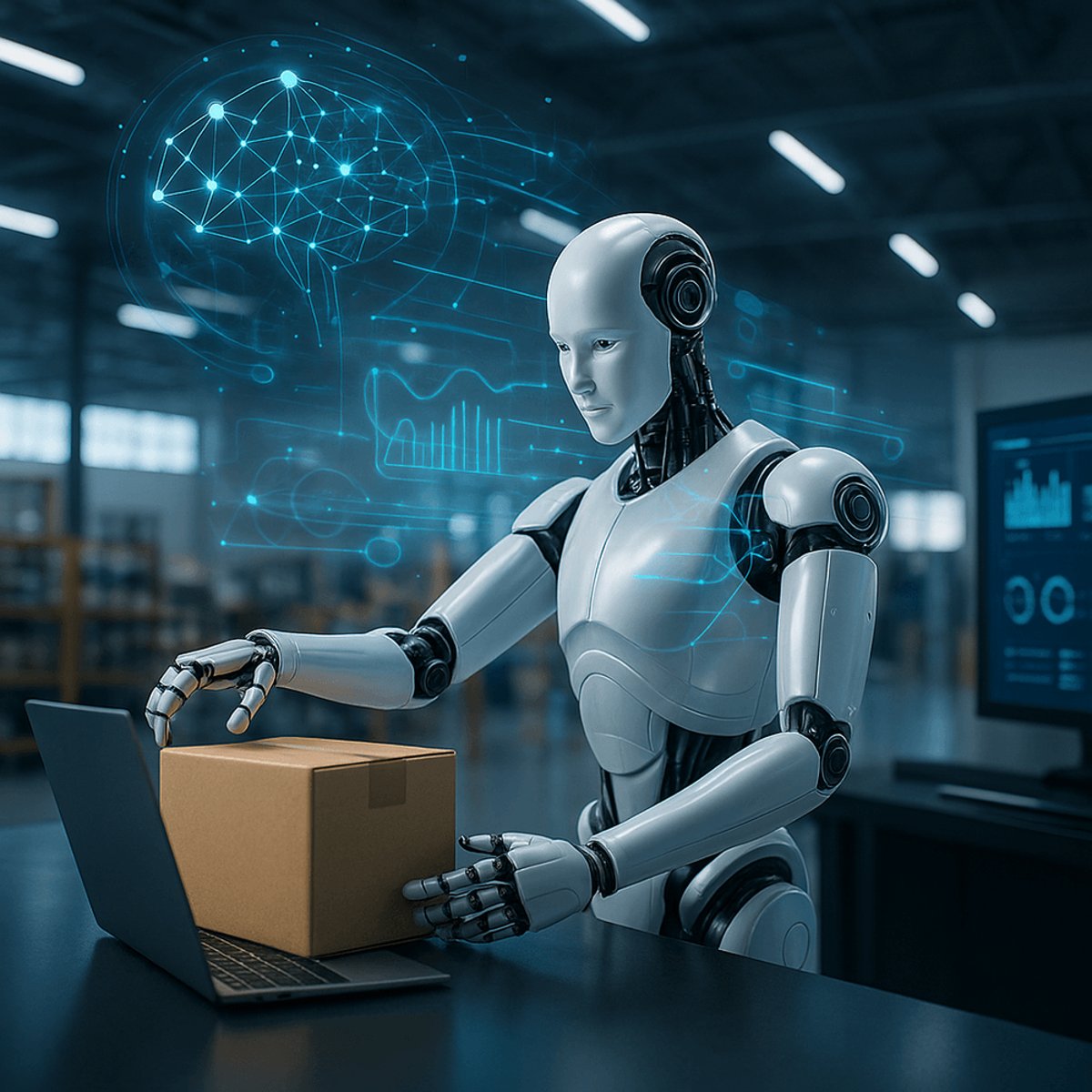
Alibaba just threw its hat into the physical AI ring, launching a new artificial intelligence model designed to power robots and autonomous systems. The move puts China's e-commerce giant in direct competition with Nvidia and Google, who've been racing to dominate what industry insiders are calling the next frontier of AI - systems that interact with and manipulate the physical world, not just generate text or images.
Alibaba is making its move into physical AI, announcing a new model designed to give robots the intelligence they need to navigate and interact with the real world. The launch comes as the industry pivots from chatbots to what Nvidia CEO Jensen Huang has called "the next wave of AI" - systems that don't just think, but act.
The timing isn't coincidental. Nvidia has been evangelizing physical AI for months, positioning its hardware and software stack as the foundation for everything from warehouse robots to humanoid assistants. Google isn't far behind, with its DeepMind division working on robotic models that can learn tasks through observation and practice. Now Alibaba's entrance signals that China's tech sector isn't content to watch from the sidelines.
Physical AI differs fundamentally from the large language models that dominated 2024 and 2025. While ChatGPT and Claude excel at understanding and generating text, physical AI models need to process sensor data, understand spatial relationships, plan complex movements, and adapt to unpredictable real-world conditions. It's the difference between describing how to pick up a coffee cup and actually doing it without spilling.
For Alibaba, the move makes strategic sense. The company operates massive logistics networks across China, with warehouses that could benefit from more intelligent automation. Its cloud division, Alibaba Cloud, has been pushing deeper into enterprise AI services, and robotics models could become a key differentiator against rivals like Tencent and Baidu. The physical AI play also aligns with China's national push for advanced manufacturing and automation.
The competitive landscape is heating up fast. Nvidia has been shipping its Isaac robotics platform and Jetson chips specifically designed for edge AI in robots. The company's advantage lies in its hardware-software integration - its GPUs train the models, its edge chips run them, and its simulation tools let developers test robots in virtual environments before deploying them. That's a tough ecosystem to crack.
Google's approach leans more heavily on software and research. DeepMind has published breakthrough papers on robotic learning, including models that can generalize across different tasks and environments. The company's robotics team has been testing systems that learn through demonstration rather than explicit programming, a technique that could dramatically lower the barrier to deploying useful robots.
But Alibaba brings unique advantages. Its access to real-world logistics data and manufacturing partnerships across China gives it training grounds that Western companies can't easily replicate. Chinese robotics startups have been proliferating, and an Alibaba-backed AI model could become the default choice for domestic developers, much like how its cloud services dominate in China.
The physical AI market is still nascent, but the stakes are enormous. Analysts project the robotics AI market could hit $20 billion by 2030, driven by applications in manufacturing, logistics, healthcare, and eventually consumer robotics. Whoever controls the foundational models could capture outsized value, similar to how OpenAI and Anthropic have dominated conversational AI.
There are technical hurdles ahead. Physical AI models need to work reliably in unstructured environments, handle edge cases gracefully, and operate safely around humans. They also face the sim-to-real gap - the challenge of transferring skills learned in simulation to messy real-world conditions where lighting changes, objects aren't perfectly placed, and unexpected obstacles appear.
The geopolitical dimension can't be ignored either. As US export controls restrict China's access to advanced AI chips, companies like Alibaba face pressure to build competitive AI systems with whatever hardware they can source. Physical AI might actually play to their strengths - it requires efficient inference on edge devices rather than massive training clusters, and China's robotics manufacturing base provides built-in deployment opportunities.
What happens next will depend on which approach proves most practical. Will Nvidia's integrated hardware-software stack dominate? Will Google's research breakthroughs translate to commercial advantage? Or will Alibaba's China-focused strategy and logistics expertise give it an edge in the world's largest manufacturing economy? The physical AI race is just getting started, and unlike chatbots, the winner will be determined by what works in the real world, not just what sounds impressive in a demo.
Alibaba's entry into physical AI marks a new phase in the global AI competition - one where success is measured not in benchmark scores but in robots that actually work. As Nvidia, Google, and now Alibaba race to define the standards for robotic intelligence, the implications stretch far beyond warehouses and factories. Whoever cracks the code for reliable, general-purpose physical AI won't just power the next generation of robots - they'll shape how AI integrates into every corner of the physical economy. For now, the race is wide open, and China just showed it's not sitting this one out.