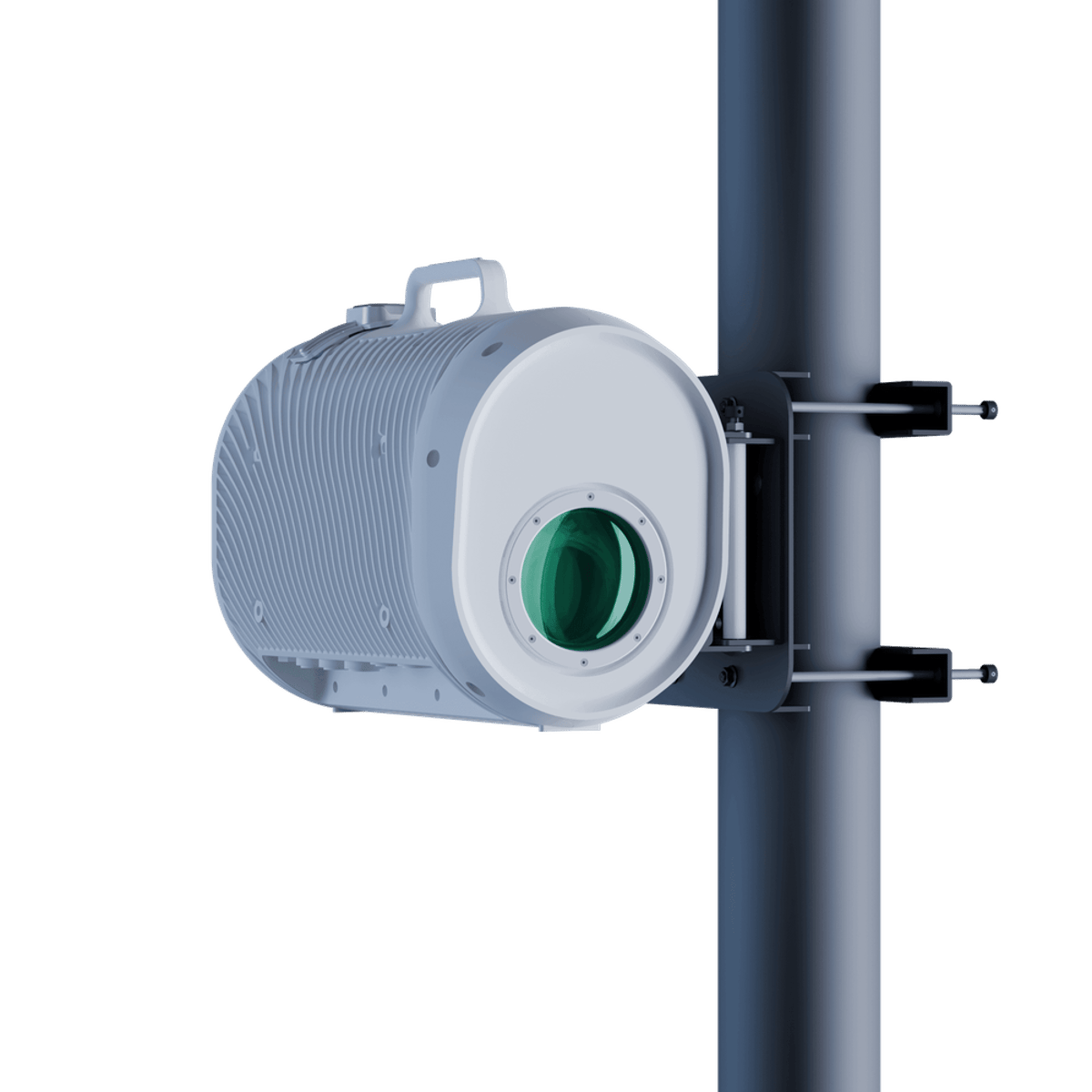
Taara, the Alphabet spinoff that emerged from Google's X moonshot lab last year, just launched Taara Beam - a shoebox-sized device that beams 25Gbps internet across cities using invisible light. The product represents a shift from the company's initial focus on connecting remote communities to targeting dense urban markets where fiber deployment remains expensive and slow. It's a direct challenge to traditional ISPs and a test of whether optical wireless can finally break into mainstream infrastructure.
Taara is taking its optical wireless technology from the mountains to the streets. The Alphabet spinoff, which spun out of Google's X lab in 2025, just unveiled Taara Beam - a compact device that transmits 25Gbps internet across cities using invisible beams of light. It's a bold play for urban infrastructure that could reshape how internet reaches buildings where fiber never will.
The shoebox-sized Beam weighs just 8kg and draws about 90W of power, making it practical for mounting on street poles and rooftops across metropolitan areas. According to The Verge, the device can maintain line-of-sight connections at distances up to 10km - roughly covering a small to mid-sized city with strategic placement. That's half the range of Taara's previous Lightbridge product, but the tradeoff comes with urban-friendly form factor and deployment flexibility.
Taara's technology relies on free-space optical communication, essentially turning the air between buildings into fiber-optic cable. The system fires focused beams of infrared light between transceivers, achieving throughput that rivals traditional fiber without digging up streets or navigating complex permitting. When Alphabet first developed the technology inside X, the goal was connecting underserved communities separated by geographic barriers. Now the company is betting that same tech can solve last-mile problems in cities where fiber economics don't make sense.
The timing reflects broader frustration with fiber deployment costs. While fiber remains the gold standard for bandwidth, running new lines in dense urban areas can cost thousands of dollars per building. Permits drag on for months, construction disrupts traffic, and building owners often resist installation. Taara Beam sidesteps all of that by turning rooftops and utility poles into network nodes. Install a device, align it with another Beam within 10km, and you've got 25Gbps of symmetric bandwidth.
But optical wireless faces its own challenges. Weather remains the obvious concern - heavy rain, fog, and snow can degrade or block light-based signals. Taara hasn't publicly detailed how Beam handles adverse conditions, though the company's earlier Lightbridge deployments in Africa and India suggest they've developed mitigation strategies. The physics still matter though. A dense fog bank can drop throughput or force failover to backup links. That's less of an issue for fixed wireless access supplementing existing networks, but it complicates using Beam as primary infrastructure.
The competitive landscape is getting crowded. Starlink and other satellite providers are pushing into urban markets with lower latency and improving bandwidth. Fixed wireless using 5G millimeter wave spectrum offers another alternative, though with more limited range and capacity than Taara's optical approach. Traditional fiber ISPs aren't standing still either - Google Fiber itself has resumed expansion in select markets, and municipal broadband projects are gaining traction. Taara needs to prove optical wireless can deliver not just comparable speeds, but comparable reliability and economics.
What makes Beam interesting is the deployment flexibility. A city could theoretically build out a metro-scale network in weeks rather than years, leapfrogging fiber incumbents in neighborhoods where infrastructure is weakest. That's particularly relevant for emerging markets where Taara cut its teeth, but it also applies to underserved areas in developed cities. Think industrial zones, low-income neighborhoods, or rapid-growth suburbs where fiber hasn't reached yet.
The spinout from Alphabet last year gave Taara independence to pursue commercial deals without navigating Google's corporate priorities. The company has been relatively quiet about funding and valuation, but the move to productize urban connectivity suggests they're building toward scale. Beam represents a more addressable market than remote connectivity - there are only so many villages separated by lakes, but thousands of cities struggling with last-mile economics.
Taara's challenge now is proving the technology at scale. Pilot projects are one thing. Building a sustainable business that competes with entrenched ISPs and well-funded satellite operators is another. The physics work, the hardware exists, but can optical wireless become infrastructure cities actually depend on? That's the question Beam needs to answer, one rooftop installation at a time.
Taara Beam represents a genuine alternative to fiber in markets where digging trenches doesn't make economic sense. The technology works, the form factor fits urban infrastructure, and 25Gbps at 10km range covers real use cases. But optical wireless still needs to prove it can handle weather, scale deployment, and compete on price with increasingly aggressive satellite and 5G alternatives. If Taara can crack those challenges, they're not just offering faster internet - they're offering a fundamentally different way to build networks. That's worth watching, even if the company's low profile and infrastructure focus keep it off most tech radars.