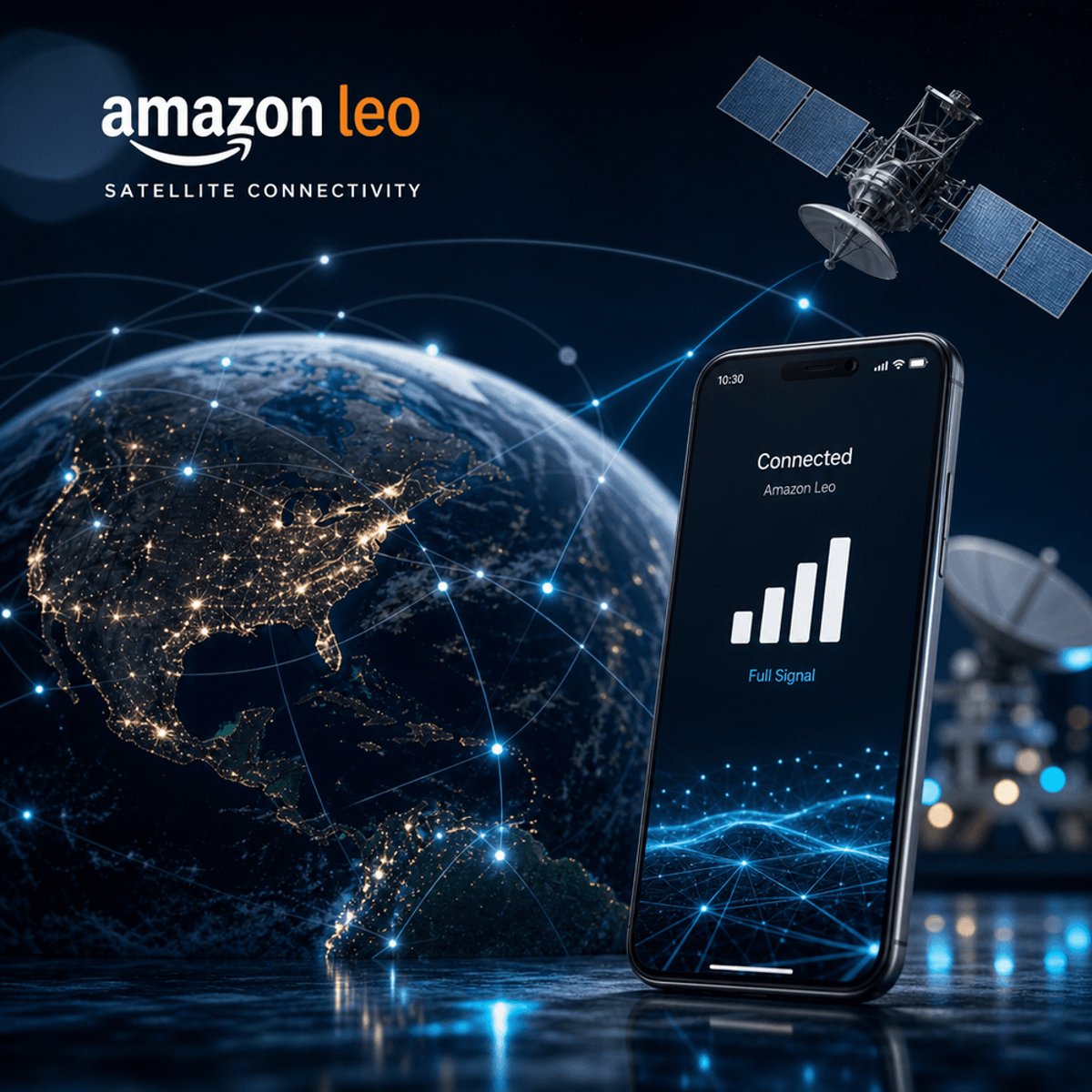
Amazon just escalated the space race for your smartphone. The company filed with the FCC to launch 5,105 satellites under its Amazon Leo division, designed to deliver voice calls, data, messaging, and emergency services directly to mobile devices without cell towers. The move puts Amazon on a collision course with SpaceX's Starlink and AST SpaceMobile in the exploding direct-to-device satellite market, leveraging spectrum from partner Globalstar to bypass traditional wireless infrastructure entirely.
Amazon is making its biggest bet yet on satellite connectivity, and it's not just about rural broadband anymore. The company's Amazon Leo division filed paperwork with the Federal Communications Commission to operate a massive 5,105-satellite constellation that will beam cellular services directly to your existing smartphone, no special hardware required.
The filing marks a strategic pivot for Amazon Leo, which has primarily focused on its Project Kuiper broadband initiative. By partnering with Globalstar to access its licensed spectrum bands, Amazon is entering the direct-to-device market that's been heating up dramatically over the past year. According to the FCC filing, the service will support voice calls, data transmission, text messaging, and emergency SOS features for standard mobile devices.
The competitive landscape just got a lot more crowded. SpaceX has been testing direct-to-cell capabilities with T-Mobile since early 2024, while AST SpaceMobile successfully demonstrated two-way voice calls from space to unmodified Samsung phones last year. Apple already partners with Globalstar for its Emergency SOS via satellite feature on iPhone 14 and newer models, though that's limited to emergency messaging. Amazon's filing suggests a far more ambitious full-service offering.
Globalstar's involvement is particularly interesting. The satellite operator has been quietly building out its constellation and spectrum portfolio, and this Amazon partnership could finally monetize those assets at scale. For Amazon, licensing Globalstar's spectrum sidesteps the years-long process of securing new frequency allocations and potentially accelerates time to market.
The technical challenge is enormous. Direct-to-device satellite service requires solving the physics problem of connecting low-power smartphone antennas to satellites orbiting 340 miles overhead while those satellites are moving at 17,000 miles per hour. Traditional satellite phones need large antennas and significant power because of these constraints. Companies racing to crack this code are developing satellites with massive phased-array antennas and sophisticated beamforming technology to focus signals on small areas.
For Amazon, this represents a natural extension of its infrastructure empire. AWS already powers a significant chunk of the internet's backend. Amazon's logistics network moves physical goods globally. Adding satellite-based telecom infrastructure would give the company yet another foundational layer of digital connectivity, potentially bundling satellite access with Prime memberships or AWS services.
The regulatory approval process could take 12 to 18 months, based on recent FCC timelines for similar mega-constellation applications. Amazon will need to demonstrate its satellites won't interfere with existing services, outline orbital debris mitigation plans, and prove it can meet deployment milestones. The FCC has been tightening requirements after criticism that it approved too many satellites without adequate safeguards.
Market implications are significant. Traditional wireless carriers have invested hundreds of billions in terrestrial cell tower networks. If satellite-to-phone service actually works at scale with acceptable quality and pricing, it could undermine the value of that infrastructure, particularly in rural and suburban areas where tower density is lower. AT&T and Verizon are already hedging their bets, exploring their own satellite partnerships.
The emergency services angle might be Amazon's strongest near-term value proposition. According to the National Telecommunications and Information Administration, roughly 20% of U.S. geographic area lacks reliable mobile coverage. Providing baseline connectivity for 911 calls, severe weather alerts, and emergency messaging in these coverage gaps could drive regulatory support and carrier partnerships rather than pure competition.
Amazon declined to comment on timeline, pricing strategy, or potential carrier partnerships beyond confirming the filing. Industry analysts expect the first test satellites could launch as early as 2027 if FCC approval comes through next year, with commercial service ramping up through 2028 and 2029 as the full constellation deploys.
Amazon's 5,105-satellite filing isn't just about connecting phones in dead zones - it's about controlling another layer of global infrastructure. If Amazon Leo can deliver on the promise of ubiquitous connectivity without cell towers, it fundamentally changes the economics of wireless service and shifts leverage away from traditional carriers. The real question isn't whether satellite-to-phone will work, but who will control it and how quickly they can scale. With SpaceX, Apple, AST SpaceMobile, and now Amazon all racing toward the same finish line, the next 24 months will determine whether your phone company needs towers at all.