Samsung just rolled out an AI Assistant built directly into its Interactive Displays, targeting one of education's toughest challenges - keeping every student engaged while managing individual learning needs. The new tool, announced today, packs live transcription, AI-powered search, and automated quiz generation into Android-based classroom screens, aiming to lighten teachers' workloads while making lessons more accessible. Early feedback from educators at Birmingham City Schools and STS Education suggests the features could reshape how teachers deliver and assess instruction in real-time.
Samsung is making a serious play for the education technology market with its new AI Assistant, a built-in app for Android-based Interactive Displays that handles everything from real-time transcription to automated quiz generation. The announcement comes as schools wrestle with balancing instruction delivery, student engagement, and individual learning needs - all without adding more to teachers' already packed schedules.
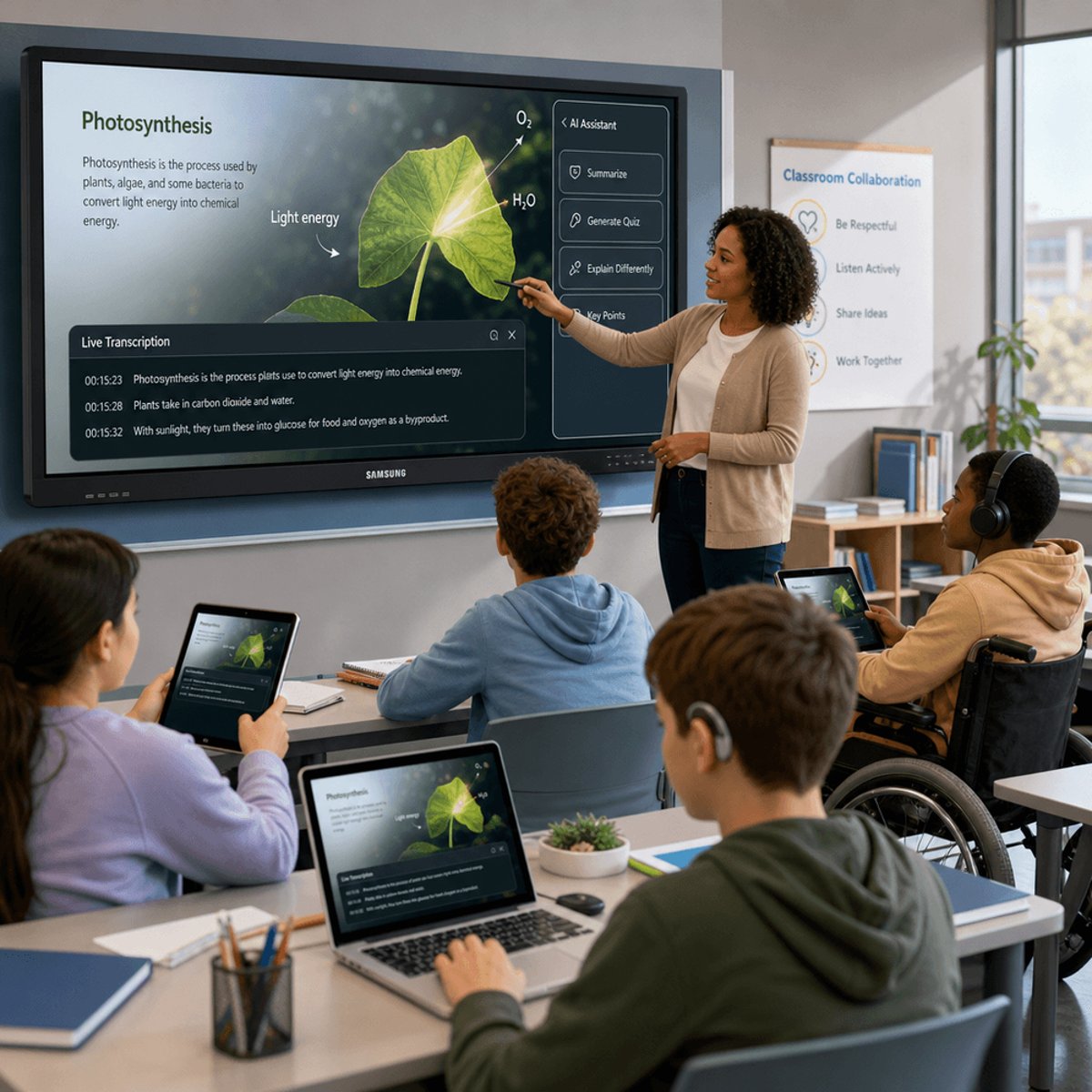
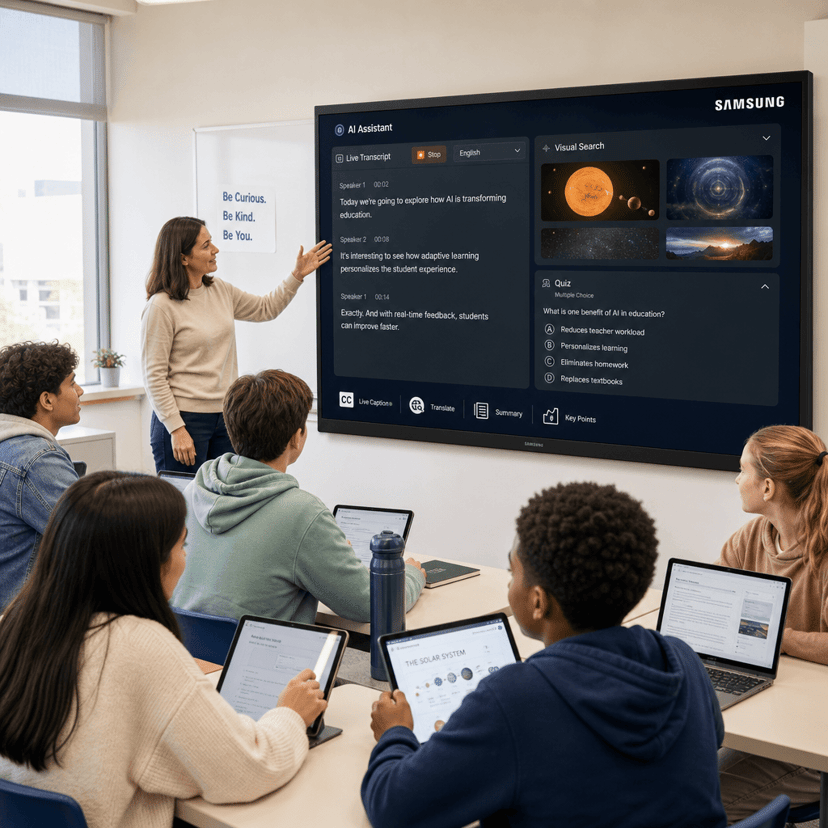
The centerpiece is Live Transcript, which converts spoken instruction into real-time text displayed on the screen. Teachers can adjust language, font size, and screen position on the fly. But here's where it gets interesting - when paired with Samsung's screen sharing app, students can pull that transcript onto their own devices, essentially giving every kid a front-row seat regardless of where they're sitting or whether they can hear clearly.
"Kids these days are turning on transcripts, even as they're watching movies at home, and it's helping with their understanding," Grant Wilson, Solution Architect AV/IFP at STS Education, told Samsung Newsroom. "What I really like is that you can pair it with the Samsung screen sharing app, so every student in the classroom has a front-row seat to the screen from their own device."
The tech addresses a real accessibility gap - in large lecture halls or for students with hearing difficulties, spoken instruction alone often isn't enough. By pushing transcripts to personal devices, Samsung's sidestepping the limitations of physical classroom setup.
Then there's Circle to Search, Samsung's answer to the mid-lesson scramble for supplemental materials. Teachers can circle any image or object on screen to instantly pull up related images, videos, and web resources. Results get added directly to the whiteboard with a press-and-hold, keeping the lesson flowing without tab-switching or typing searches.
Tambra Clark, Technology Integration Facilitator at Birmingham City Schools and a Samsung Solve for Tomorrow Top 10 winner, highlighted the time savings. "Being able to use that Circle to Search feature just saves a lot of time where you don't have to go in and type in certain words, content or videos," Clark said in the Samsung announcement. "Everything comes up at once simply by circling that word."
The feature builds on Google's existing Circle to Search functionality but adapts it specifically for classroom workflows - think less consumer convenience, more instructional efficiency.
As lessons wrap up, AI Quiz steps in. Teachers generate quizzes based on transcripts from recorded lessons and uploaded materials, with the system creating questions that align with what was actually taught. Students join via QR code or link from their devices, submit answers, and teachers reveal correct responses with explanations after each question.
The results dashboard shows completion rates, average scores, and correct answer rates per question - giving teachers immediate visibility into which concepts need reinforcement. "You can see where the students are at, and you're able to identify areas of improvement with that quiz," Clark noted.
Voice-recorded lessons automatically save to My Lessons, where teachers can revisit transcripts, review AI-generated summaries, and share materials for future classes. It's essentially building a searchable library of instruction that teachers can repurpose or students can reference later.
Shaun Taylor, Director of Sales at STS Education, zeroed in on the differentiation angle. "The word that I would use from my experience is differentiation," Taylor said in the announcement. "Having tools that allow students to engage at their own pace helps support different learning needs."
The AI Assistant requires compatible Android-based Samsung Interactive Displays, and feature availability varies by model and region. Samsung notes that the AI may provide inaccurate information and can't guarantee response reliability, though user inputs aren't used for model training. An external microphone is required for voice features and isn't included with the displays.
The education tech push comes as Samsung competes with established players like Google Classroom, Microsoft Teams for Education, and interactive display makers like Promethean and SMART Technologies. Unlike software-only platforms, Samsung's betting on hardware integration - embedding AI directly into the displays schools are already buying.
Early educator feedback suggests the approach resonates. Birmingham City Schools and STS Education are already deploying the platform, with both organizations highlighting how the tools reduce prep time while supporting varied learning styles. The real test will be whether schools see measurable improvements in student outcomes and whether the AI features justify the hardware investment.
For now, Samsung's carved out a distinct position - not just selling screens, but selling screens that actively participate in instruction. Whether that's enough to shift purchasing decisions in a budget-constrained education market remains to be seen, but the company's clearly betting that AI-powered differentiation is the unlock schools have been waiting for.
Samsung's AI Assistant isn't just another education software play - it's a hardware-embedded bet that schools want teaching tools built directly into the displays they're already purchasing. By bundling live transcription, intelligent search, and automated assessment into Interactive Displays, Samsung's targeting the time crunch and accessibility challenges that plague modern classrooms. Early adopters at Birmingham City Schools and STS Education are already seeing time savings and differentiation benefits, but the real measure will be whether schools see enough instructional impact to justify the investment. As education budgets tighten and AI tools proliferate, Samsung's wagering that integrated, purpose-built classroom AI will win out over bolt-on software solutions. The next year will show whether educators agree.