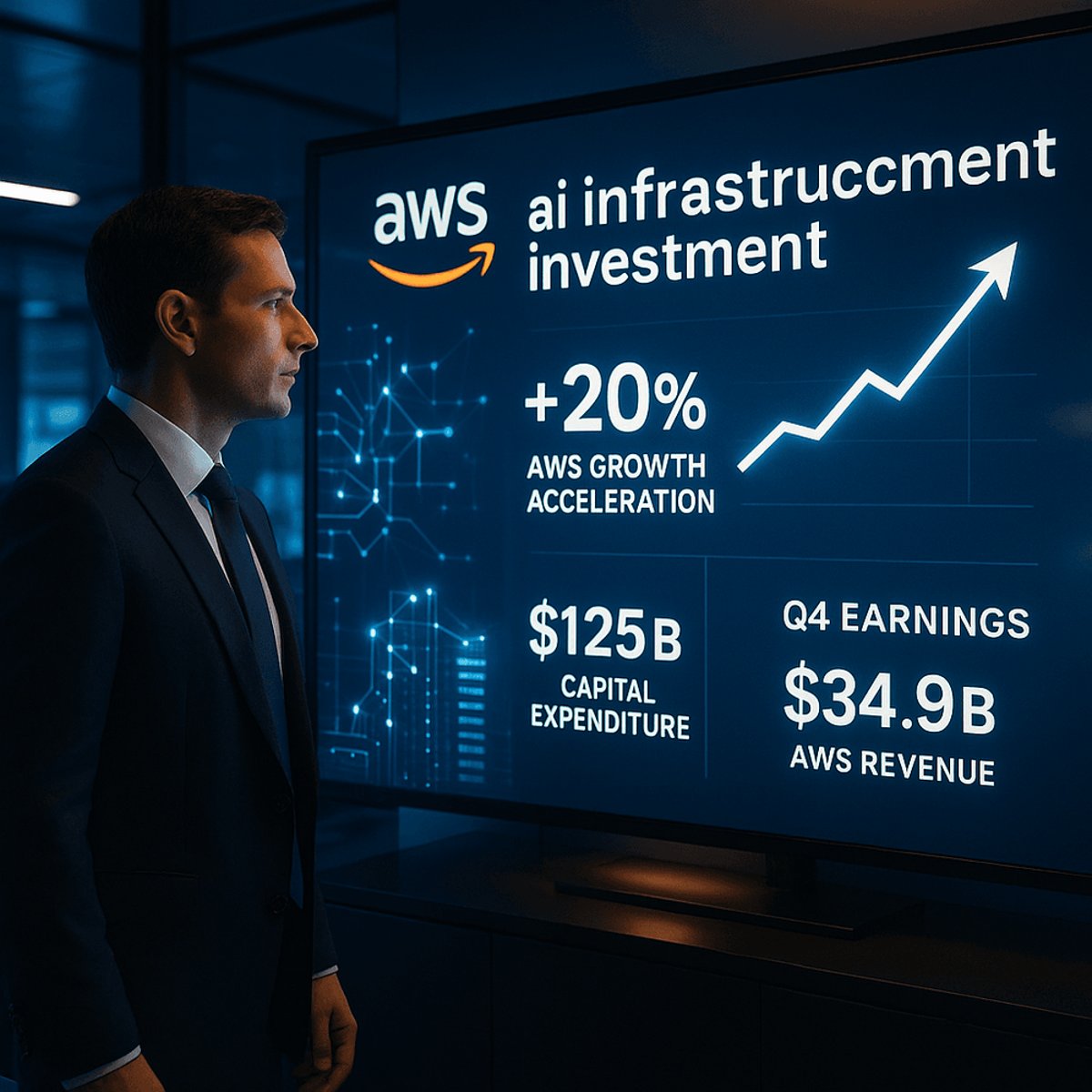
Amazon drops its fourth-quarter earnings report today, and investors are zeroing in on three critical flashpoints: whether AWS can sustain its acceleration past 20% growth, how high the company's AI infrastructure spending will climb beyond $125 billion, and whether the recent elimination of 16,000 corporate jobs signals a deeper strategic reset. The numbers arrive as CEO Andy Jassy faces mounting pressure to prove Amazon isn't falling behind in the AI arms race, even as the company juggles a $50 billion potential investment in OpenAI and controversy over a $75 million documentary deal.
Amazon is about to reveal whether its massive bet on AI infrastructure is paying off—or just burning cash faster than its cloud competitors can keep up.
The e-commerce and cloud giant reports fourth-quarter results today, with Wall Street expecting $211.33 billion in revenue and earnings of $1.97 per share, according to LSEG data via CNBC. But the real action is happening inside Amazon Web Services, where analysts are projecting $34.93 billion in quarterly revenue and 21.4% year-over-year growth.
That acceleration matters. AWS growth ticked up from 18% in Q2 to 20.2% in Q3, and sustaining that momentum would signal that Amazon's aggressive AI buildout is actually translating into customer demand. The cloud unit has become the proving ground for CEO Andy Jassy's strategy of spending first and optimizing later—a gamble that's drawn skepticism from investors who've watched Amazon shares underperform other Magnificent Seven tech stocks.
"Amazon remains positioned as one of the worst performers among the Mag 7 given fears around the company being an AI laggard," Deutsche Bank analysts wrote in a research note this week. They don't expect today's earnings to be "the magic bullet" that changes sentiment overnight, but believe the company can chip away at doubts throughout 2026.
Those doubts stem partly from Amazon's capital expenditure trajectory. The company revealed last quarter that capex was on track to hit $125 billion in 2025, with guidance that the figure would likely increase this year. That's an eye-watering sum that eclipses most competitors, and investors will be listening closely for any updates on where that money's going—and when it starts generating returns.
The spending spree has funded projects like Project Rainier, an $11 billion AI data center in Indiana built exclusively to handle workloads from Anthropic, the AI startup behind Claude. Amazon opened that facility last October, positioning it as a dedicated infrastructure play for frontier AI models.
But the bigger story might be Amazon's evolving relationship with OpenAI. The ChatGPT creator signed a deal last November to purchase $38 billion worth of AWS cloud services over seven years—a massive commitment that locks OpenAI into Amazon's infrastructure ecosystem. Now the companies are in talks about Amazon investing up to $50 billion in OpenAI itself, according to reports, with discussions extending to using OpenAI's models to power Amazon's Alexa voice assistant and other internal projects, CNBC confirmed Wednesday.
That potential deal would represent a strategic pivot for Amazon, which has primarily backed Anthropic through a multibillion-dollar investment. Partnering with both leading AI labs gives Amazon optionality, but it also raises questions about how the company plans to differentiate its own AI offerings in an increasingly crowded market.
To fund this AI expansion, Amazon has been ruthlessly cutting costs elsewhere. The company announced plans last week to eliminate roughly 16,000 corporate jobs, coming after it cut about 14,000 positions last October. Jassy has framed the reductions as part of a broader effort to reduce bureaucracy and boost innovation, saying he wants Amazon to operate like the "world's largest startup."
The layoffs coincided with a week of controversy that included scrutiny over Amazon's $75 million investment in a documentary about the first lady and criticism of its response to fatal shootings by federal agents in Minnesota. Those distractions have done little to help Amazon's stock, which continues to lag peers like Microsoft and Google in the AI narrative.
Investors are also watching Amazon's advertising business, where analysts expect $21.16 billion in Q4 revenue, according to StreetAccount. The ad unit has been a bright spot for Amazon, leveraging its e-commerce data to compete with Meta and Google in digital advertising.
Meanwhile, Amazon is navigating a shifting landscape in agentic AI shopping—where AI assistants can browse, compare, and purchase products autonomously. The company has moved to block third-party shopping agents while building its own services, though Jassy told investors last quarter that Amazon expects to eventually partner with external agents.
On the retail front, Amazon shut down its Fresh and Go grocery chains during Q4, converting some locations into Whole Foods stores while maintaining Fresh grocery delivery. The move reflects Amazon's ongoing struggle to crack the brick-and-mortar grocery business, even as it dominates online shopping.
What investors really want to hear today is whether Amazon's AI investments are starting to show up in customer workloads and revenue growth. AWS remains the company's profit engine, and any sign of deceleration would raise fresh questions about whether the $125 billion-plus spending plan is justified—or if Amazon is just racing to keep up with competitors who've already built more efficient AI infrastructure.
Today's earnings report will either validate Amazon's strategy of spending aggressively to win the AI infrastructure race or amplify concerns that the company is burning capital without a clear path to dominance. With AWS growth, AI capex guidance, and Jassy's commentary on the OpenAI partnership all in play, investors are looking for proof that Amazon's massive bets are translating into competitive advantages—not just bigger bills. The 16,000 job cuts underscore how seriously the company is taking its efficiency drive, but the real test is whether those savings can fund enough innovation to shake off the 'AI laggard' label and catch up to rivals who've been faster to market with differentiated AI products.